H-1B Professional Visa Fee in the U.S. Raised 100-Fold
Canada Launches Fast-Track Immigration and Major Investment
"Creating 100 New Research Chairs and Supporting Laboratories"
As the Donald Trump administration in the United States increases the H-1B professional visa fee by 100 times and cuts research funding for scientists, Canada has decided to invest approximately 1.8 trillion won to attract global talent. On December 9 (local time), The New York Times (NYT) reported, "The Canadian government has announced a plan to create a fast-track immigration process for holders of the U.S. H-1B visa and to invest 1.7 billion Canadian dollars (about 1.8 trillion won) in this initiative."
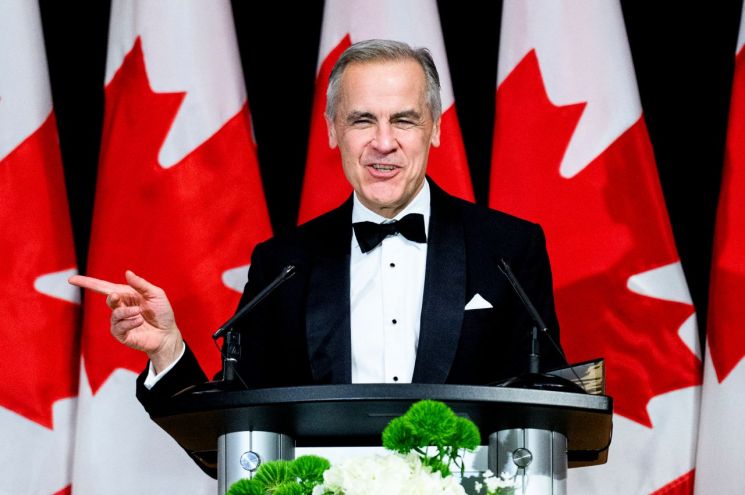 Canada has decided to invest approximately 1.8 trillion won to attract talent from around the world. Photo by Mark Carney, Canadian Prime Minister. AP Yonhap News
According to the NYT, Melanie Joly, Canada's Minister of Industry, directly addressed the United States, stating, "While other countries are restricting academic freedom and undermining cutting-edge research, Canada is increasing its investment in science." Minister Joly said, "This funding will be used to create 100 new research chairs and to support their teams and laboratories." She emphasized, "For decades, Canada has struggled with brain drain, but now we are experiencing a brain gain."
She added, "This budget is the first step toward keeping researchers in Canada for longer," and continued, "If you want to live in the most livable and safest country on earth, a country that respects your work and provides an environment where your work can truly flourish, come to Canada."
Previously, in September, the Trump administration announced that the H-1B visa fee would be increased from 1,000 dollars (about 1.41 million won) per person per year to 100,000 dollars (about 140 million won). The H-1B visa applies to specialized occupations in science, technology, engineering, and mathematics (STEM) fields and has been regarded as a means for U.S. companies to hire high-level talent and maintain competitiveness. However, hardline conservatives in the U.S. have criticized the H-1B visa for taking away high-paying jobs from Americans. As of last year, 71% of H-1B visa recipients were from India, and 11.7% were from China.
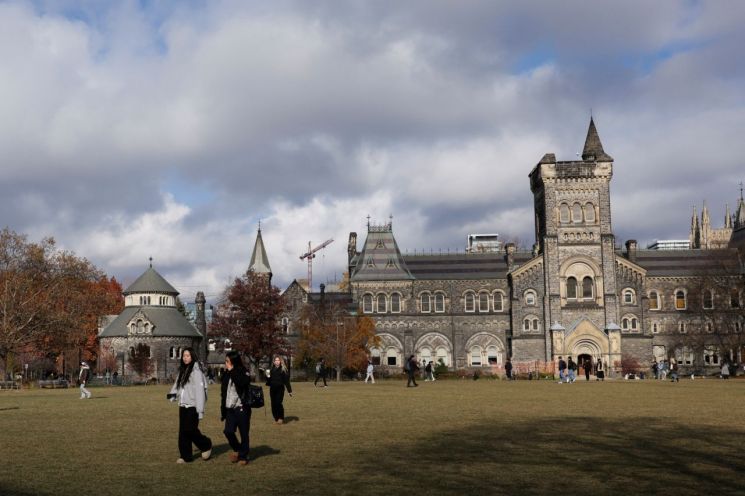 Students walking on the St. George campus of the University of Toronto located in Toronto, Canada. Photo by Reuters Yonhap News
In response, countries around the world have stepped up efforts to attract talent leaving the United States. In particular, Canada has actively promoted itself by leveraging its geographical proximity to the U.S. According to the NYT, major academic and medical institutions in Canada have been actively recruiting in the United States this year. The University of Toronto successfully recruited several prominent professors from leading American private universities this year.
Canadian Prime Minister Mark Carney stated in September, "This is an opportunity to attract people who previously held H-1B visas in the United States," adding, "Many H-1B visa applicants are in technical fields and are willing to relocate for job opportunities." He emphasized, "We are reviewing immigration policies to attract talent and will make clear policy proposals in this regard." This investment plan can be seen as part of that effort.

The NYT reported, "Canada is considered a highly livable country, but has struggled to attract highly skilled workers due to its relatively small economy compared to the United States." The report noted that Canada sees the current exodus of talent from the U.S. as an opportunity.
© The Asia Business Daily(www.asiae.co.kr). All rights reserved.
![Clutching a Stolen Dior Bag, Saying "I Hate Being Poor but Real"... The Grotesque Con of a "Human Knockoff" [Slate]](https://cwcontent.asiae.co.kr/asiaresize/183/2026021902243444107_1771435474.jpg)


















