Labor-Management Negotiations Break Down... "Minimizing Passenger Inconvenience"
Korail Operates 24-Hour Emergency Response Headquarters
As the final main negotiations between the National Railway Workers' Union and Korail broke down after just over 30 minutes, the union will begin an indefinite general strike as previously announced, starting at 9 a.m. on December 11. Labor and management attempted last-minute negotiations from 3 p.m. on December 10, the day before the strike, but failed to narrow their differences after the key agenda item of normalizing performance-based bonuses was not submitted to the Public Institutions Management Committee of the Ministry of Economy and Finance.
The main cause of this strike is the issue of "criteria for performance-based bonus payments." The union is demanding that the current performance-based bonus, which is set at 80% of the base salary, be restored to 100%. The union criticized, "The Ministry of Economy and Finance is postponing the submission of the agenda, citing a lack of time," and added, "Ignoring the President's promise and the mediation of the political community, and allowing wage arrears to persist, is effectively encouraging the strike."
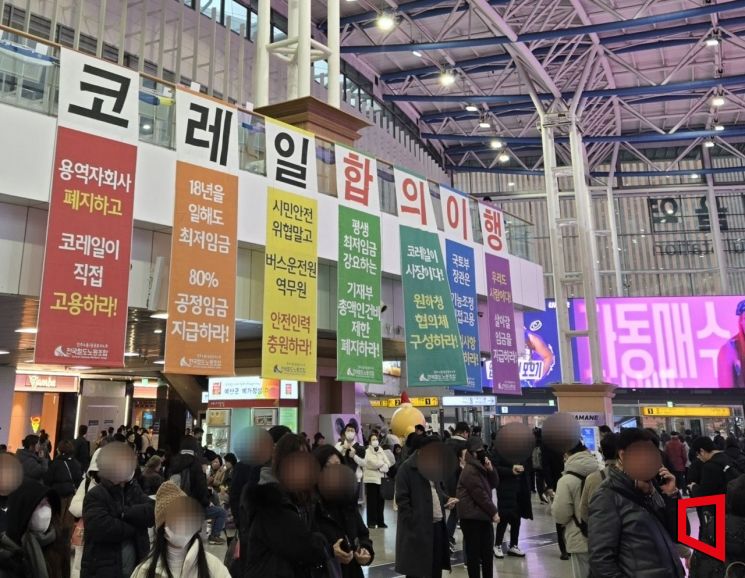 On the 10th, one day before the announced strike date, banners with phrases such as "Implement the Korail Agreement" and "Fair Wage Payment" were displayed at Seoul Station by the Railway Workers' Union. The labor and management held final negotiations that day but ultimately failed to reach an agreement. Photo by Choi Seoyoon
Once the strike begins, disruptions in train operations are expected to cause inconvenience to the public and lead to logistical delays. During the strike, Korail plans to operate KTX trains at 66.9% of normal capacity, and Saemaeul and Mugunghwa trains at 59% and 62%, respectively. For metropolitan commuter trains, more than 90% will run during rush hour to minimize inconvenience, but the overall average operation rate will drop to 75.4%, making it inevitable to adjust intervals between trains during off-peak hours.
In particular, the operation of freight trains, which are the lifeline of industrial logistics, is expected to plummet to 21.5% of normal levels, raising concerns over the transportation of urgent cargo such as cement and import/export containers. Korail plans to prioritize freight trains for export/import cargo and essential industrial goods in order to minimize logistical disruptions.
Korail will operate an emergency response headquarters around the clock and mobilize all available personnel. During the strike, a total of 15,369 people-including 10,449 essential maintenance staff and 4,920 substitute workers-will be deployed to operate the trains. This represents 62.6% of the normal workforce. In addition, 128 order maintenance personnel will be deployed to 32 major stations where congestion is expected, in order to prevent safety accidents.
© The Asia Business Daily(www.asiae.co.kr). All rights reserved.
![Clutching a Stolen Dior Bag, Saying "I Hate Being Poor but Real"... The Grotesque Con of a "Human Knockoff" [Slate]](https://cwcontent.asiae.co.kr/asiaresize/183/2026021902243444107_1771435474.jpg)
















