Implementation of Comprehensive Winter Natural Disaster Measures
Gwangmyeong City in Gyeonggi Province will expand its standard for snow removal response roads from those 20 meters wide or more to those 10 meters wide or more this winter.
On December 10, Gwangmyeong City announced at a policy briefing that it has established and is implementing the "2025 Comprehensive Winter Natural Disaster Measures," which includes this change.
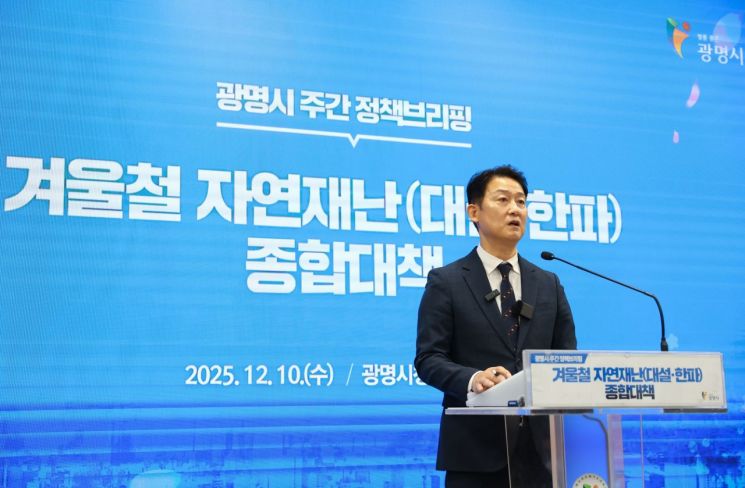 Kwanghee Park, Director of the Safety, Construction, and Transportation Bureau of Gwangmyeong City, is briefing on the comprehensive winter natural disaster measures on the 10th at the city hall's medium conference room. Provided by Gwangmyeong City
Under these measures, the city will significantly strengthen its field-oriented response system to immediately address unpredictable heavy snowfall situations.
In particular, snow removal operations, which previously only applied to main roads and roads at least 20 meters wide, will now be expanded to include secondary roads with a width of 10 meters or more starting this year. To this end, the city has increased the number of snow removal vehicles from 8 to 12.
Customized snow management will be carried out for areas such as Gwangmyeong Traditional Market, Gwangmyeong Saemaeul Market, bus stops, subway entrances, and alleyways. The city has secured 2,222 tons of snow removal agents, exceeding the standard amount of 2,118 tons.
Centered on the "Disaster Situation Team," which was newly established in July, a 24-hour disaster preparedness system will be operated. For 138 residential vinyl greenhouses, designated managers will be assigned to establish communication networks, conduct on-site inspections, and provide evacuation guidance, ensuring one-on-one management.
The city will also apply new response guidelines according to different levels of snowfall. Depending on the amount of snow, clear step-by-step actions will be implemented, such as preparing snow removal vehicles, issuing evacuation advisories, and issuing evacuation orders.
Customized support for vulnerable groups will be strengthened as well. Elderly recipients of basic livelihood security and those with severe disabilities will receive 50,000 won in heating cost support until March next year, while households eligible for emergency living expenses will receive 150,000 won for heating costs.
About 120 locations, including senior centers and welfare centers, will operate as shelters from the cold. Night patrols and on-site inspections will be strengthened for places such as gosiwons (small, low-cost rooms) and for the homeless, to address welfare blind spots.
Kwanghee Park, Director of the Safety, Construction and Transportation Bureau of Gwangmyeong City, said, "We will operate a 24-hour disaster preparedness system to respond immediately to unpredictable disasters, and through swift and decisive field-oriented actions, we will ensure that citizens can live with peace of mind."
© The Asia Business Daily(www.asiae.co.kr). All rights reserved.