Meeting with New York Correspondents
"Weak Won Likely to Become Entrenched if U.S. Investments Continue"
Recommendations for Structural Reform: Revitalizing SMEs and Achieving Regional Balanced Development
Maurice Obstfeld, Professor Emeritus at the University of California, Berkeley, assessed on December 9 (local time) that the outcome of the South Korea-US trade negotiations, which were finalized at the end of October, was akin to a "tribute" paid by South Korea to the United States. He identified the recent weakness of the Korean won as being primarily driven by tariff negotiations with the US, and predicted that if the planned US-bound investment totaling 350 billion dollars (approximately 515 trillion won) is implemented in stages, the depreciation of the won could become structurally entrenched.
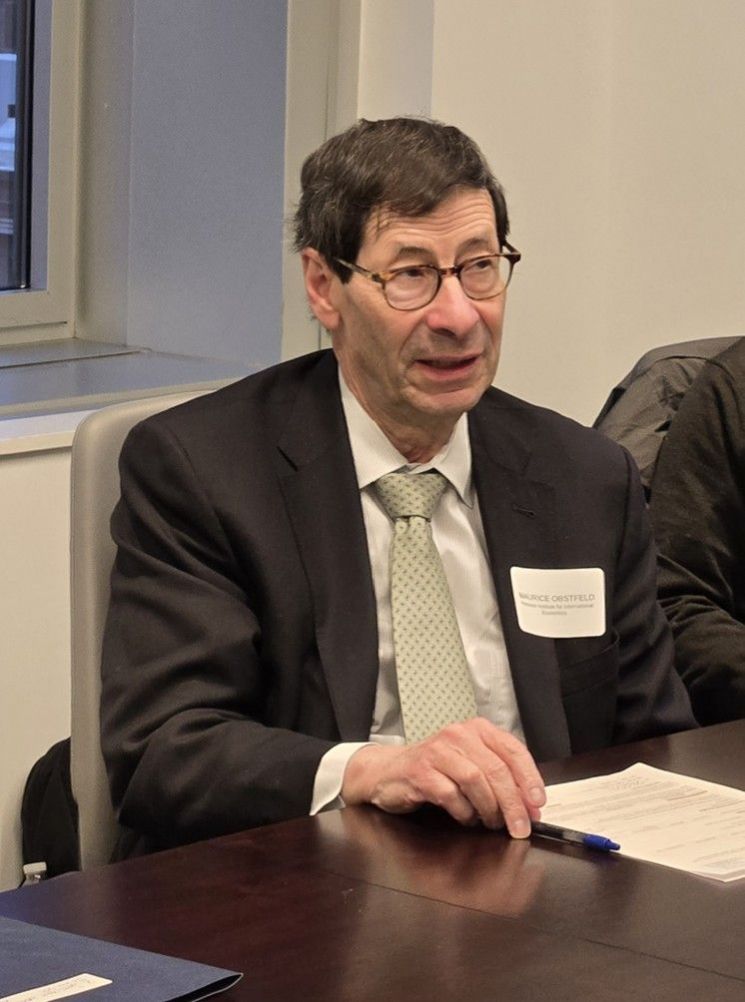 Maurice Obsfeld, Professor Emeritus at the University of California, Berkeley, held a meeting with correspondents on the 9th (local time) at the Korea Society in Manhattan, New York. New York - Photo by Kwon Haeyoung
At the "Korea-US Economic Relations in the New Tariff Era" forum held at the Korea Society in Manhattan, New York, Professor Obstfeld stated that "while some promises regarding the shipbuilding sector may benefit South Korea, other aspects are essentially a pure tribute paid to the US" in relation to the bilateral tariff negotiations.
Professor Obstfeld, who previously served as Chief Economist at the International Monetary Fund (IMF), was a member of the White House Council of Economic Advisers during the Barack Obama administration in 2014 and is known as an "Obama mentor." He is currently a professor at UC Berkeley and a Senior Fellow at the Peterson Institute for International Economics (PIIE), a US think tank.
He pointed out that the US agreed to lower tariffs imposed on South Korea from 25% to 15% in exchange for South Korea's commitment to invest a total of 350 billion dollars in the US over the next ten years. He added, "Although South Korea pledged to ease non-tariff barriers and exclude artificial currency manipulation, it failed to secure the bilateral currency swap agreement it had sought."
He especially warned that if large-scale investments in the US continue, the weakness of the won could become a structural trend rather than a short-term phenomenon. Of the 350 billion dollars pledged by South Korea, 200 billion dollars (about 294 trillion won) is in the form of cash investment. Many experts have expressed concerns that such sustained capital outflows would exert downward pressure on the value of the won.
In a subsequent meeting with correspondents, Professor Obstfeld further explained, "The current value of the won has fallen to levels seen during the martial law period last year, approaching a historically weak phase," adding, "I believe the recent weakness of the won is mainly a response to changes in the trade environment." He also stated, "When another country imposes tariffs on South Korea, the won theoretically weakens, and this has indeed happened. In a situation where South Korea must transfer massive investments to the US over an extended period, the won is bound to weaken to support those capital flows."
He predicted, "If the flow of investment into the US continues for a long time, the weakness of the won will become a structural phenomenon," and added, "High tariffs are also another structural factor weakening the won."
As one of South Korea's responses to global trade environment changes such as US tariff hikes, Professor Obstfeld suggested that South Korea should more actively participate in multilateral economic cooperation frameworks, including joining the Comprehensive and Progressive Agreement for Trans-Pacific Partnership (CPTPP).
He also mentioned the need for structural reform of the Korean economy, specifically pointing out the low dynamism of the small and medium-sized enterprise (SME) sector, widespread monopoly power across the economy, and worsening inequality.
Professor Obstfeld explained, "The SME sector is very important, but business dynamism is excessively low and monopoly power is too great throughout the economy. If the SME sector becomes more dynamic, it would also help address youth unemployment." He further emphasized, "Economic activity is overly concentrated in Seoul, leading to rising housing prices and social tensions. Regional-based policies could be very beneficial for the Korean economy."
Regarding the US economy, he identified the rapidly increasing fiscal deficit as a major issue. He also expressed concern that attempts by President Donald Trump to intervene in monetary policy could further fuel inflation and interest rates.
Professor Obstfeld warned, "If President Trump effectively seizes control of the Federal Reserve, we will see more efforts to lower government debt interest through (benchmark) rate cuts, which will ultimately lead to inflation." He continued, "While inflation may reduce debt in the short term, if market expectations for inflation rise, interest rates will go up further and only the costs will remain."
© The Asia Business Daily(www.asiae.co.kr). All rights reserved.

















