Joint Venture with Chinese PET Recycling Company Kelinle
to Build Feedstock Innovation Center
Factory Operations Targeted for Second Half of 2026
SK Chemicals is achieving Korea's first fully vertically integrated recycling system by independently securing the feedstock needed for recycling.
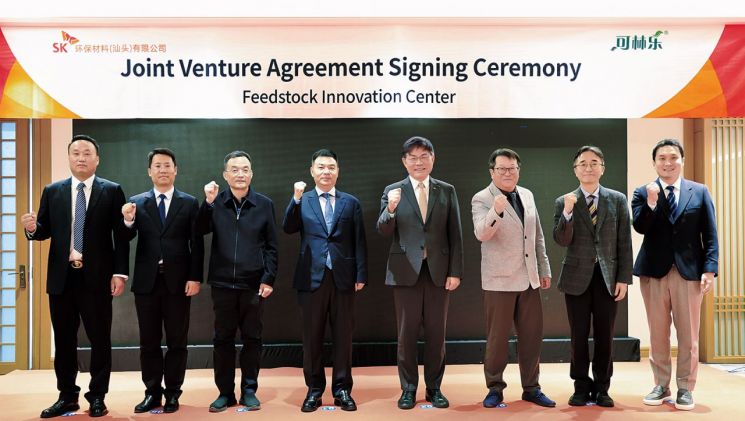 SK Chemicals is establishing a joint venture with Kelinle, a plastic recycling specialist company in Shanxi Province, China, to build a waste plastic processing facility called the "Feedstock Innovation Center." Jaehyun Ahn, President of SK Chemicals (fifth from the left), Jaejun Jung, President of SK Shantou (sixth from the left), Jingsheng Zhang, President of Kelinle (first from the left), and other officials are posing for a commemorative photo after signing the agreement. SK Chemicals
On December 10, SK Chemicals announced that it will establish a joint venture with Kelinle, a plastic recycling specialist company in Shanxi Province, China, to build a waste plastic processing facility called the "Feedstock Innovation Center (FIC)."
The FIC will be responsible for processing waste plastics into feedstock. Once this facility is completed, SK Chemicals will secure a value chain that extends beyond the production of chemically recycled materials to include the sourcing of waste plastics. SK Chemicals is the first domestic chemical company engaged in chemical recycling, such as depolymerization, to establish a subsidiary equipped with waste plastic sourcing facilities.
The two companies plan to set up a process for producing recycled feedstock from waste on a 13,200-square-meter idle site owned by Kelinle in Weinan, Shanxi Province. Kelinle, which has been operating in the local plastic recycling industry for 10 years, will leverage its local network to procure feedstock, and SK Chemicals will use its technology to preprocess and produce recycled PET pellets.
Unlike mechanical recycling companies that use PET bottles as feedstock, the FIC will be constructed as a facility that converts discarded comforters and fine particles (fines) generated during the PET bottle shredding process into raw materials for chemical recycling. The facility will initially produce about 16,000 tons of recycled feedstock, with plans to expand to an annual capacity of 32,000 tons, supplying most of the raw materials needed for SK Shantou.
SK Chemicals expects that the establishment of the FIC will serve as a turning point for significantly enhancing the competitiveness and stability of its circular recycled plastics business.
The circular recycling business based on depolymerization technology, which SK Chemicals is pursuing, decomposes waste plastics at the molecular level to produce new plastics. In this structure, waste plastics serve as a fundamental feedstock, similar to crude oil. Therefore, securing a stable supply of waste plastics at low cost is a critical foundation for the recycled plastics business.
The main feedstock to be handled at the FIC consists of materials that were previously incinerated because they were difficult to recycle, which can be sourced at a lower price compared to easily recyclable transparent PET bottles. SK Chemicals expects that once the FIC is fully operational, it will secure supply stability for the feedstock needed in its circular recycling business, while also reducing the cost of waste plastic raw materials by about 20%. The company also anticipates a waste reduction effect by reusing discarded comforters, which were mostly incinerated or landfilled.
Jaehyun Ahn, President of SK Chemicals, stated, "Through the FIC, we have secured a complete recycling value chain, from depolymerization and material production to feedstock procurement. By converting hard-to-recycle waste comforters and other materials into resources, the resulting price competitiveness will help break down the price barrier of recycled plastics, which has been higher than petroleum-based materials."
© The Asia Business Daily(www.asiae.co.kr). All rights reserved.
![Clutching a Stolen Dior Bag, Saying "I Hate Being Poor but Real"... The Grotesque Con of a "Human Knockoff" [Slate]](https://cwcontent.asiae.co.kr/asiaresize/183/2026021902243444107_1771435474.jpg)
















