Korean Finance Association and Bank of Korea Hold Joint Symposium
Lee Chang-yong, Governor of the Bank of Korea, emphasized that in order to raise South Korea's potential growth rate, it is essential to reallocate limited financial resources to more productive sectors.
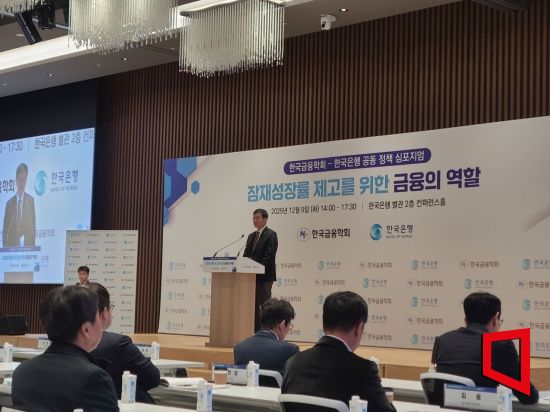 Lee Chang-yong, Governor of the Bank of Korea, is delivering a welcoming speech at the "Bank of Korea-Korean Finance Association Joint Policy Symposium" held on the afternoon of the 9th at the Bank of Korea in Jung-gu, Seoul. Photo by Kim Hyemin
Governor Lee made these remarks in his welcoming speech at the policy symposium on "The Role of Finance in Enhancing Potential Growth," co-hosted by the Korean Finance Association and the Bank of Korea on the afternoon of December 9.
He stated, "South Korea's potential growth rate has fallen from around 5% in the early 2000s to just below 2% recently. If the current trend continues, it is highly likely to drop to the 0% range by 2040."
He explained, "The weakening of our growth potential is due to a shrinking labor force caused by rapid low birth rates and population aging, while corporate investment and productivity innovation have been insufficient to offset this. Another significant factor has been the inefficient allocation of resources, which have not been directed to the most productive areas." He went on to stress, "Given these circumstances, the role of finance is more important than ever. Finance serves as the core infrastructure that reallocates limited resources to the most efficient areas, thereby driving innovation and productivity improvement."
Shin Kwanho, President of the Korean Finance Association and Professor of Economics at Korea University, stated, "The projection that the potential growth rate could fall below 1% is not just an economic indicator. It is a serious issue that threatens our welfare, employment, and fiscal sustainability." He added, "Ultimately, the direct engine of growth is innovation and dynamism in the real economy, but finance can be the enabler and institutional foundation that makes such innovation possible."
He pointed out, "For finance to contribute to growth, resources must flow smoothly to productive sectors, innovative companies should be able to enter the market more easily, the venture IPO ecosystem must regain its vitality, and regulations need to be adjusted to reflect the actual risks. We need to think together about how finance can promote and support the structural reform of the real economy."
The symposium discussed the direction of finance and policy tasks needed to enhance South Korea's growth potential.
First, Cho Sungwook, Professor at the College of Business Administration at Seoul National University, gave a presentation on "Enhancing Trust and Strengthening the Role of Capital Markets for Corporate Growth and Innovation." He pointed out, "The Korean capital market has not been functioning properly due to the prolonged Korea Discount and a lack of investor trust. Incidents such as fund scandals and conflicts of interest at financial institutions have made households reluctant to invest in domestic stocks and funds, resulting in an excessive concentration of household assets in real estate and deposits, as well as an increase in overseas investments."
Professor Cho continued, "If the capital market fails to distinguish between growing and declining industries and allocate capital to highly productive companies amid declining potential growth and demographic changes such as low birth rates and aging, corporate innovation investment and the overall economic growth potential may weaken further. We must restore trust through investor protection, improved corporate governance, and supervisory systems, and use this as a foundation to support corporate growth and innovation."
Next, Kim Jin-young, Research Fellow at the Korea Capital Market Institute, presented on "Tasks for Venture Capital to Promote Growth." He said, "In a low-growth, aging phase, venture capital supplies long-term risk capital to startups and venture companies, which are key growth drivers for employment, research and development (R&D), and national strategic technologies. We need to strengthen the 'patient capital' function of venture capital and improve the institutional and market environment so that it can enhance the innovation capacity and potential growth rate of our economy."
From the Bank of Korea, Hwang Indo, Head of the Monetary and Financial Research Division at the Economic Research Institute, gave a presentation on "Redirecting Capital Flows to the Productive Sector and Revitalizing Growth," and Choi Kisan, Associate Research Fellow at the Economic Research Institute, presented on "The Current Status of Korean SMEs and Proposals for Improving Support Systems."
© The Asia Business Daily(www.asiae.co.kr). All rights reserved.

















