President Lee Jae-myung Presides Over Cabinet Meeting on December 9
Criticizes Government for Paying Minimum Wage to Non-Regular Workers
Points Out 'Split Contracts' Used to Avoid Severance Pay
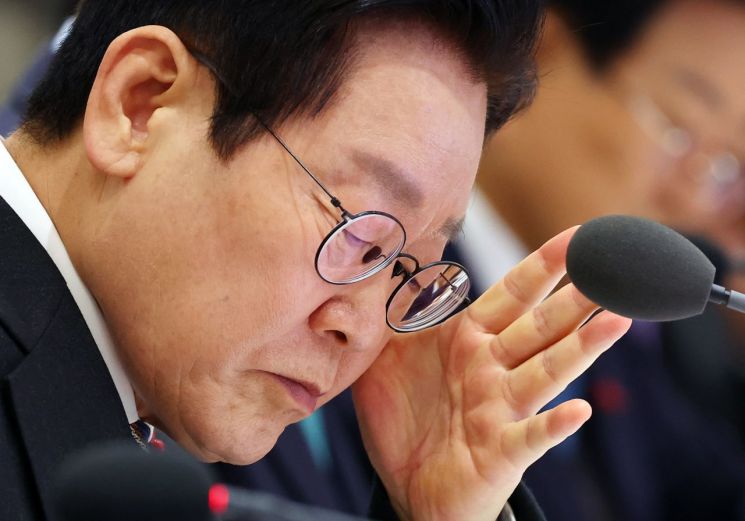 President Lee Jae-myung is reviewing documents at the Cabinet meeting held on the 9th at the Presidential Office in Yongsan, Seoul. Photo by Yonhap News Agency
On December 9, President Lee Jae-myung emphasized that non-regular workers should receive higher wages than regular workers. He also instructed the government to ensure that it pays appropriate wages above the minimum wage and to check whether any ministries are engaging in deceptive hiring practices to avoid paying severance pay. Additionally, regarding controversial bills such as the establishment of a special tribunal for insurrection and the introduction of the crime of judicial distortion-on which the Democratic Party of Korea has decided to slow down-he stated that these would be handled in accordance with the will of the people.
At the Cabinet meeting held at the Presidential Office in Yongsan that day, President Lee said, “Equal pay should be given for equal work, but the government currently pays more to regular employees or those with job security, even when they do the same work.” He continued, “It should actually be the opposite. If job security is lower, wages should be higher.”
Referring to the example of Australia, President Lee stated, “In a rational society, non-regular workers are paid more for the same work. In our country, however, we pay non-regular workers less-about 50 to 60 percent less.” He criticized this, saying, “This blocks the potential for our society to progress.”
He also instructed the government to correct the practice of paying only the minimum wage when hiring workers. President Lee explained, “The government pays the minimum wage without exception to daily or non-regular workers. The minimum wage is a legal floor, not a recommended wage.” He added, “The government should pay a fair wage for labor. It is a mistake to think that paying only the minimum wage is something to be proud of.”
He directed Minister of Employment and Labor Kim Young-hoon, “The government must take the lead. The Ministry of Employment and Labor needs to change its perception.” At the same time, he ordered the ministry to investigate whether it and its affiliated agencies are paying appropriate wages to temporary workers, and to examine how other government ministries and public enterprises are handling wage payments.
Regarding the so-called ‘split contract’ practice, he strongly criticized the government for being unethical. President Lee pointed out, “The government fires workers after 1 year and 11 months, just before they would become regular employees after two years. To avoid paying severance, it signs 11-month contracts, lets workers rest for a month, and then rehires them.” He stated, “Regular positions should be filled with regular employees. The Ministry of Employment and Labor should check whether it is doing this properly, and whether other ministries are following suit, and issue corrective orders as needed.”
Lee: "Some conflict and resistance are inevitable when correcting irrationalities"
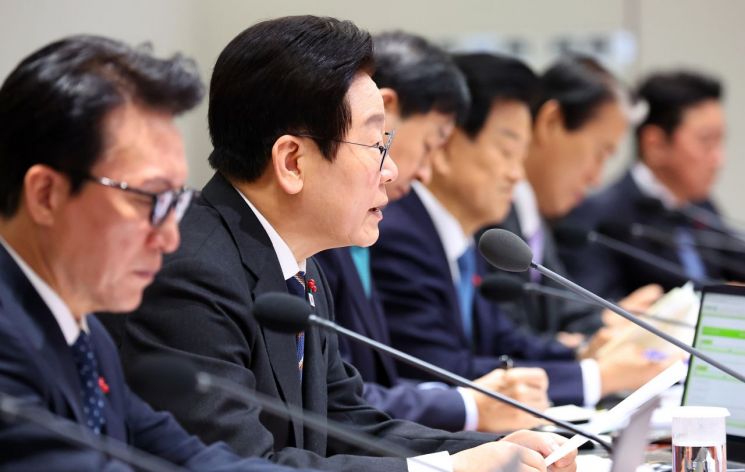 President Lee Jae-myung is speaking at the Cabinet meeting held on the 9th at the Presidential Office in Yongsan, Seoul. Photo by Yonhap News
Furthermore, President Lee said that even if there is conflict during the legislative process, he will continue to do what is necessary in accordance with the will of the people. This appears to reference the fact that opposition parties have strongly objected to and stalled legislation led by the Democratic Party of Korea, including the special bill to establish a special tribunal for insurrection, the bill to introduce the crime of judicial distortion, and amendments to the Constitutional Court Act.
While expressing gratitude for the bipartisan agreement to pass next year’s budget within the legal deadline, President Lee emphasized, “Even if there are differing opinions on legislation, I believe that, based on common sense and principles, we can always handle matters rationally by respecting the will of the sovereign people.”
He further explained, “Reform originally means to shed one’s skin. Change without conflict is not true change. If our society is to move in a better direction and correct irrationalities, some degree of conflict and resistance is inevitable.”
He also announced plans to transparently release the upcoming ministry work reports starting from December 11. Beginning with the Ministry of Economy and Finance, President Lee plans to conduct work reports from nearly 300 ministries and affiliated public institutions by the end of the year. He stated, “Through these work reports, we will accelerate the recovery of the people's livelihood and the normalization of the nation, and take a step forward in Korea’s great transformation. In accordance with the people's right to know and the principle of transparent governance, except for matters requiring confidentiality, I intend to broadcast all work report contents live.” He added, “Next year should mark the starting point of a national leap forward, with tangible policy results and greater happiness for the people, beginning with reforms in six key areas.”
President Lee also noted the surging global interest in K-food due to the worldwide K-culture boom and asked for preparations to make K-food a vanguard of exports. He said, “Winning over people’s palates is winning over their hearts. The government will strongly support the K-food industry so that it can grow beyond the domestic market and become a strategic export industry.” He instructed relevant ministries, including the Ministry of Culture, Sports and Tourism, to prepare comprehensive support measures, such as overseas marketing, logistics support, development of tourism-linked products, and stronger protection of intellectual property rights.
Meanwhile, at the Cabinet meeting that day, the government’s first budget proposal under President Lee Jae-myung, totaling 727.9 trillion won for next year, was submitted. The first budget significantly increased support, allocating a record-high 35.5 trillion won for research and development (R&D) and approximately 10 trillion won for the artificial intelligence (AI) sector, aiming to make Korea one of the world’s top three AI powers.
© The Asia Business Daily(www.asiae.co.kr). All rights reserved.
![Clutching a Stolen Dior Bag, Saying "I Hate Being Poor but Real"... The Grotesque Con of a "Human Knockoff" [Slate]](https://cwcontent.asiae.co.kr/asiaresize/183/2026021902243444107_1771435474.jpg)

















