Impact of Last Week's Meeting with CEO Jensen Huang
Nvidia, AMD, and Intel Stocks
Climb an Additional 1?2% After Market Close
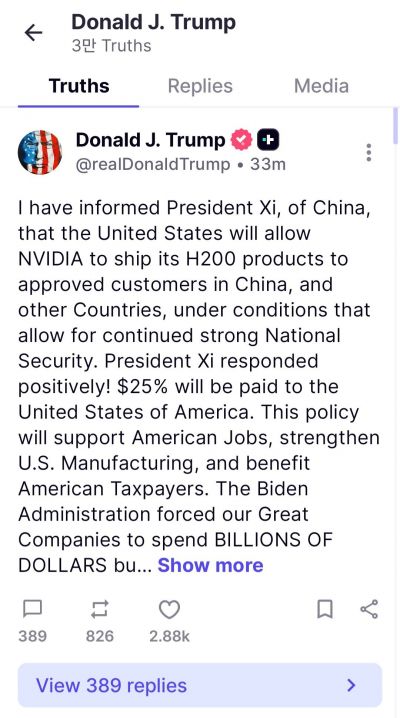 A post on Truth Social by Donald Trump, former President of the United States. On the 8th (local time), President Trump announced that he decided to allow the export of Nvidia's semiconductor chip, the 'H200' chip, to China. Trump Truth Social
On December 8 (local time), former U.S. President Donald Trump announced that he would allow Nvidia, an American artificial intelligence (AI) semiconductor company, to export its products to China. As the world's second-largest market, China's export route had been blocked due to the U.S.-China power struggle, significantly impacting Nvidia's performance outlook. This decision is expected to brighten Nvidia's prospects.
After the market closed that day, President Trump posted on his own social networking service, Truth Social, stating, "I informed President Xi Jinping of China that Nvidia will be allowed to sell the 'H200' chip to approved customers in China and other countries."
He added, "This will be done on the condition that strong national security continues to be ensured," and "President Xi responded positively. Twenty-five percent of the sales proceeds will be paid to the United States."
Bloomberg reported that this 25% of sales proceeds is expected to be collected by the U.S. government in the form of a surcharge. According to a Commerce Department official, the 25% surcharge will be imposed when the chips are brought into the United States from production facilities in Taiwan. This is part of a security review conducted by the Bureau of Industry and Security (BIS) of the U.S. Department of Commerce. After inspection, the chips will be shipped to approved customers in China.
However, President Trump appeared to take security concerns into account by limiting Nvidia's exports to China to only the H200 chip. He emphasized that Nvidia's most advanced chip, 'Blackwell,' and the upcoming 'Rubin' chip scheduled for release next year, are not included in this agreement. This measure will also apply to other American semiconductor companies such as AMD and Intel in the same manner.
According to foreign media, this policy is seen as a compromise by President Trump to avoid an extreme measure of completely halting the supply of American AI chips to China, while still prohibiting the export of the cutting-edge Blackwell chip. Earlier this year, the Trump administration allowed Nvidia to sell its lower-spec 'H20' chip to China, but the Chinese government, citing security concerns, banned domestic companies from using the H20 chip.
The Wall Street Journal and Bloomberg reported that this decision came shortly after a meeting between President Trump and Nvidia CEO Jensen Huang last week. CEO Jensen Huang has publicly advocated for resuming exports to China, arguing that the regulations benefit Chinese companies, including Huawei.
It is known that Howard Lutnick, the Secretary of Commerce, who oversees the relevant department, supported the approval of H200 exports to China. Secretary Lutnick reportedly judged that exporting to China would help expand Nvidia's profits while maintaining the global standard status of American technology.
The easing of U.S. export restrictions is expected to be a positive development for Nvidia and other American semiconductor companies. CEO Jensen Huang previously urged for regulatory relaxation, emphasizing that China represents a $50 billion annual market for Nvidia.
In a statement, Nvidia said, "This decision will help support high-paying jobs and manufacturing in the United States," and praised the move as "a very favorable and balanced measure for the United States to provide the H200 to approved commercial customers who have passed the Commerce Department's verification."
In fact, after the market closed, shares of American semiconductor companies such as Nvidia, AMD, and Intel all rose an additional 1-2%. However, as the decision had already been reported in advance by foreign media outlets such as Semaphore and the Wall Street Journal, the after-hours trading gains were not significant.
Nevertheless, concerns about national security regarding semiconductor exports to China are expected to persist. This is also an area where opinions are sharply divided within the potential second Trump administration. In addition to Secretary Lutnick, who played a key role in this decision, David Sacks, the so-called AI czar, is among the proponents of export. On the other hand, Secretary of State Marco Rubio is cited as a prominent opponent.
Opposition from hardline lawmakers in Congress regarding exports to China is also anticipated. Senator Elizabeth Warren (Democrat, Massachusetts) criticized, "CEO Jensen Huang realized his wish to sell the most powerful AI chips to China after a private meeting with President Trump and a donation to the President's ballroom," adding, "This risks accelerating China's technological and military superiority efforts and undermining America's economic and national security."
© The Asia Business Daily(www.asiae.co.kr). All rights reserved.
![Clutching a Stolen Dior Bag, Saying "I Hate Being Poor but Real"... The Grotesque Con of a "Human Knockoff" [Slate]](https://cwcontent.asiae.co.kr/asiaresize/183/2026021902243444107_1771435474.jpg)
















