Kuala SMART Tunnel Operates in Four Stages
Roadways in Normal Times, Waterway During Heavy Rain
Oh Sehoon, the Mayor of Seoul, who is currently on a business trip to Malaysia, inspected the SMART Tunnel in Kuala Lumpur, which is designed for flood prevention, and once again emphasized the importance of Seoul's deep underground rainwater tunnels.
On the 8th, Mayor Oh visited the SMART (Stormwater Management and Road Tunnel) in Kuala Lumpur, shared operational experiences from the Sinwol Deep Underground Rainwater Storage Tunnel, which was completed in Korea for the first time in 2020, and reviewed future operational plans for the deep underground rainwater drainage tunnels currently under construction, as well as the Isu-Gwacheon Complex Tunnel.
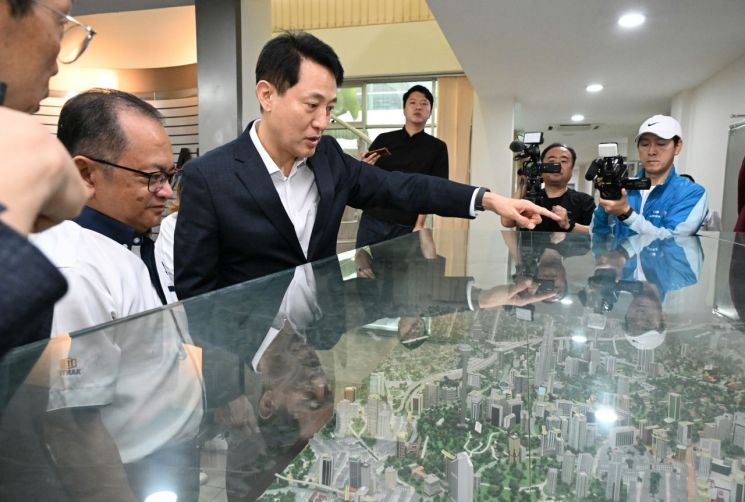 On the 8th, Seoul Mayor Oh Sehoon visited the Kuala Lumpur SMART (Stormwater Management and Road Tunnel) and discussed the operation status with tunnel officials. Provided by Seoul City
The Malaysian government built the SMART Tunnel in 2007 to prevent frequent flooding of the Klang River during rainfall and to alleviate downtown traffic congestion during normal times. The tunnel serves dual functions as both a floodwater channel and a road for vehicles. It consists of three levels: the top two levels are used as roadways under normal conditions, while the bottom level functions as a water conduit. The tunnel operates in four stages: in the first stage, traffic operates normally; in the second stage, the road remains open, but water begins to be stored in the lower rainwater tunnel; in the third stage, vehicle traffic is restricted; and in the fourth stage, both the road and the rainwater tunnel are fully used as a waterway. The total storage capacity reaches 3 million tons.
Currently, the city is constructing deep underground rainwater drainage tunnels in three areas: Gangnam Station, Gwanghwamun, and the Dorimcheon area. These tunnels, located 40 to 50 meters underground, serve as temporary "water tanks" that store and then release rainwater during heavy downpours to prevent urban flooding. In the past, the Yangcheon and Gangseo districts were prone to frequent flooding, but after the construction of the Sinwol Rainwater Tunnel, there have been 33 instances over five years in which a total of 1.04 million tons of rainwater was stored, with not a single case of flooding reported.
The Isu-Gwacheon Complex Tunnel, scheduled for completion in 2031, will feature a floodwater channel beneath and near the road tunnel that can store up to approximately 42,000 tons of rainwater during heavy rainfall. However, unlike the SMART Tunnel, it does not have the function of storing rainwater in the road tunnel itself where vehicles travel. Mayor Oh stated, "It is practically difficult for Seoul to build a tunnel that can simultaneously serve as both a rainwater storage facility and a roadway," adding, "We need land at both ends of the tunnel to construct large storage reservoirs, but that is not easy for us."
Mayor Oh repeatedly emphasized the necessity of deep underground rainwater tunnels. He said, "Malaysia also built this tunnel only after experiencing several major floods," and expressed regret, "If all the downtown tunnels that were planned in 2007 had been completed, we could have prevented much of the flood damage in advance."
He added, "Although it is late, I expect that once the deep underground rainwater tunnels at Gangnam Station, Dorimcheon, and Gwanghwamun are fully operational, we will be able to significantly reduce flood damage, just as they have experienced here."
© The Asia Business Daily(www.asiae.co.kr). All rights reserved.
![Clutching a Stolen Dior Bag, Saying "I Hate Being Poor but Real"... The Grotesque Con of a "Human Knockoff" [Slate]](https://cwcontent.asiae.co.kr/asiaresize/183/2026021902243444107_1771435474.jpg)
















