"If Law to Prevent Suspension of Trials Due to Constitutional Review Is Pushed, Party Should Be Dissolved as Unconstitutional"
Filibuster Planned for Judicial Reform Bills at Plenary Session on December 9
On December 8, one day before the plenary session, the People Power Party launched a full-scale defense against the "judicial reform bills" being pushed by the Democratic Party of Korea, including the bill to establish a special court for insurrection cases and the bill to introduce the crime of judicial distortion.
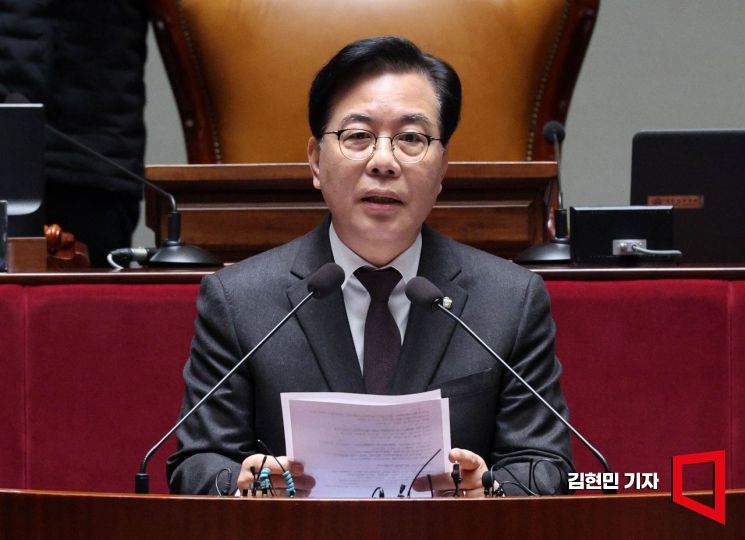 Song Unseok, floor leader of the People Power Party, is speaking at the party meeting held at the National Assembly and the public accusation event against the Lee Jae-myung administration's dictatorship law 'Field 1. Destruction of the Judiciary.' December 8, 2025. Photo by Kim Hyunmin
From 10:30 a.m. to 4:30 p.m. on this day, the People Power Party held a parliamentary meeting titled "Public Accusation Event Against the Lee Jae-myung Government’s Dictatorship Laws" for approximately six hours. During the meeting, the party pointed out and discussed issues with each bill, including the bill to establish a special court for insurrection cases, the introduction of the crime of judicial distortion, the amendment to the Court Organization Act (which includes increasing the number of Supreme Court justices and abolishing the Court Administration Office), the introduction of a four-tier court system, and the amendment to the National Assembly Act (the so-called filibuster restriction bill), followed by a Q&A session.
Song Unseok, floor leader of the People Power Party, condemned in his opening remarks at the parliamentary meeting, "The Democratic Party is announcing that it will force through all of these bad laws in the plenary session tomorrow, the last day of the regular session, thereby destroying the fundamental constitutional order of the Republic of Korea." Targeting the government and the ruling party, he criticized, "A regime filled with self-interest and party interests cannot see the opposition," and added, "They are wrapping up their rampage of destruction and dismantling with plausible lies, calling it 'reform,' 'democracy,' or 'normalization.'"
Jang Youngsoo, Professor Emeritus at Korea University Law School, who gave the keynote presentation, compared the ruling party’s push for a special court for insurrection cases to "changing the rules of the game because they think they might lose," and pointed out, "Even the Presidential Office acknowledged the possibility of unconstitutionality, and wasn’t it discussed at the Democratic Party’s parliamentary meeting as well?"
Professor Jang explained, "For insurrection to be recognized, there must be participation in war on the territory or a disruption of the constitutional order. Since it is not participation in war, the problem is the incapacitation of constitutional institutions, and at that time, the institution in question was the National Assembly." He added, "Simply deploying martial law troops or police with respect to the National Assembly does not mean it has been incapacitated."
Ji Seongwoo, Professor at Sungkyunkwan University Law School, who also gave a keynote presentation, predicted that if the special court for insurrection cases and the crime of judicial distortion are derailed due to constitutional concerns, the Democratic Party would shift to pushing for an increase in the number of Supreme Court justices and the introduction of a constitutional complaint system. Professor Ji stated, "The special court for insurrection cases and the crime of judicial distortion are Plan A, but Plan A will never succeed," and added, "If Plan A fails, they will begin their offensive by increasing the number of Supreme Court justices and introducing the constitutional complaint system."
Regarding the bill to increase the number of Supreme Court justices, he argued, "If the number of justices is increased from 14 to 26, all but two would be appointed by the Lee Jae-myung government, which is unprecedented." He continued, "If the number of justices is changed, it will lead to judicial dictatorship, resulting in a restructuring of the national system and ultimately leading to its downfall." On the introduction of a four-tier court system, he warned, "The Constitutional Court would be overwhelmed with lawsuits, which could result in the collapse of the judicial system," and emphasized, "If we are to follow the German model, a preliminary review system must also be introduced."
During the Q&A session, when Assemblywoman Cho Eunhee of the People Power Party asked about the government and ruling party’s claim to "minimize the possibility of unconstitutionality" regarding the special court for insurrection cases, Professor Jang responded, "Jokingly, you are either pregnant or not; there is no such thing as being a little pregnant or partially pregnant." He continued, "The possibility of unconstitutionality should not be minimized, but eliminated. If even a little remains, it must be removed," and criticized, "The very existence of a special court for insurrection cases is unconstitutional."
He also argued that if the Democratic Party pushes for a "law to prevent the suspension of trials due to constitutional review," even if a request for a constitutional review is filed, the party should be dissolved as an unconstitutional party. When Assemblyman Sung Iljong of the People Power Party asked for an explanation of the law to prevent the suspension of trials due to constitutional review, Professor Jang asserted, "If that is real, the Democratic Party should be dissolved as an unconstitutional party." Professor Ji also commented, "I doubt it will actually be enacted," but added, "The fact that such an idea is coming from outside the party is a significant problem."
The People Power Party plans to launch unlimited debate (filibuster) on any bill deemed to have constitutional concerns that is brought up at the plenary session scheduled for December 9. Choi Sujin, chief spokesperson for the People Power Party, told reporters immediately after the parliamentary meeting, "The principle is not to bring up any bill with constitutional concerns," and added, "Regardless of which bill is brought up, the filibuster will begin starting tomorrow."
© The Asia Business Daily(www.asiae.co.kr). All rights reserved.
!["The Woman Who Threw Herself into the Water Clutching a Stolen Dior Bag"...A Grotesque Success Story That Shakes the Korean Psyche [Slate]](https://cwcontent.asiae.co.kr/asiaresize/183/2026021902243444107_1771435474.jpg)
















