Strong Performance and Value Enhancement Stand Out
Aligning with Government Policy: Arctic Route and Productive Finance in Focus
Challenge Remains to Boost Banking Unit Performance
Bin Daein, Chairman of BNK Financial Group, has succeeded in securing a second term. Despite external pressures that led to the candidate recommendation process being questioned during a National Assembly audit, his achievements in reversing performance trends, enhancing corporate value (value-up), and designing internal controls appear to have influenced the decision of the Executive Candidate Recommendation Committee. Given the pressure from the government and the ruling party, it is expected that he will align with government policies, and he still faces the challenge of improving the underperforming banking sector within the group.
On December 8, the BNK Financial Group Executive Candidate Recommendation Committee conducted in-depth interviews and, after a vote among committee members, recommended Chairman Bin as the next chairman and convened a board meeting to confirm him as the final candidate. Lee Gwangju, Chairman of the BNK Financial Group Board of Directors, explained the decision at a press briefing immediately after the meeting, stating, "We focused on continuity in group management and organizational stability, not only on financial performance based on risk management, but also given the ongoing regional economic downturn and the lingering impact of project financing (PF) insolvencies."
The process for Chairman Bin's reappointment was not smooth due to external factors. First, there was criticism from the political sphere regarding the chairman selection process. During the National Assembly audit in October, Lee Chanjin, Governor of the Financial Supervisory Service, criticized, "Some financial group chairmen fill boards with their own people to build 'trenches.'" He reiterated similar concerns at his first press conference after taking office. On December 4, Democratic Party officials, including the party's Busan regional chairman and lawmakers from the Busan, Ulsan, and South Gyeongsang regions, held a press conference, claiming that "Chairman Bin is seeking reappointment through the candidate committee composed of outside directors he appointed." There was also opposition from some shareholders. On the same day, Life Asset Management, which holds about 3% of BNK Financial Group's shares, sent an open shareholder letter demanding the suspension of the chairman selection process, citing a lack of communication with shareholders.
Each time external pressure arose, the BNK Financial Group Executive Candidate Recommendation Committee stated that the succession process was being conducted in accordance with the Financial Supervisory Service's exemplary governance practices. Regarding communication with shareholders, they also said, "We will continue active communication with shareholders together with the final candidate," and pledged to support holding additional meetings before the general shareholders' meeting in March next year, including briefings on the three-year management plan and measures to enhance shareholder value.
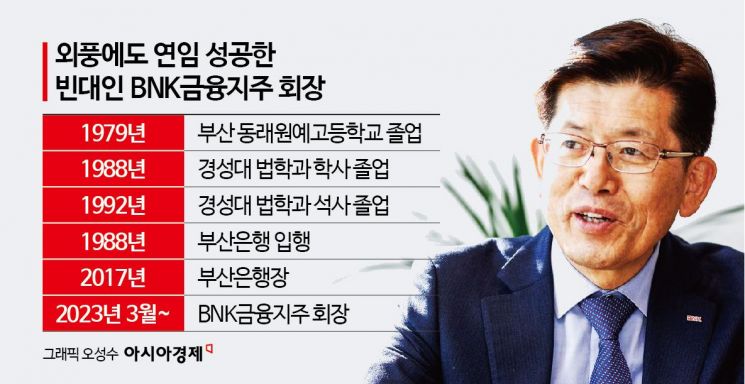
The main reasons the committee selected Chairman Bin as the final candidate were strong business performance and achievements in value-up. Since Chairman Bin took office in 2023, BNK Financial Group recorded net profits of 630.3 billion won and 802.7 billion won, respectively. This year, cumulative net profit for the third quarter reached 770 billion won, likely to surpass the all-time high of 810.7 billion won in 2022. Since taking office, he has also actively implemented shareholder return policies. In August 2023, BNK Financial Group became the first regional financial holding company to implement an interim dividend and share buyback and cancellation. The stock price has soared, rising from 6,510 won at the close on March 31, 2023 (when Chairman Bin took office), to 15,470 won at the close on December 8, an increase of 137.6%. To address the embezzlement incident at Kyongnam Bank, which occurred just after his appointment and involved over 300 billion won, he completely overhauled the approval and decision-making system for high-risk operations such as project financing and corporate lending, and established an ethics management department, thereby redesigning the internal control system.
Chairman Bin's future task is to implement group-level strategies in line with government policy trends. The BNK Financial Group Executive Candidate Recommendation Committee also stated, "The ability to respond to government policies, such as understanding the region that will be elevated to a maritime capital with the relocation of the Ministry of Oceans and Fisheries and productive finance, was a key reason for the selection." Earlier last month, Chairman Bin met with Jeon Jae-soo, Minister of Oceans and Fisheries, and signed a comprehensive mutual business agreement between the Ministry and BNK Financial Group. After the "Special Act on Supporting the Relocation of Institutions to Busan Maritime Capital" passed the National Assembly plenary session, BNK Financial Group announced, "We welcome the passage of the special act and will immediately launch a comprehensive response strategy package to lead the era of Busan as a maritime capital." To this end, Chairman Bin has quickly responded by urgently forming a "Group Maritime City Strategy Task Force (TF)." To commemorate the passage of the special act, the group plans to launch special deposit products and significantly strengthen financial support for employees of the Ministry of Oceans and Fisheries-affiliated organizations and shipping companies relocating to Busan. With Busan Bank selected as the exclusive lender for Ministry employees, the group aims to improve financial access for these staff members.
The group also plans to actively support the government's policy to pioneer the Arctic shipping route. BNK Financial Group has launched the BNK New Maritime Power Fund, jointly invested by group affiliates, and is considering a 2 trillion won investment in new and renewable energy projects in the southeastern region. The group has also established a Productive Finance Council to respond to changes in the industrial structure of the Busan, Ulsan, and South Gyeongsang regions.
Overcoming the underperformance of the banking sector is also one of the challenges. While BNK Financial Group's overall performance has steadily improved since Chairman Bin took office, much of the improvement has been driven by non-banking sectors. This year, non-banking affiliates such as BNK Capital and BNK Investment & Securities posted net profits of 166 billion won, up 41.9 billion won year-on-year. In contrast, the cumulative net profit for the banking sector (Busan Bank and Kyongnam Bank) for the third quarter of this year was 670.4 billion won, down 0.7% compared to the same period last year.
© The Asia Business Daily(www.asiae.co.kr). All rights reserved.
![Clutching a Stolen Dior Bag, Saying "I Hate Being Poor but Real"... The Grotesque Con of a "Human Knockoff" [Slate]](https://cwcontent.asiae.co.kr/asiaresize/183/2026021902243444107_1771435474.jpg)
















