"Restoration Costs Exceed Current Value"
The cause of the fire accident on the Navy landing ship Hyangrobong (LST-683) that occurred in July has been identified as the crew's failure to follow work procedures and safety regulations.
On December 8, the Navy announced the results of its investigation into the fire accident on the Hyangrobong. Since August, the Navy had formed an accident investigation committee chaired by Brigadier General Jeong Seungil (designate), and conducted a thorough investigation into the cause of the fire through joint on-site inspections with external organizations such as the National Forensic Service, Gyeongnam Provincial Police Agency, and Namhae Coast Guard, as well as statements from crew members and witnesses.
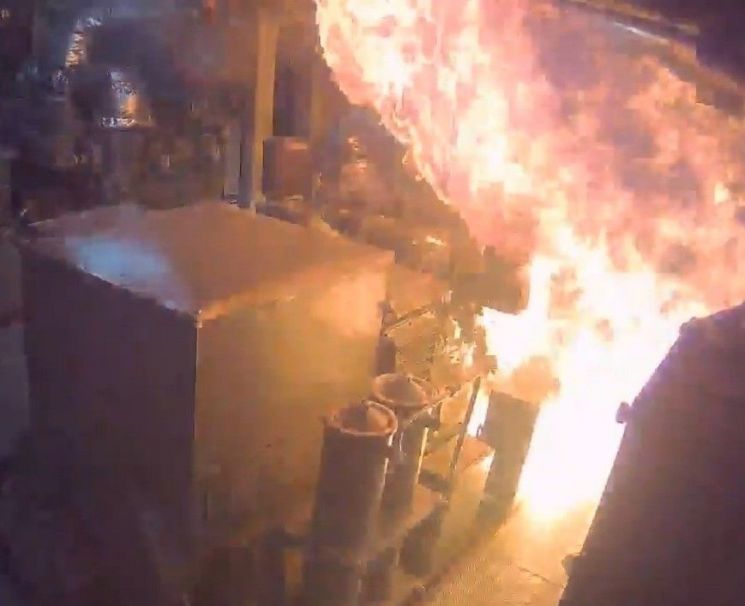
Previously, on July 31 at around 3:43 p.m., a fire broke out in the auxiliary engine room of the Hyangrobong as it was entering Jinhae Port after supporting training for cadet officers. The auxiliary engine room is the area where the ship's generator and other machinery are installed. As a result of this accident, one non-commissioned officer suffered third-degree burns on his right arm and other areas and is being treated at the Armed Forces Capital Hospital, while 35 others (three enlisted soldiers and 32 cadet officers) received treatment for smoke inhalation and other injuries. The fire was completely extinguished the following day, on August 1.
According to the Navy, the ignition point of the fire was identified as the high-temperature section (over 250°C) of the generator exhaust pipe inside the auxiliary engine room. The cause of the fire was found to be the failure of the auxiliary engine room crew to follow work procedures and safety regulations during fuel oil extraction and transfer operations. Specifically, two days before the accident, on July 29 at 3:32 p.m., two engine department soldiers opened the sampling valve connected to the fuel oil transfer pump in the auxiliary engine room to fill a portable fuel container, but failed to close the valve afterward. Normally, the sampling valve should remain closed, but forensic analysis confirmed that the valve was left open.In addition, on the day of the accident at 3:43 p.m., an engine department non-commissioned officer transferred fuel oil from the storage tank to the supply tank using the auxiliary engine room's fuel oil transfer pump, without following the guideline to operate the purifier during fuel oil transfer. During the process of ending the transfer operation, the exit valve was closed without stopping the transfer pump. As a result, excessive pressure built up in the fuel oil system, causing the hose connected to the sampling valve-which had been left open two days earlier-to rupture. Fuel oil was then sprayed in aerosol form and came into contact with the high-temperature section of the adjacent generator, leading to an explosive fuel fire.
The Navy attributes the cause of the fire to the crew's failure to follow work procedures and safety regulations, but also noted that the ship's personnel vulnerability was a contributing factor. The replenishment rate for propulsion engine department non-commissioned officers was only about 74%, resulting in excessive workload for newly assigned non-commissioned officers (sergeants) on the ship. In particular, the prolonged vacancy of intermediate supervisors (staff sergeants) also had an impact.
Jeong Seungil, chair of the accident investigation committee, stated, "The ideal composition of non-commissioned officers and enlisted soldiers for the Hyangrobong should have been one master sergeant, three staff sergeants, five sergeants, and five enlisted soldiers. In reality, however, it consisted of one master sergeant, four senior sergeants, one sergeant, and five enlisted soldiers," adding, "There were no staff sergeants to supervise and train the sergeants during their work, and this was seen as a key vulnerability."
After the fire, the Hyangrobong is scheduled to undergo a detailed inspection by the end of this month, but it is likely to be decommissioned. The ship is currently 26 years old and, considering the standard service life of 30 years for naval vessels, could be used for about four more years. However, much of the ship was damaged in the accident. The Hyangrobong was introduced in 1997 at a cost of 39.4 billion won and has been in service for 26 years. A Navy official stated, "Given 26 years of depreciation, our initial assessment is that the cost of restoration would exceed the ship's current value," adding, "Whether it will become a reserve vessel or be retired after decommissioning is uncertain, but at this stage, decommissioning is the most likely outcome."
The Navy is strengthening compliance with work safety regulations and related training, enhancing the ship's emergency response capabilities in the event of a fire, and implementing preventive measures and a comprehensive review of the ship's damage control system to prevent similar accidents. In addition, the Navy plans to select follow-up tasks based on the investigation results and review all related areas.
Chairman Jeong stated, "We have developed measures to prevent recurrence related to personnel, equipment, fire suppression systems, and other areas, and will select specific follow-up tasks in the future," adding, "Among these, we will categorize immediate actions, short-term tasks, and mid- to long-term tasks by timeline to ensure effective implementation and maintain our focus on these measures."
© The Asia Business Daily(www.asiae.co.kr). All rights reserved.

![Clutching a Stolen Dior Bag, Saying "I Hate Being Poor but Real"... The Grotesque Con of a "Human Knockoff" [Slate]](https://cwcontent.asiae.co.kr/asiaresize/183/2026021902243444107_1771435474.jpg)















