Aftermath of One-Person-One-Vote Rejection Spreads
Party Attempts to Calm Tensions with Nomination Rule Revisions
After the collapse of the proposed changes to the delegate and rights party member one-person-one-vote system and the local election nomination rules, tensions between the pro-Lee Jae-myung (pro-Myung) and pro-Jeong Cheong-rae (pro-Cheong) factions within the Democratic Party of Korea have reignited, now spilling over into the upcoming Supreme Council by-election.
According to the ruling bloc on December 8, several pro-Myung figures are considering running in the Democratic Party’s Supreme Council by-election scheduled for January 11 next year. These include Assemblyman Lee Geon-tae, who served as President Lee Jae-myung’s attorney in the Daejang-dong case; Assemblyman Kang Deuk-gu, who was the chief deputy secretary-general during Lee’s term as party leader; and Yoo Dong-chul, head of the Suyeong-gu district chapter in Busan, who was recruited into the party. On the pro-Cheong side, potential candidates include Assemblywoman Moon Jeong-bok, the party’s organizational deputy secretary-general; Assemblywoman Lim Oh-kyung, head of the civil complaint policy office under the party leader; and Assemblyman Lee Seong-yoon.
The Democratic Party’s Supreme Council decided on this day that the valid voting results for each electoral group will be reflected as follows: 50% from the Central Committee and 50% from rights party members. The right for party members to vote in this election will be granted to those who joined the party by May 31 this year, with the voting rights taking effect from December 1, 2025. Only those who have paid party dues at least six times between December 1, 2024, and November 30, 2025, will be eligible to vote.
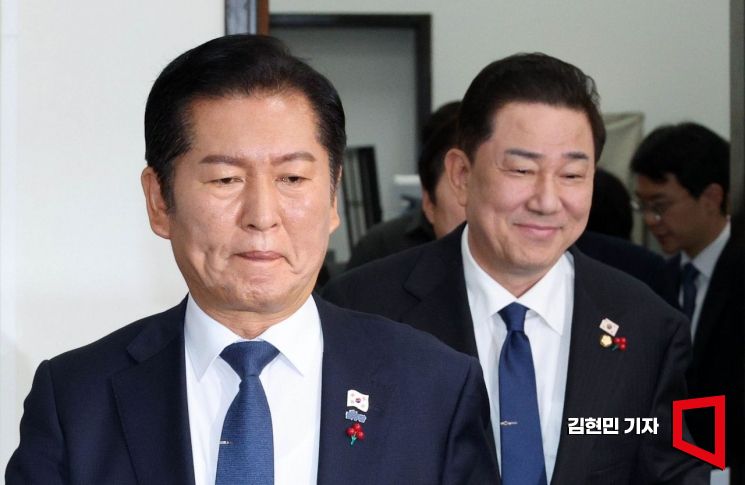 Jeong Cheong-rae, leader of the Democratic Party of Korea, and Kim Byung-gi, floor leader, are attending the Supreme Council meeting held at the National Assembly on December 8, 2025. Photo by Kim Hyun-min
Within the party, after the Central Committee rejected the one-person-one-vote system and nomination rule changes, escalating tensions between the pro-Myung and pro-Cheong factions prompted Secretary-General Cho Seung-rae and Chief Spokesman Park Soo-hyun to urge restraint. In a press briefing and on Facebook, they both emphasized, "There needs to be restraint from factionalism centered on specific individuals," as they sought to deescalate the situation.
At the Supreme Council meeting that day, Party Leader Jeong Cheong-rae focused on calming internal backlash by approving a revised nomination rule amendment prepared by the Local Election Planning Committee the previous day. Instead of the original proposal for rights party members to have 100% of the vote in selecting proportional representation candidates for basic councilors, the party will submit to the Party Affairs Committee a compromise reflecting a 50% voting ratio between executive committee members and rights party members.
At the Supreme Council meeting, Jeong Cheong-rae stated, "If you look at the approval rates-80% for the nomination rule amendment and 73% for the one-person-one-vote system-they would have passed, but due to low voter turnout, they were not adopted. I respect the decision of the Central Committee." Regarding the one-person-one-vote system for delegates and rights party members, he said, "Because the party belongs to its members, I will seek their opinions to find a way forward."
Chief Spokesman Park Soo-hyun commented, "For metropolitan areas, the scope is already broad, so even with 100% party member voting, there is little difference from the current system," adding, "The Supreme Council members agreed and approved this as part of the move toward a party governed by its members."
© The Asia Business Daily(www.asiae.co.kr). All rights reserved.
!["The Woman Who Threw Herself into the Water Clutching a Stolen Dior Bag"...A Grotesque Success Story That Shakes the Korean Psyche [Slate]](https://cwcontent.asiae.co.kr/asiaresize/183/2026021902243444107_1771435474.jpg)
















