South Korea Urged to Counter China
Some Say, "Not an Acceptance of North Korea's Nuclear Program"
The new National Security Strategy (NSS) document for the second Trump administration omits references to "North Korea" and "denuclearization of the Korean Peninsula," while emphasizing the need for South Korea, as an ally, to play a role in countering China. This leaves South Korea with the complex challenge of addressing North Korea's nuclear and missile threats, as well as managing its relationship with China, a major trading partner.
In the 33-page NSS released by the U.S. administration on December 5 (local time), there were no mentions of North Korea or denuclearization of the Korean Peninsula. This contrasts with the NSS issued by former President Joe Biden’s administration in 2022, which mentioned North Korea three times, and the first Trump administration’s NSS in 2017, which referenced North Korea 17 times. The NSS is the highest-level foreign and security policy document, outlining the U.S. administration’s key national interests, major security objectives, priorities, and the strategies to achieve them.
In previous U.S. administrations’ NSS documents, North Korea was identified as a major threat alongside China, Russia, and Iran. Successive administrations have used the NSS to express a strong commitment to the denuclearization of the Korean Peninsula. The exclusion of the phrase "complete denuclearization of North Korea" from this top-level strategy document has raised concerns in some quarters that this could amount to tacit acceptance of North Korea’s nuclear status. Early in his term, President Trump sparked controversy by referring to North Korea as a "nuclear power."
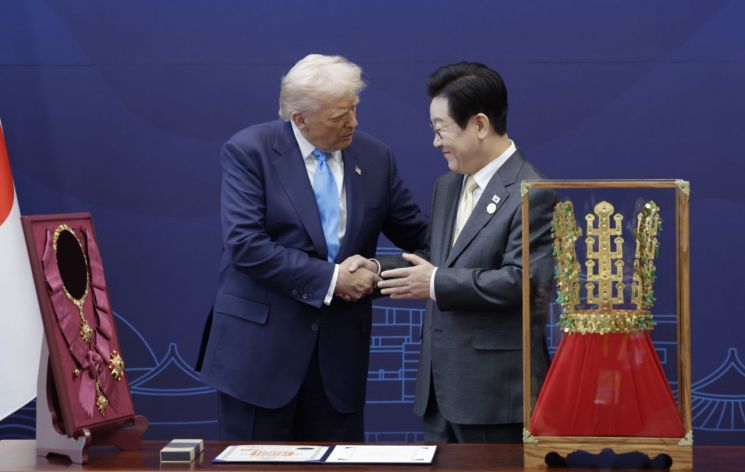
However, some analysts caution against concluding that the omission of North Korea from the latest NSS signals a major shift in U.S. policy. In the joint fact sheet from the U.S.-South Korea summit on November 14, the phrase "complete denuclearization of the DPRK" was explicitly included. The same wording appeared in the joint statement from the U.S.-South Korea-Japan foreign ministers’ meeting held in New York in September. It is also highly likely that the National Defense Strategy (NDS), prepared and released by the U.S. Department of Defense, will contain North Korea policy explicitly mentioning denuclearization.
Park Wongon, a professor at Ewha Womans University, explained, "The NSS is extremely U.S.-centric, outlining what the U.S. perceives as threats and what it prioritizes at this time. The omission of North Korea’s nuclear program means it is not considered an existential threat at present." Hong Min, Senior Research Fellow at the Korea Institute for National Unification, assessed, "The exclusion of the Korean Peninsula denuclearization issue from the NSS does not necessarily mean acceptance of North Korea’s nuclear weapons. Rather, it reflects Trump-style realism and isolationism, implying that denuclearization is not seen as a realistic immediate goal."
Wi Sunglak, Director of the National Security Office in the Presidential Office, also commented at a briefing on December 7, "The absence of a reference to 'North Korea denuclearization' in this NSS report is due to a fundamentally different drafting approach compared to 2022," adding, "Specific regional disputes and major issues will likely be addressed in subsequent, lower-level documents."
Nevertheless, the impression that the denuclearization of the Korean Peninsula has been deprioritized in U.S. security policy could increase South Korea’s burden. In particular, the latest NSS identifies "defense of Taiwan" as the top priority for the Northeast Asia region and explicitly calls for expanded roles for allies such as South Korea. The NSS states, "The United States will build a military capable of deterring Chinese military aggression within the First Island Chain (stretching from the Japanese archipelago through Taiwan, the Philippines, to Borneo), but cannot do so alone," adding, "Allies within the First Island Chain, including Japan, South Korea, Australia, the Philippines, and Taiwan, must invest much more."
Experts stress the need to strengthen capabilities to respond to North Korea’s nuclear and missile threats while managing tensions with neighboring countries. Eom Hyosik, Secretary-General of the Korea Defense and Security Forum, commented, "The latest NSS sets Taiwan as the core of the Northeast Asian security landscape, with South Korea and Japan positioned as supporters. This effectively means that North Korea’s denuclearization has been pushed down the list of U.S. security priorities. It is urgent for South Korea to rapidly expand its own three-axis defense system and to enhance its potential capabilities by revising the U.S.-South Korea nuclear cooperation agreement."
Hong, the senior research fellow, noted, "South Korea’s strategic flexibility has been structurally limited as it aligns with the U.S. global strategy. It is important to adjust the pace so that our military and forces, beyond the U.S. Forces Korea, do not become subject to strategic flexibility. At the same time, efforts are needed to manage the overall situation through effective messaging."
Shin Beomchul, former Vice Minister of Defense and Senior Research Fellow at the Sejong Institute, stated, "South Korea faces the complex challenge of minimizing conflict with China, bringing North Korea to the negotiating table, and persuading the U.S. on denuclearization of the Korean Peninsula. Therefore, it is essential to clearly define what to cooperate on and what to reject in dealings with the U.S."
© The Asia Business Daily(www.asiae.co.kr). All rights reserved.

















