Plans for Sports, Commercial, and Convenience Facilities in the Surrounding Area
Full-Scale Bid to Attract K-Arena in Response to Government Initiative
Gwangmyeong City in Gyeonggi Province is planning to build the largest domed performance arena in Korea, with a capacity of 40,000 seats, in Gwangmyeong-Siheung New Town.
On December 8, Gwangmyeong City held the final report meeting for the 'Gwangmyeong K-Arena Basic Strategy Establishment Project' at the city hall conference room, where it reviewed its strategy for attracting the K-Arena as outlined in this plan.
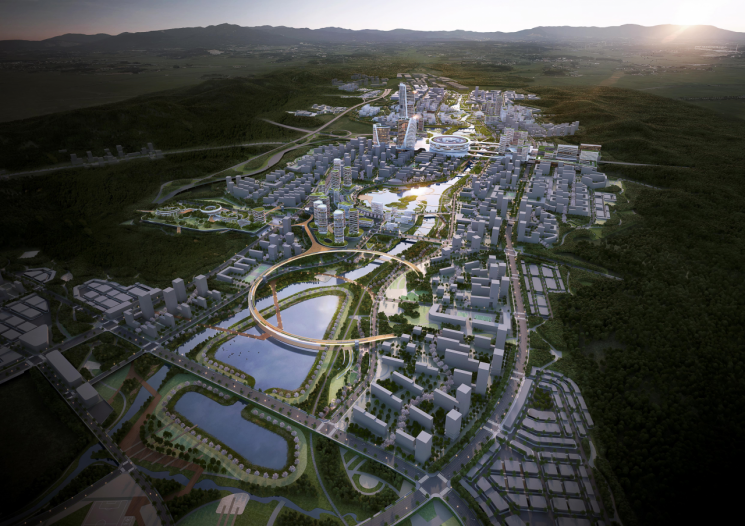 A panoramic view of Gwangmyeong-Siheung New Town, where Gwangmyeong City is promoting the construction of a large-scale K-Arena with a capacity of 40,000 seats. Provided by Gwangmyeong City
This study, which was completed just over two months after its launch in September, was conducted in response to the government's national policy initiative for 'medium- and large-scale complex performance arena (K-Arena)' facilities. The study specified the suitability of the site, the scale of construction, and the direction for surrounding complex development.
As a result of the study, the city decided to build a dome-shaped arena in Gwangmyeong-Siheung New Town with a maximum capacity of 40,000 people. This would be the largest arena in Korea. Currently, most arena venues in the country that are either operating or under construction have fewer than 20,000 seats.
The city planned this scale of construction based on the judgment that a performance facility matching the global influence of K-pop is necessary.
The performance arena will be equipped with specialized facilities such as architectural acoustics design, an electronic sound system, and an overhead system capable of supporting various stage productions. The design will also aim to minimize obstructed views.
The arena is intended to operate as a multi-purpose performance and sports complex, accommodating not only popular music concerts but also national football team matches, e-sports tournaments, and future-oriented content such as artificial intelligence (AI), robotics, and drone racing.
In the surrounding area, the city plans to establish a complex entertainment space that combines viewing, experience, and leisure, by arranging citizen sports facilities, hotels, shopping malls, and other commercial, convenience, and accommodation facilities.
Based on the results of the study, the city concluded that Gwangmyeong-Siheung New Town is the optimal location for attracting the arena. The city explained that, from the early stages of new town development, it is possible to plan the urban area around the arena, and that the area is equipped with excellent metropolitan transportation networks, including KTX Gwangmyeong Station and a new subway station. The city also cited its excellent accessibility to Incheon International Airport, which is advantageous for attracting international tourists, and the potential to address the shortage of cultural facilities in the southwestern part of the Seoul metropolitan area as key strengths.
The city plans to finalize its strategy by incorporating expert opinions, proceed with a second study to further detail the basic plan, and actively pursue the attraction of the arena in accordance with the government's public bidding procedures.
Park Seungwon, Mayor of Gwangmyeong City, stated, "The K-Arena will serve as a strong foundation for Gwangmyeong City to become a cultural and tourism hub," adding, "We will thoroughly prepare for the arena's attraction in line with the government's public bidding process."
© The Asia Business Daily(www.asiae.co.kr). All rights reserved.
![Clutching a Stolen Dior Bag, Saying "I Hate Being Poor but Real"... The Grotesque Con of a "Human Knockoff" [Slate]](https://cwcontent.asiae.co.kr/asiaresize/183/2026021902243444107_1771435474.jpg)
















