Rare Earth Magnet Factory Begins Operations on Lithuanian Border
Putin Says "Narva Is Territory Ruled by Russian People"... Security Concerns Grow
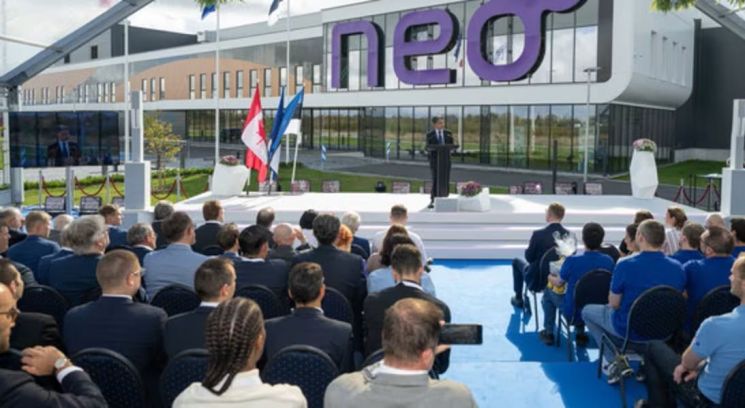 Last September, a completion ceremony was held for Neo Performance Materials' rare earth magnet factory in Narva, located in the eastern border area of Estonia. Neo Performance Materials website
The largest rare earth magnet factory in Europe, built in Estonia, has begun full-scale operations just two years after construction started, thanks to comprehensive support from the European Union (EU). This is seen as the first step toward reducing Europe's dependence on Chinese rare earth magnets, which currently exceeds 90%. However, concerns have been raised that the factory's location on Estonia's eastern border facing Russia could lead to security issues if there is military provocation from Russia, or could disrupt rare earth magnet production.
Rare Earth Magnet Factory Built at Estonia's Eastern Edge... First Step Toward Rare Earth Independence
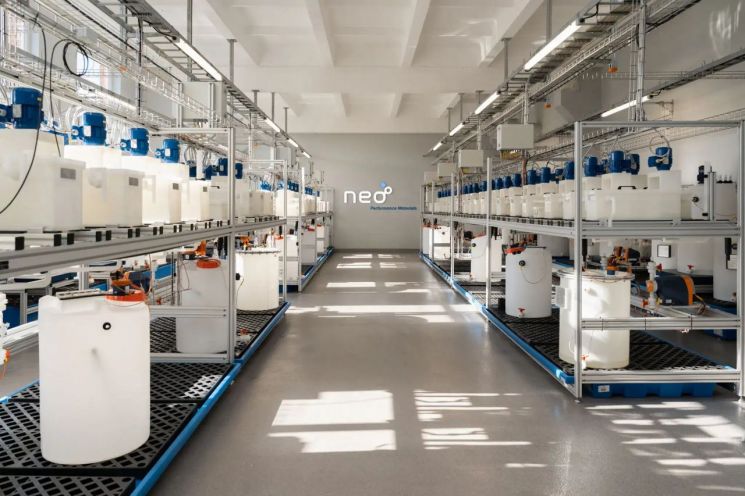
According to CNBC, the rare earth magnet factory established in Narva, Estonia, began full-scale operations on December 4 (local time). The factory is operated by Neo Performance Materials, a Canadian company specializing in rare earth magnets. The EU provided about 30% of the $75 million (approximately 110 billion won) construction cost, and expedited the necessary administrative procedures, allowing the factory to be completed just two years after groundbreaking.
Rare earth magnets are essential materials for advanced industries such as electric vehicle motors, wind turbine generators, medical devices, and precision weaponry. In Europe, over 90% of these magnets are imported from China. Last year, total demand for rare earth magnets in Europe was about 22,000 tons. The new factory plans to produce 2,000 tons annually, which is expected to reduce Europe's dependence on Chinese rare earth magnets by about 10 percentage points in the future.
Estonia, in particular, has been considered the most suitable location in Europe for operating rare earth facilities, as it has had rare earth refining plants since the Soviet era. Rahim Suleman, CEO of Neo Performance Materials, told CNBC, "Estonia has many rare earth separation facilities capable of processing both light and heavy rare earths," adding, "We plan to increase rare earth magnet production to 5,000 tons and expand supply, especially to German automakers, starting next year."
With the establishment of this factory, the EU plans to actively secure rare earth supply chains going forward. According to 'ResourceEU,' the EU's critical mineral supply chain restructuring plan announced last October, the EU will invest in rare earth mine development in Ukraine, Australia, Canada, Kazakhstan, Uzbekistan, Chile, and Greenland to reduce dependence on China. In addition, the EU aims to mine 10% of its annual strategic raw material demand within Europe, secure 25% through recycling, and process 40% domestically. This is intended to prepare for any potential disruption of the Chinese rare earth supply chain.
Putin Calls Narva "Ancient Russian Land"... Security Concerns Grow After Ukraine War
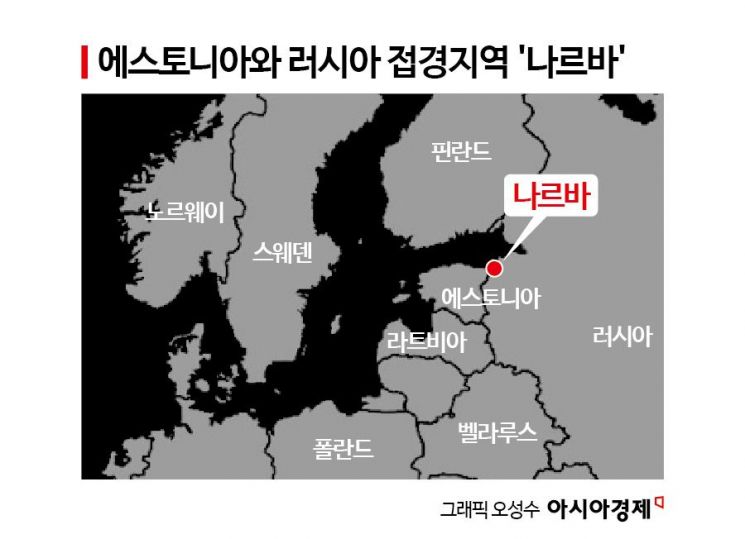
However, some are concerned that the rare earth magnet factory's proximity to the Russian border could create security risks. The Narva region of Estonia, where the factory is located, has been the site of ongoing border disputes with Russia, and there are suspicions that Russia has recently engaged in sabotage operations targeting the infrastructure of various Eastern European countries, raising concerns that the factory could also become a target.
According to CNN, the Narva region has been a point of contention between Estonia and Russia since the collapse of the Soviet Union. In Narva, 40% of residents hold Russian citizenship, and over 90% speak Russian. The Russian government has repeatedly claimed this region as its former territory.
In June 2022, Russian President Vladimir Putin stated at a press conference that "Narva is a territory ruled by Russian Slavs," prompting Estonia to summon the Russian ambassador in protest. In April of this year, Estonian and Russian border patrols clashed over the installation of buoys along the Narva River, which marks the border region.
Of Estonia's 1.3 million people, 320,000 are of Russian descent, and among them, 90,000 still hold Russian citizenship. In last October's local elections, amid growing suspicions of Russian interference, the Estonian parliament passed a constitutional amendment just before the vote to strip Russian and Belarusian nationals of their local voting rights.
The Estonian government is also preparing for future security risks by building a border barrier in Narva. According to Estonia's public broadcaster ERR, citing government officials, "Since August, a barrier has been erected along the border with Russia in the Narva region, and there have been ongoing incidents of unidentified individuals illegally crossing from the Russian side," adding, "The Estonian government is also expediting security measures for infrastructure and factories in Narva."
© The Asia Business Daily(www.asiae.co.kr). All rights reserved.



















