An air purification technology capable of removing 99.9% of ultrafine dust without using filters has been developed.
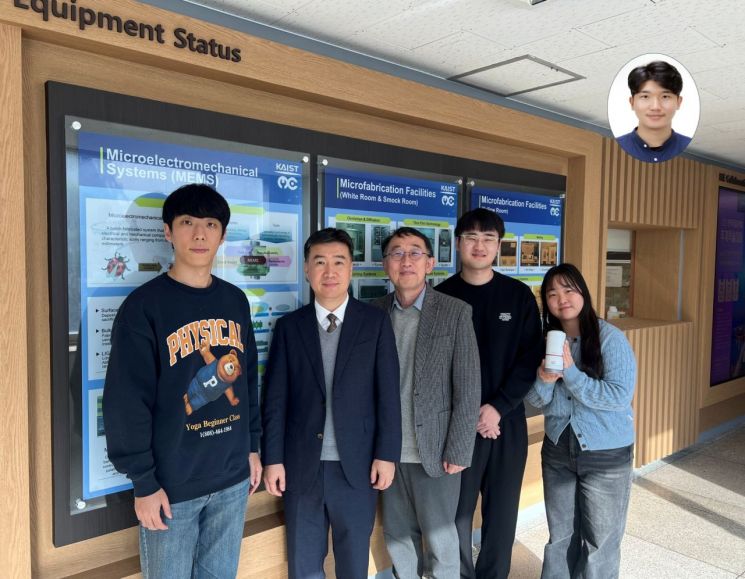 (From left) Woo Sungyun, PhD candidate at KAIST; Kim Ildu, Professor; Lee Seungseop, Professor; Chae Jihwan, PhD candidate; Yoo Jiyeon, Researcher at A2US (top) Jo Yujang, PhD. Provided by KAIST
KAIST announced on December 8 that a joint research team led by Professor Kim Ildu from the Department of Materials Science and Engineering and Professor Lee Seungseop from the Department of Mechanical Engineering has developed a 'water electrostatic spray'-based air purification device. This device rapidly removes ultrafine dust without a filter, operates at ultra-low power, and does not generate ozone.
The device was completed by combining a technology in which nano-sized water droplets capture dust and a 'nano-sponge structure' that autonomously draws up water.
It is evaluated to be both safe and durable, as it can remove even extremely fine particles with a diameter of 0.3 micrometers (PM 0.3) or less in a short period of time, and its performance does not degrade even after prolonged use.
Inside the device are high-voltage electrodes, a nanofiber absorber that autonomously draws up water, and polymer microchannels that move water via capillary action.
Thanks to this structure, a self-pumping mechanism is implemented, allowing water to be automatically supplied without a pump, enabling stable water electrostatic spraying for extended periods.
In tests conducted by the joint research team in a 0.1m³ experimental chamber, the device removed 99.9% of various particles in the PM0.3 to PM10 range within 20 minutes.
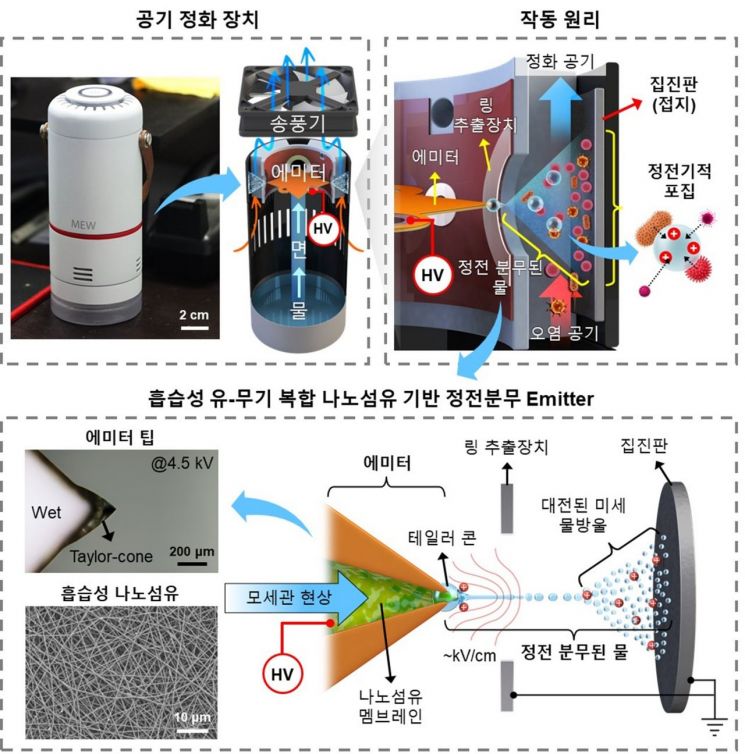 Design and Operating Mechanism of a Small Air Purification Device Based on Water Electrostatic Spray. Provided by KAIST
In particular, it demonstrated the ability to remove 97% of PM 0.3 ultrafine particles-difficult to eliminate with conventional filter-based air purifiers-within just 5 minutes.
This performance was stably maintained during 30 consecutive tests and 50 hours of continuous operation. Most notably, the power consumption was only 1.3W, which is less than that of a smartphone charger and just 1/20th that of conventional HEPA (High-Efficiency Particulate Air) filter-based air purifiers, according to the research team.
The developed device maintains high purification efficiency without generating any ozone, making it a promising next-generation eco-friendly air purification platform. It is expected to be applicable in a wide range of fields, including indoor environments, vehicle use, clean rooms, portable, and wearable air purification modules.
Meanwhile, this research was jointly led by Chae Jihwan, PhD candidate (Department of Mechanical Engineering, KAIST), and Jo Yujang, PhD (Department of Materials Science and Engineering, KAIST) as co-first authors, with Professor Lee Seungseop (Department of Mechanical Engineering) and Professor Kim Ildu (Department of Materials Science and Engineering) serving as corresponding authors.
The research findings (paper) were recently introduced in the international academic journal 'Advanced Functional Materials (AFM),' which covers the fields of materials science and nanotechnology.
© The Asia Business Daily(www.asiae.co.kr). All rights reserved.


















