0.25 Percentage Point Cut Likely Due to Labor Market Slowdown
Inflation Concerns Persist as Hawks Raise Their Voices
Possibility of Five Dissenting Votes Emerges
This week, Wall Street's attention is focused on the final Federal Open Market Committee (FOMC) regular meeting of the year held by the United States Federal Reserve (Fed). Amid concerns about a slowdown in the labor market, there is a strong likelihood that the benchmark interest rate will be cut by 0.25 percentage points. However, as inflation concerns have not been resolved, expectations are growing that there will be multiple dissenting votes. Some predict that, for the first time since 1983, as many as five members could vote against the decision, fueling concerns about internal division within the Fed.
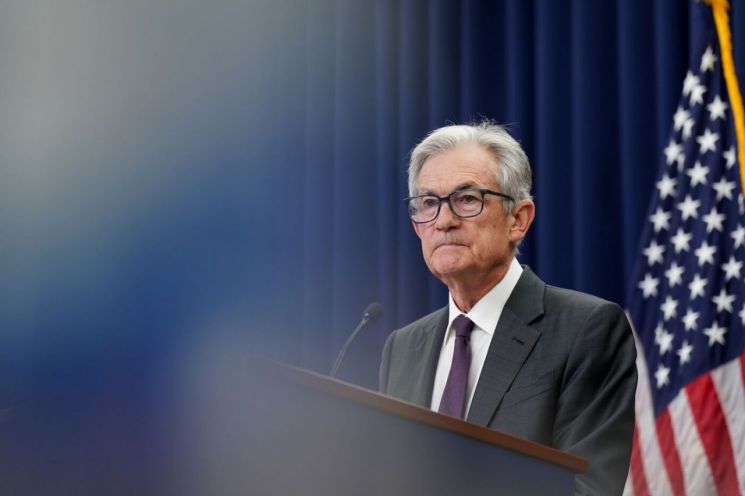
According to the Fed on December 7 (local time), the FOMC will hold its regular meeting on December 9-10 to decide the direction of the benchmark interest rate, which currently stands at 3.75-4.0% per year.
The market overwhelmingly expects a 0.25 percentage point rate cut. According to CME FedWatch, the interest rate futures market is pricing in an 86.2% chance that the Fed will lower rates by 0.25 percentage points at this meeting. Economists also largely view a rate cut as a given. In a joint survey conducted by the Financial Times (FT) and the University of Chicago Booth School of Business's Clark Center, 85% of the 40 economists surveyed predicted that the Fed will cut rates by 0.25 percentage points due to concerns about a slowdown in the labor market. The remaining 15% expected rates to be held steady.
As a result, the Fed is likely to cut rates by 0.25 percentage points for the third consecutive time in October and December, following the first cut in September this year. If the rate is lowered to 3.5-3.75% per year, it will be the lowest level in nearly three years.
The key issue is not whether the rate will be cut, but the number of dissenting votes. With inflation still above the Fed's 2% target and signs of a slowdown emerging in the labor market, the FOMC is increasingly divided over whether to prioritize price stability or employment. In addition, the recent federal government shutdown, which caused gaps in key economic indicators, has further increased uncertainty in policy decisions.
There are significant differences in perspectives among committee members. John Williams, President of the Federal Reserve Bank of New York, indicated last month the possibility of a rate cut in response to potential cooling in the job market. Fed Governor Christopher Waller and Fed Vice Chair Michelle Bowman also support a 0.25 percentage point cut. On the other hand, hawkish members are mounting strong resistance. Jeffrey Schmid, President of the Federal Reserve Bank of Kansas City, is likely to argue for holding rates steady, as he did in October when he cast a dissenting vote. Susan Collins, President of the Federal Reserve Bank of Boston, and Austan Goolsbee, President of the Federal Reserve Bank of Chicago, have also signaled the possibility of dissent, while Fed Governor Michael Barr has stated that there is little room for a rate cut. In addition, Fed Governor Stephen Miran, known as President Donald Trump’s "economic advisor," is expected to vote against a 0.25 percentage point cut, instead advocating for a 0.5 percentage point reduction. If there are five dissenting votes, it would be the first time since 1983; four dissenting votes would be the first since 1992.
Economists are also predicting such divisions. In the FT survey, only one respondent expected all 12 FOMC voting members to unanimously support a 0.25 percentage point cut. Sixty percent of respondents anticipated two dissenting votes, while more than 30% expected three or more dissenting votes.
The dot plot, which will show the future path of interest rates, is also a key point of interest at this meeting. Even if rates are cut this time, there is a possibility that the dot plot will reinforce a hawkish outlook, indicating that the pace of future rate cuts will be limited. According to the September dot plot, the median forecast for the Fed's interest rate projections was 3.4% in 2026 and 3.1% in 2027. If the Fed cuts rates this week and maintains this outlook, it would mean only one rate cut each in the next two years.
Bank of America (BofA) analyzed, "At least two dissenting opinions are expected at this meeting," adding, "The fact that Fed Chair Jerome Powell cannot firmly commit to a rate hold may prompt hawkish members within the FOMC to maintain an even more hardline stance."
© The Asia Business Daily(www.asiae.co.kr). All rights reserved.