Hong Kong Legislative Council Election Concludes
Second Election Since China’s Electoral Overhaul
Only Candidates Who Passed the "Loyalty Test" Allowed to Run
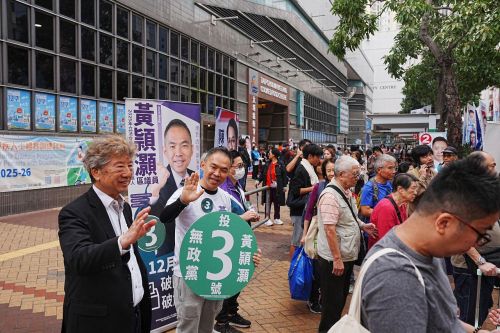 On the 7th, as the Hong Kong Legislative Council election concluded, independent candidate Alan Wong greeted supporters in the Tai Po district of Hong Kong. Photo by Reuters Yonhap News
As Hong Kong mourns the tragic fire at the Wong Fuk Court apartment complex, which claimed the lives of 159 people, the city proceeded with its Legislative Council (LegCo) election as scheduled on the 7th. This election was regarded as a barometer of public sentiment.
The BBC and Hong Kong daily South China Morning Post (SCMP), citing the Hong Kong Electoral Affairs Commission, reported that the final voter turnout was tallied at 31.9%. Out of approximately 4.1 million eligible voters, 1.3 million participated in the election.
This figure surpasses the 30.2% turnout recorded in the 2021 election, but remains significantly lower than the 52.28% turnout in 2016. In 2021, China overhauled Hong Kong's electoral system, introducing a "patriots-only" requirement for candidates.
In this election, 161 candidates competed for the 90 seats in the Legislative Council. Of these, 20 seats are directly elected by residents of 10 constituencies, while 40 seats are chosen by an election committee dominated by pro-Beijing forces. The remaining 30 seats are functional constituency seats, filled through indirect elections by industry representatives.
There were no opposition-leaning candidates among those running in this election. Earlier this year, in February, the Democratic Party, previously the largest opposition party, decided to dissolve. In June, the last remaining opposition party, the League of Social Democrats (LSD), also disbanded, leaving Hong Kong without any official pro-democracy forces. Against this backdrop, 35 current lawmakers-accounting for 40% of sitting legislators, including moderate politicians-chose not to run in this election.
 A Hong Kong resident is looking at the list of election candidates installed in the Tai Po area. Photo by Reuters and Yonhap News Agency
Traditionally, around 60% of Hong Kong voters have supported pro-democracy candidates, but since the electoral system was reformed, this segment of the electorate is now seen as largely disengaged from the election process. In the district council election held in December 2023, voter turnout was just 27.5%, marking the lowest participation rate in any election in Hong Kong's history and highlighting a notable decline in civic engagement.
Amid these trends, last month's fire disaster further fueled concerns about deteriorating public sentiment. In response, Chinese and Hong Kong authorities labeled critical voices as "anti-China" and "anti-government" forces and cracked down on them harshly.
The Hong Kong government employed both incentives and punitive measures. To boost turnout, authorities extended voting hours, set up additional polling stations, encouraged voting leave, and offered discount coupons for shops and restaurants. At the same time, 11 people were arrested for allegedly encouraging others online to boycott the election or cast invalid ballots. On December 6, it was reported that the authorities summoned foreign media outlets such as Reuters, AP, and AFP to address their coverage of the Legislative Council election.
This election took place just 11 days after the Wong Fuk Court apartment fire in Tai Po on November 26, which resulted in at least 159 deaths. Authorities have faced criticism for inadequate oversight and a delayed response, which are believed to have exacerbated the tragedy.
According to the SCMP, voting in the Tai Po district took place in a subdued atmosphere. Ngai Bekking, a 70-year-old Tai Po resident, said that after the disaster, he was disappointed with the Democratic Alliance for the Betterment and Progress of Hong Kong (DAB), the largest pro-Beijing party, and voted for a different candidate. He shared that he has suffered from insomnia since the fire, stating, "Some of them just caused problems. They did not do their jobs properly and wasted taxpayers' money," explaining that he cast his vote for a younger candidate.
© The Asia Business Daily(www.asiae.co.kr). All rights reserved.


















