Bloomberg Survey: Fund Managers' Investment Outlook for Next Year
77% of Respondents Maintain Preference for Risk Assets
Expectations for AI, Accommodative Monetary Policy, and Robust Growth
AI Bubble Concerns: "Strong Fundamentals... Still Early
Amid growing concerns over an overheating artificial intelligence (AI) investment boom, eight out of ten fund managers at major global asset management firms-including those in the United States-believe the stock market rally will continue into 2026. In particular, there is strong anticipation that the AI-driven bull market will persist, especially centered around the United States.
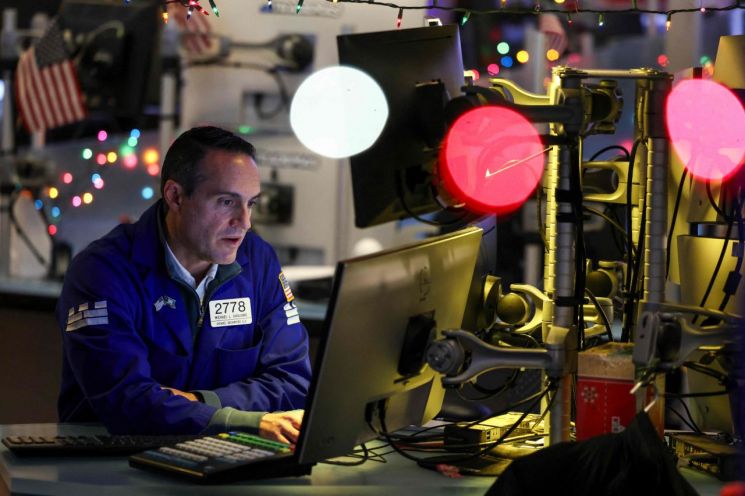 On the 5th (local time), a trader is working on the trading floor of the New York Stock Exchange (NYSE) in the United States. Photo by AFP News Agency
According to an interview survey conducted by Bloomberg on December 7 (local time) with 39 fund managers across the United States, Europe, and Asia, 30 respondents, or 77% of the total, said they expect a continued bull run in risk assets through 2026 and have constructed 'risk-on' investment portfolios.
Additionally, 10% of respondents (4 managers) described their market outlook as 'mixed-view,' while 7.7% (3 managers) took a 'risk-off' stance, expressing a preference against risk assets. The remaining 5% (2 managers) did not disclose their outlook for the market next year.
The bullish outlook has been attributed to expectations that, despite ongoing debates about a bubble in large-cap AI-related technology stocks, the continued proliferation of AI, the recovery of the global economy, and accommodative monetary and fiscal policies will drive returns across global equity markets.
Sylvia Sheng, Global Multi-Asset Strategist at JP Morgan Asset Management, stated, "Expectations for robust growth and accommodative monetary and fiscal policies are supporting the risk appetite in multi-asset portfolios," adding, "We are maintaining a strategy of increasing allocations to both equities and bonds."
David Bianco, Chief Investment Officer (CIO) for the United States at DWS, commented, "We are capitalizing on a strong trend and expect the bull market to continue through the end of next year," emphasizing, "Now is not the time to pursue contrarian investments that go against this trend."
Despite concerns about a bubble in large-cap AI-related technology stocks, the prevailing view is that, given their solid earnings and fundamentals, valuation pressures are not excessive. Eighty-five percent of fund managers said that the share prices of key AI technology stocks-including the 'Magnificent 7' (Nvidia, Apple, Alphabet, Microsoft, Amazon, Meta, and Tesla)-are "not excessively inflated." Many analysts believe we are at the beginning of a new industrial cycle.
Anwiti Bahuguna, Co-CIO at Northern Trust Asset Management, emphasized, "The performance of technology companies continues to far outpace all other companies in the United States," adding, "In such a strong performance environment, it is not accurate to call the AI rally a bubble."
Jose Rasco, CIO at HSBC Americas, predicted, "American exceptionalism will never disappear," and added, "As AI spreads globally, the United States will play a central role."
According to Bloomberg, the valuation of major U.S. technology stocks remains below the historical peaks of the past decade. The price-to-earnings ratio (PER) for the Magnificent 7 averaged in the high 20s over the past ten years and currently stands at around 31 times, which is significantly lower than the peak of 40 times reached in November 2021, when global liquidity was at its highest during the COVID-19 pandemic. The PER is an indicator of how expensive a stock is relative to the company's earnings; a higher PER means the stock price is more expensive compared to its earnings.
While U.S. large-cap technology stocks centered on AI are driving global equity markets higher, some analysts note that investment opportunities are not limited to the United States. There are growing assessments that performance momentum is strengthening in major Asian markets such as Japan, Taiwan, and South Korea. Bloomberg forecasts annual earnings per share (EPS) growth rates for 2026 at 13.2% for the S&P 500 in the United States and 16.6% for the MSCI Emerging Markets Index. Goldman Sachs Asset Management identified India as the most attractive market for 2026.
Amid the U.S. Federal Reserve's interest rate cut cycle, the outlook for small- and mid-cap stocks is also becoming increasingly bullish. While small- and mid-cap companies typically have higher debt ratios, their interest expense burden is expected to decrease next year, leading to significant profit growth. Santander Asset Management suggested that the earnings growth rate for U.S. small-cap stocks could exceed 20% in 2026.
Despite this optimism, the potential resurgence of U.S. inflation is cited as one of the biggest risks facing the market.
Amelie Derambure, Senior Multi-Asset Portfolio Manager at Amundi SA, stated, "If U.S. inflation rebounds in 2026, both equities and bonds will be impacted," adding, "For investors to keep moving forward next year, the Fed must be on their side by lowering interest rates."
The uncertainty surrounding the trade policy of a potential Donald Trump administration is also identified as another risk. If trade disputes reignite or supply chain instability increases, inflationary pressures could intensify, and investor appetite for risk assets could rapidly diminish.
© The Asia Business Daily(www.asiae.co.kr). All rights reserved.

















