NYT Sheds Light on Korea's Cafe Market
"Startup and Closure Cycles Fueled by Fierce Competition"
The New York Times (NYT) has reported that the fervor for opening cafes in South Korea has led to excessive competition and low profitability, resulting in a surge of business closures.
In a recent article titled "South Korea Has a Coffee Shop Problem," the NYT shed light on the harsh realities faced by domestic cafe owners amid fierce competition.
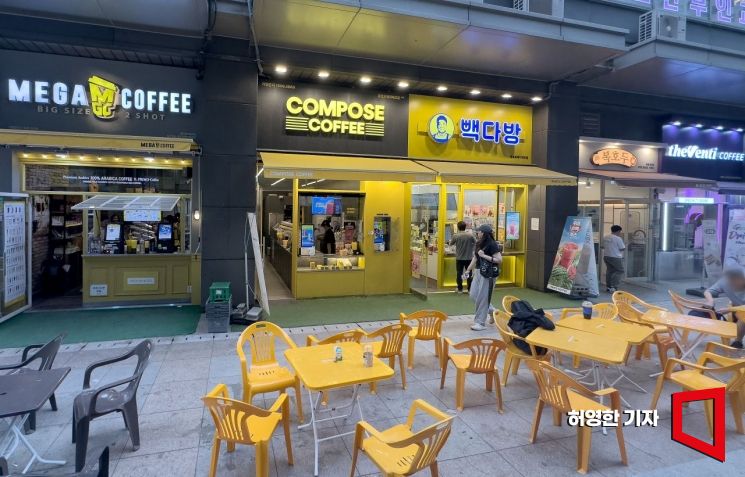 Stores of domestic low-cost coffee brands located in a building in Jongno-gu, Seoul. From the left, Mega Coffee, Compose Coffee, Paik's Coffee, and The Venti Coffee, skipping one in between. Photo by Hyunghan Heo
High Coffee Demand in South Korea... A Surge in Cafe Startups
The NYT cited the case of Ko Jangsu, who operates a cafe in Sillim-dong, Gwanak-gu, Seoul. When Ko opened his cafe in 2016, there were only two other cafes nearby. However, the number of cafes in the area has recently surpassed 50, leading to a decrease in customers. Ko lamented, "If I could start over, I would never open a cafe again."
Coffee culture in South Korea became widespread, centered around instant coffee, during and after the Korean War. After Starbucks entered the market in the late 1990s, Americano became the representative beverage, and "A-A" (iced Americano) has become a national drink. Currently, there are approximately 80,000 cafes nationwide, with over 10,000 located in Seoul alone. The NYT analyzed that, given South Koreans' strong preference for coffee, many view this as an opportunity and continue to open new cafes.
Cafes serve not only as places to sell coffee but also as social spaces. The NYT noted, "Because it is difficult to invite guests home due to small living spaces, cafes have functioned as a 'third place' for couples, friends, students, and individuals to spend time." The article also pointed out that low initial startup costs and the lack of certification requirements have increased the appeal of opening a cafe. Furthermore, "a consumption culture centered on social networking services (SNS) has made new stores appear more attractive, with lines forming in front of newly opened locations," the NYT added.
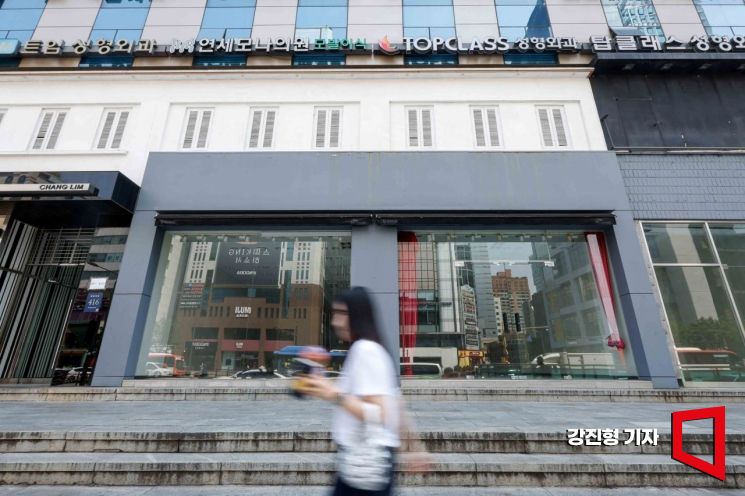 The first floor of a commercial building on a main street near Gangnam Station in Seoul is vacant due to business closures. Photo by Kang Jin-hyung
"The Work Is Grueling and Profits Are Low": Lament of Small Business Owners
However, the reality for those who actually start a cafe is far from easy. Ko said, "People see lines in front of cafes and think the business is easy, but the work is grueling and the profits are low." Choi Sunwook, a cafe startup consultant, also pointed out that many prospective owners have little to no operational experience. He noted that many cafe owners work more than 13 hours a day, yet only make a monthly profit of 3.97 million to 5 million won. This is why closures are concentrated in the first or second year, when lease contracts expire.
As competition intensifies, it has become difficult to compete based on coffee quality alone. Jang Eunseok, who runs a cafe near a university district in Seoul, said that owners now need skills in marketing, interior design, and menu development to keep up with trends. In the race on social media, store interiors have become more important than the menu itself, leading to a proliferation of cafes with similar designs.
Jang shared that five out of the seven cafes he has worked at over the past ten years have already closed down. He said, "Sometimes I feel hopeless," and added, "I have worried about whether I can continue working as a barista."
Reflecting these circumstances, there has been a rise in YouTube content discouraging people from opening cafes. Kwon Sungjun, winner of the Netflix cooking competition "Black & White Chef," also shared his own failed cafe experience and advised against starting a cafe.
Nevertheless, those hoping for success continue to enter the market. Ko commented, "A cafe is not a place to become rich. It's just a space to drink coffee."
© The Asia Business Daily(www.asiae.co.kr). All rights reserved.


















