Dongwon Reactivates Task Force, POSCO Forms Advisory Team
Companies Begin Full-Scale Preparations for Another Bid
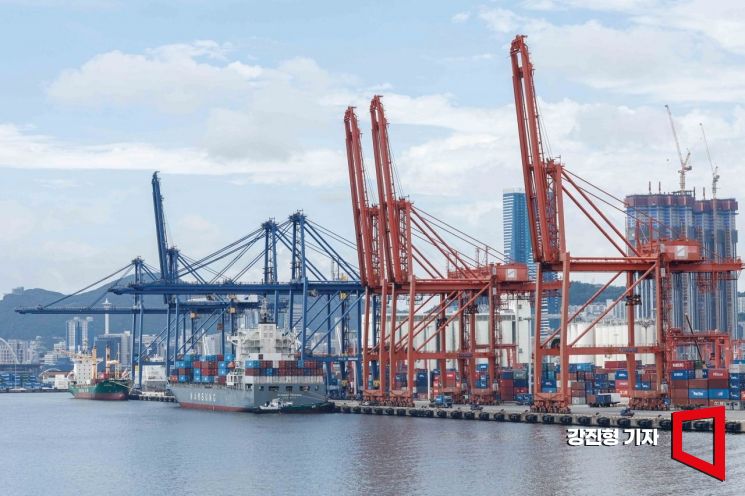
Discussions regarding the sale of HMM (formerly Hyundai Merchant Marine), which had stalled after the failed acquisition by Harim Group, are accelerating again after about a year. Recently, KDB Korea Development Bank has initiated an external valuation, and the government is preparing a roadmap for restructuring the company's governance, signaling a renewed push for the sale. As major companies such as Dongwon Group and POSCO have once again expressed interest, the market is evaluating that "the privatization clock has started ticking."
According to industry sources on December 7, Korea Development Bank recently sent out a Request for Proposal (RFP) to accounting firms and has begun a due diligence process to reassess the fair value of its HMM shares. After selecting an institution through a limited competitive bidding process, the bank plans to receive the final report by the end of February next year. As of the end of September, Korea Development Bank is the largest shareholder, holding 35.42% of HMM shares.
The market views this due diligence as "effectively a signal to resume the sale." The government is also expected to announce a comprehensive roadmap early next year, including HMM's governance restructuring and the relocation of its headquarters to Busan. As a result, there are expectations that the overall framework, including the sale method and the handling of public shares, will soon become clear.
After last year's failed sale to the Harim-JKL Partners consortium for approximately 6.4 trillion won, HMM has remained under the control of its creditors, including Korea Development Bank and Korea Ocean Business Corporation.
Why Food Companies Are Turning to Shipping Lines
Meanwhile, there are signs of changes in the structure of the acquisition race. The reason food companies are once again eyeing HMM is that a highly uncertain logistics environment is directly linked to corporate competitiveness. For seafood and food companies that import large quantities of raw materials from overseas, rising shipping rates or transport delays can immediately impact their performance. This has led to increasing efforts to secure stable shipping capacity and to bring maritime logistics networks in-house. Since a stable logistics network is essential for expanding into overseas markets, there is also a trend to make shipping assets the foundation of global strategy.
Dongwon Group, which participated in last year's acquisition race, has recently reactivated its internal task force and is moving again. At that time, Dongwon reportedly offered about 6.2 trillion won, competing with Harim until the final stage with a difference of only 200 billion won. Recently, Dongwon Group Honorary Chairman Kim Jaecheol reportedly instructed management to "reassess the possibility of acquiring HMM." As a result, the group is quietly reorganizing related materials and reviewing the acquisition internally.
Dongwon Group is evaluated as having both the financial capacity and logistics assets to create significant synergy with HMM. With Dongwon Industries (seafood), Dongwon Loex (logistics), and Global Terminal Busan (DGT, operator of Busan New Port) already under its umbrella, acquiring HMM would allow the group to establish vertical integration across "maritime, port, logistics, and food." This would enable the group to link everything from raw material procurement, maritime transport, port stevedoring, and inland logistics to final processing and distribution. Strengthening its cold chain competitiveness and absorbing risks from shipping rate fluctuations with its own shipping capacity are cited as key advantages.
On the other hand, industry consensus is that the possibility of Harim Group making another attempt is low. From the beginning, there were concerns about its heavy reliance on financial investors, and with large-scale capital projects such as the redevelopment of the Yangjae-dong cargo terminal site in Seocho-gu (Pi City) underway, analysts believe it will be difficult for Harim to secure additional resources for another acquisition.
POSCO Group is also reportedly reviewing the feasibility of acquiring HMM by signing contracts with Samil PwC and Boston Consulting Group (BCG) and assembling a large advisory team. One scenario under consideration is for POSCO to first acquire the stake held by Korea Development Bank and then explore a joint management structure with Korea Ocean Business Corporation, the second-largest shareholder with a 32.28% stake.
However, some in the shipping industry have raised concerns about POSCO's acquisition attempt. They worry that if POSCO acquires HMM, the fleet's operations may be reorganized to focus on steel cargo, which could weaken the independent competitiveness of a specialized shipping company. There are also concerns that HMM may end up serving mainly as a transport subsidiary for the steel industry, rather than fulfilling its strategic role as a global shipping company.
© The Asia Business Daily(www.asiae.co.kr). All rights reserved.
![Clutching a Stolen Dior Bag, Saying "I Hate Being Poor but Real"... The Grotesque Con of a "Human Knockoff" [Slate]](https://cwcontent.asiae.co.kr/asiaresize/183/2026021902243444107_1771435474.jpg)
















