Cho Hee-dae: "The Public's Expectations and Demands on the Judiciary Are Heavier and Greater Than Ever"
Gathering Opinions of Judges at All Levels on the Ruling Party's 'Judicial Reform'
A national meeting of court presidents was held on December 5 to discuss the judiciary's position and countermeasures regarding the bills to establish a special tribunal for insurrection cases and to introduce a new crime of judicial distortion, both of which passed the National Assembly's Legislation and Judiciary Committee under the leadership of the Democratic Party of Korea. Chief Justice Cho Hee-dae stated, "The public's expectations and demands on the judiciary are heavier and greater than ever," and emphasized, "Judicial system reforms must be carried out with utmost caution."
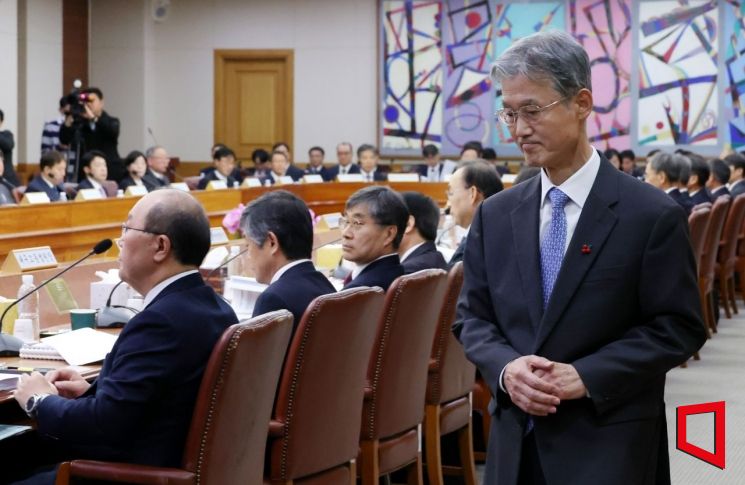 Chief Justice Cho Hee-dae is attending the National Court Presidents' Meeting held on the 15th at the Supreme Court Auditorium in Seocho-gu, Seoul. Photo by Joint Press Corps
The Court Administration Office (headed by Supreme Court Justice Chun Dae-yeop), which is the judicial administrative body under the Supreme Court, and the presidents of courts at all levels across the country began their regular national court presidents' meeting at around 2 p.m. in the main conference room of the Supreme Court building in Seocho-dong.
The main agenda of the meeting is expected to focus on the establishment of a special tribunal for insurrection cases and the introduction of the crime of judicial distortion, as the ruling party aims to pass the related bills within the year. Opinions on the proposal to abolish the Court Administration Office are also expected to be discussed.
Before the start of the meeting, Chief Justice Cho stated in his opening remarks, "If the judicial system is reformed in the wrong direction, the consequences could be direct and irreversible harm to the public. Therefore, it is desirable that judicial reforms be carried out with sufficient discussion and public debate, and be based on the careful judgment of experts with both theoretical and practical experience."
He continued, "The public's expectations and demands on the judiciary are heavier and greater than ever. At times like this, we must once again remind ourselves that the only way to regain the public's trust is to steadfastly fulfill the constitutional mission entrusted to us: to guarantee the people's fundamental rights through fair and swift trials."
On December 3, the National Assembly's Legislation and Judiciary Committee, led by the Democratic Party, passed bills to establish a special tribunal for insurrection cases and to introduce the crime of judicial distortion. The law to establish the insurrection tribunal provides for a special court to handle insurrection cases related to the December 3 Martial Law, in which former President Yoon Suk-yeol and others are implicated. The crime of judicial distortion allows for the punishment of judges or prosecutors who intentionally distort legal principles or manipulate facts in ongoing trials or investigations.
The National Court Presidents' Meeting brings together the presidents of courts at all levels (excluding the Supreme Court), as well as the head of the Court Administration Office, the head of the Judicial Research and Training Institute, and the head of the Judicial Policy Research Institute-making it a gathering of the highest-ranking judges from each institution.
This meeting is expected to focus on discussions regarding the establishment of the insurrection tribunal and the introduction of the crime of judicial distortion, as well as topics such as the potential abolition of the Court Administration Office, judicial administration, and strengthening judicial ethics. Typically, the court presidents' meeting covers reviews of judicial administration and reports on major work issues.
In September, the Supreme Court held an extraordinary national court presidents' meeting to discuss the Democratic Party's judicial reform initiatives. After the meeting, the court presidents issued an official statement declaring, "Judicial independence must be guaranteed," and "Judicial participation is essential in discussions on institutional reform."
© The Asia Business Daily(www.asiae.co.kr). All rights reserved.

















