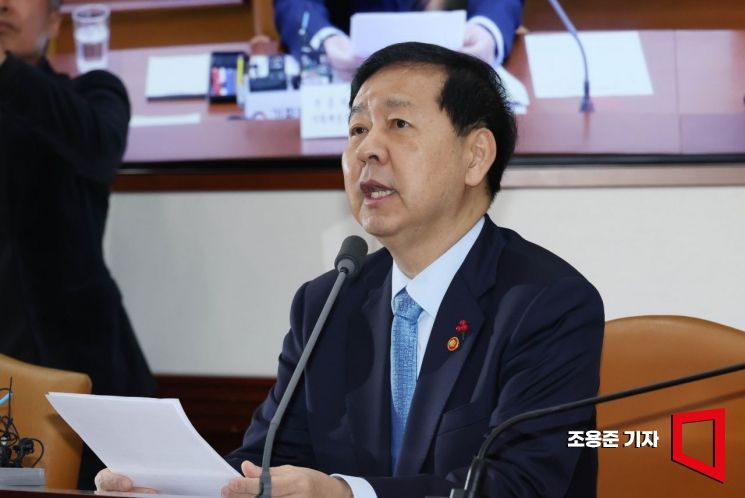
 Koo Yoon-chul, Deputy Prime Minister for Economy and Minister of Strategy and Finance, attended the Economic Ministers' Meeting and Price Ministers' Meeting held at the Government Seoul Office in Jongno-gu, Seoul on December 2, 2025, and made remarks related to consumer price trends. Photo by Jo Yongjun
On December 5, Koo Yoon-chul, Deputy Prime Minister for Economy and Minister of Economy and Finance, addressed the recent issue of the strong dollar, stating, "The fundamental solution is to make the domestic market more attractive so that it can become competitive in the long term."
Appearing on MBC Radio's "Kim Jongbae's Focus" that day, Deputy Prime Minister Koo was asked whether there was room to use policy tools in response to the strong dollar. He responded, "We need to enhance the competitiveness of companies and the country so that demand for our products increases and foreign investment rises, which will bring in more dollars. In the long term, we will strengthen national competitiveness to create an economy overflowing with foreign currency."
He added, "Although the current account surplus is close to 90 billion dollars, more money is flowing out due to overseas investments and other factors. In the short term, we will address the structural imbalance in foreign exchange supply and demand so that the market can stabilize."
When asked whether the National Pension Fund might be mobilized to defend the exchange rate, he emphasized, "The government will never intervene in the asset management of the National Pension Fund." Regarding the four-party consultative body formed by the Ministry of Economy and Finance and others, he explained, "As pension income increases, there is demand for dollars due to overseas investments during the asset management process. When it comes time to pay out pensions, dollars must be brought in, which can lead to a stronger won and a lower exchange rate. Taking these factors into account, we will create a 'new framework,' but the government will never intervene in asset management."
In response to a question about whether raising the corporate tax rate runs counter to global trends, he argued, "This is not a tax hike, but a normalization to the 2022 level, reversing the previous administration's cut. The logic that lowering corporate taxes will automatically lead to more investment by companies (and thus follow global trends) is flawed. Companies will not invest if they do not expect returns on their investments."
Addressing concerns that a higher corporate tax rate could increase the burden on businesses, he explained, "Even large corporations receive significant tax breaks for investments in high-tech strategic sectors. We have normalized the corporate tax system to create a virtuous cycle in which tax revenue is collected and then focused support is provided to such areas."
Regarding the reduction in the artificial intelligence (AI) and policy fund budgets in next year's budget bill, which was recently passed by the National Assembly, he said, "We adjusted the excessively increased portions," and explained, "AI-related investment will still increase to 10.3 trillion won next year, more than triple this year's 3.3 trillion won."
When asked whether the 8% increase in next year's budget could be considered expansionary fiscal policy, he replied, "This is not a simple expansion. We are increasing the budget for sectors that will help build a 'Great Korea,' such as AI innovation, to raise the country's growth potential, while also conducting the largest-ever restructuring of underperforming existing projects." When asked about the possibility of a supplementary budget next year, he declined to comment, saying, "The budget bill has just been passed."
Asked whether next year's local elections could affect the speed of budget execution, he dismissed the idea, saying, "We always focus on the economic aspect and do not take political considerations into account." He added, "We will ensure that the entire 728 trillion won budget is executed within the year to serve as a catalyst and foundation for economic growth and recovery."
Regarding the possibility of raising the growth forecast for next year, he said, "We have predicted a growth rate in the high 1% range, but the Organisation for Economic Co-operation and Development (OECD) is forecasting over 2%. We will review this again when we announce next year's economic management plan."
Addressing concerns about inflation due to the strong dollar, he stated, "We are managing this as our top priority by lowering tariffs or releasing government stockpiles. We will do our utmost to prevent difficulties caused by price instability."
© The Asia Business Daily(www.asiae.co.kr). All rights reserved.

















