First Meeting of the Resource Security Council
Three Core Strategies: Early Warning, Expanded Stockpiling, and Overseas Resource Development
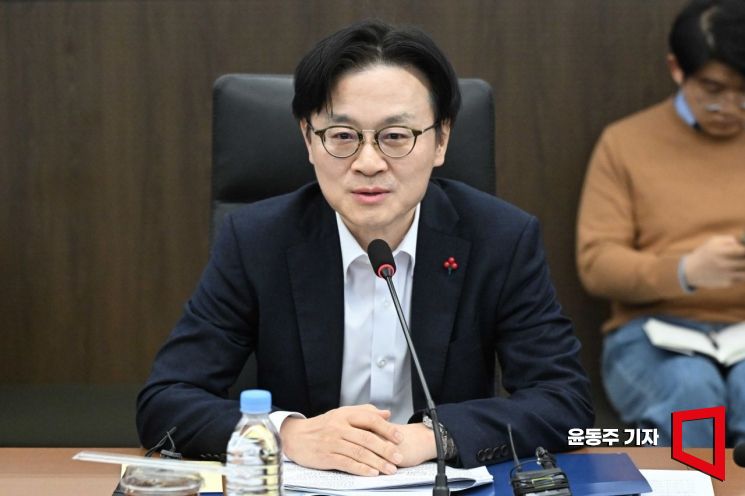 Kim Jeonggwan, Minister of Trade, Industry and Energy, is delivering a welcoming speech at the "M.AX Alliance-National Growth Fund Linked Meeting" held at the Korea Chamber of Commerce and Industry in Jung-gu, Seoul on December 4, 2025. Photo by Dongju Yoon
The government has officially launched the "National Resource Security Control Tower," a body dedicated to responding to crises in the energy and mineral resource supply chain, and has begun a sweeping overhaul of supply chain policies across all sectors, including crude oil, gas, and rare earth elements. This measure aims to establish an integrated national response system in light of persistent global geopolitical risks and ongoing instability in the supply and demand of critical resources.
On December 5, Kim Jeonggwan, Minister of Trade, Industry and Energy, announced at the first Resource Security Council meeting held at the Government Complex Seoul that the policy framework under the Special Act on National Resource Security would be fully implemented. At the meeting, the government reviewed five key agenda items: operational regulations, measures to strengthen national resource security, designations of core supply and demand institutions, a comprehensive plan for the rare earth element supply chain, and the fifth oil stockpiling plan.
Comprehensive Overhaul of Early Warning, Stockpiling, and Crisis Response
The Resource Security Council is an official decision-making body chaired by the Minister of Trade, Industry and Energy, with vice-ministerial level officials from related ministries such as the Ministry of Economy and Finance, Ministry of Foreign Affairs, and Ministry of Land, Infrastructure and Transport directly participating. The government will implement three core tasks centered around this body.
First, it will establish an early warning system based on an integrated database, shifting national risk response from reactive measures to proactive prevention and continuous monitoring. The core of this effort is the construction of a national resource security integrated information system that enables real-time analysis of supply, pricing, and demand for each critical resource.
The public-private joint crisis response system will also be strengthened. The government will designate oil, gas, and mineral companies as "core supply institutions" and key companies in industries such as semiconductors and automobiles as "core demand institutions," requiring them to immediately report any signs of abnormality to the government. This is to ensure that, in the event of supply disruptions or price spikes, the relevant companies, overseas embassies, and trade offices can respond simultaneously. Cyber and physical protection systems will also be reinforced.
Establishing a stable supply chain for critical resources is another key mission. The government announced that it will fully transition its overseas resource development policy to a "project-based" approach, designing country-specific policy packages to share risk with private companies. The government will increase the loan support rate for overseas resource development to 70% and expand the reduction rate in the event of exploration failure. The stockpile of critical minerals will be significantly increased from the current 100 days' worth to 180 days' worth. In natural gas stockpiling, a dual system will be introduced that imposes emergency stockpiling obligations on direct importers.
Reducing Complete Dependence on China for Rare Earth Elements
The most emphasized measure by the government on this day was the rare earth element supply chain. Rare earth elements are essential for Korea's core industries, such as electric vehicle motors, semiconductors, defense, and batteries. However, most processing and refining capacity is concentrated in China, making this the greatest supply chain risk for Korean industry. In response, the government has designated all 17 types of rare earth elements as critical minerals and has developed short-, medium-, and long-term response strategies.
In the short term, the government will strengthen export permit negotiations with China to reduce supply uncertainty, while expanding stockpiles and public preparedness systems. Import statistics for rare earth elements will be subdivided by element to improve the accuracy of supply chain analysis.
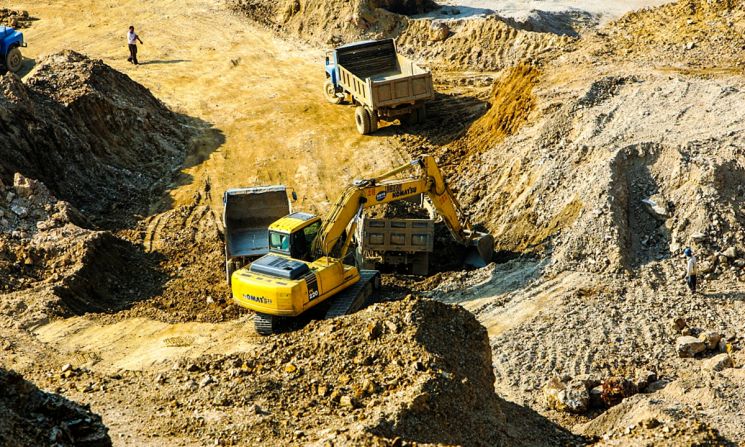
In the medium term, diversification of supply sources is key. The government is considering joint Korea-U.S. projects as part of strategic investment cooperation with the United States and will strengthen bilateral cooperation channels with countries such as Japan, Australia, Laos, and Malaysia. Joint investments will be actively pursued using overseas resource development loans, supply chain fund investments, and critical mineral funds.
In the long term, the focus will be on establishing a domestic production base and building a resource recycling ecosystem. The government will accelerate R&D for rare earth element refining and separation technologies and expand subsidies for investments in domestic production facilities. Standards for recycling using large appliance waste magnets will be established, regulations on the import of non-hazardous waste will be eased, and circular economy pilot projects will be promoted.
Through the "Fifth Oil Stockpiling Plan (2026-2030)," the government plans to expand oil stockpiles from 1.01 billion barrels in 2025 to approximately 1.026 billion barrels by 2030. In preparation for the anticipated peak in global demand, some heavy oil will be converted to light oil, and aging facilities will be replaced while strengthening safety management systems. The core focus is on upgrading the stockpiling system to prevent accidents, including replacing storage tanks and pipelines and improving fire and disaster response systems.
At the meeting, Minister Kim Jeonggwan emphasized, "Geopolitical risks surrounding critical minerals, including rare earth elements, are rapidly increasing amid strategic competition between China and the United States. The government will mobilize all available resources through this council to systematically strengthen resource security."
© The Asia Business Daily(www.asiae.co.kr). All rights reserved.


















