The Dark Side of Department Store Record Trading
Underground Deals Repeated Every Year-End
Evolving Schemes, Stagnant Crackdowns
Experts: "Obstruction of Business Charges May Apply"
"The cash receipt will be issued under my number, and the points will be credited to the buyer's number."

As the end of the year approaches, fraudulent transactions involving department store VIP customer qualification records are becoming increasingly rampant.
On December 8, when a potential buyer expressed interest to a seller online who was offering to transfer 5 million won worth of luxury goods purchase records for 5% of the transaction amount, the seller replied, "There are so many people who want to buy, so you'll have to wait," and added, "If the previous deal falls through, I will contact you again."
The department store VIP system assigns tiers based on annual purchase amounts and provides benefits such as lounge access, free parking, and discounts. Lotte Department Store will select next year's VIP customers based on accumulated purchases through the end of this month, while Hyundai Department Store and Shinsegae Department Store will do so based on amounts accumulated through the end of this year. Although the criteria differ by store, generally, customers need to accumulate between 5 million and 10 million won in annual purchases to receive even the lowest tier of VIP benefits. This structure has led to rampant fraudulent transactions, as customers lacking sufficient purchase records and sellers seeking cash discounts on high-priced items find their interests aligned.
The department store industry is also struggling to prevent fraudulent point accumulation. An official from Department Store A explained, "At the time of payment, we check the cardholder's identification to verify their identity, and we continuously monitor secondhand trading sites. If fraudulent use is confirmed, we impose sanctions according to our internal regulations."
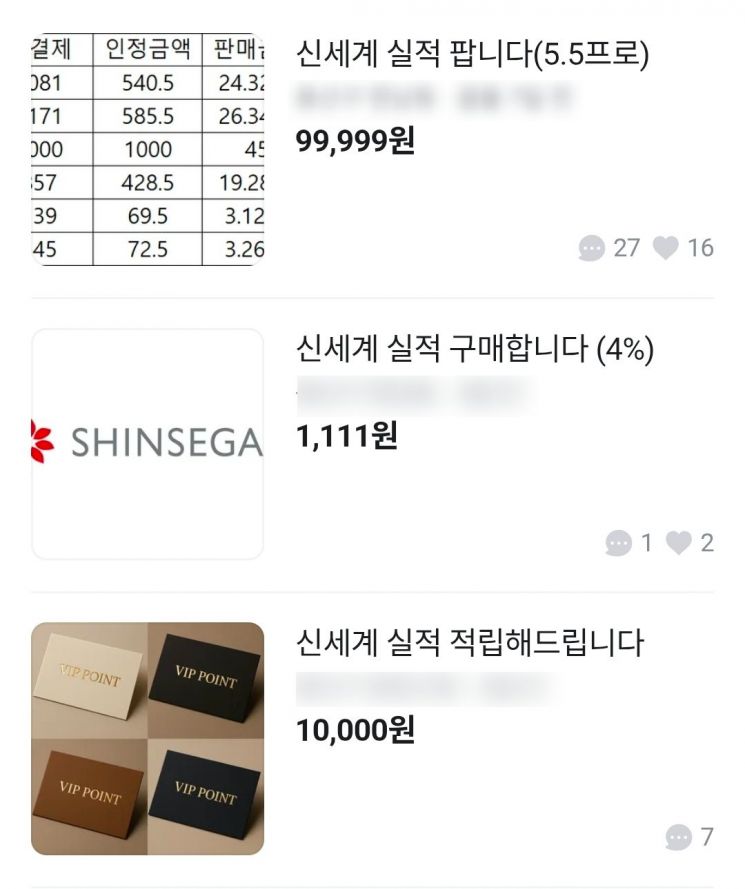 Department store sales performance on the secondhand trading platform. Screenshot from Danggeun Market
However, methods to evade monitoring are becoming increasingly sophisticated. As exchanging receipts for post-purchase point accumulation has become easier to detect, a new method called "on-site proxy payment" has emerged, where the seller meets the buyer in person at the store and makes the payment on their behalf. This method exploits the fact that transactions conducted inside the store are virtually impossible to detect.
Experts point out that trading department store purchase records can be subject to criminal penalties. Shin Minyoung, an attorney at Hoam Law Firm, stated, "If fraudulent point accumulation is prohibited in the department store's terms and conditions, and it is determined that such actions interfere with business operations, charges of obstruction of business may apply." Jang Jinhwan, a professor at Dankook University Law School, added, "There is a possibility that the crime of obstruction of business by fraudulent means could be established," but also noted, "There may be practical limitations for department stores in directly proving such cases."
© The Asia Business Daily(www.asiae.co.kr). All rights reserved.


















