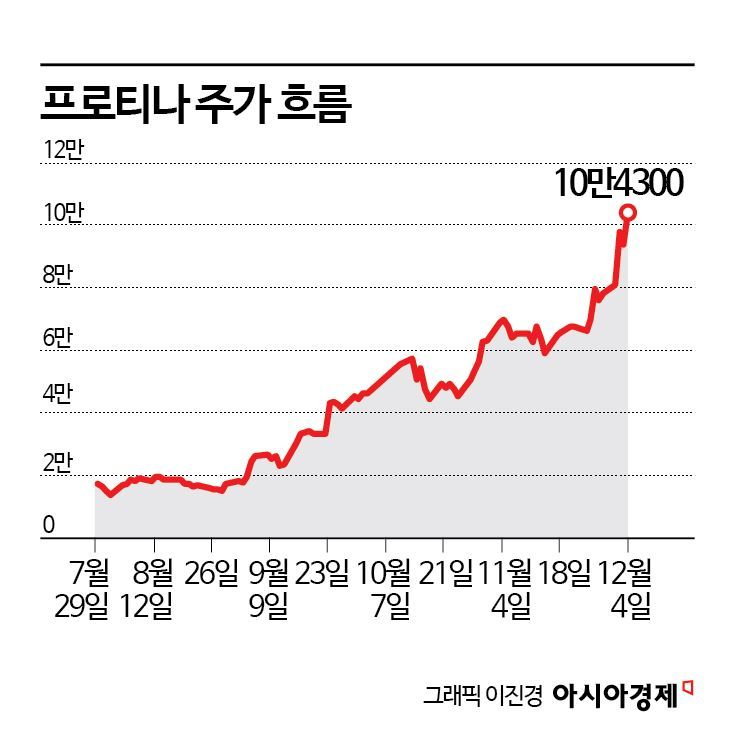
Proteina listed at an IPO price of 14,000 won on July 29
Stock price surpasses 110,000 won in just four months
JP Morgan reduces stake within a week after reporting 5% ownership in September
The corporate value of Proteina, a biotech company specializing in protein-protein interaction (PPI) big data, has been rapidly increasing. Just over four months after its listing on the KOSDAQ market on July 29, its market capitalization has grown more than sevenfold.
According to the financial investment industry on December 5, Proteina's stock price has risen 645% compared to its initial public offering price of 14,000 won. During the previous trading day, it reached an all-time high of 112,500 won at one point, setting a new post-listing record. The market capitalization has surpassed 1.14 trillion won. Since the listing, individual investors have recorded a cumulative net purchase of 146.9 billion won, driving the stock price upward. The average purchase price for individual investors is 34,967 won, resulting in an evaluated return rate of 198%.
Proteina, founded in 2015 as a faculty startup from the Korea Advanced Institute of Science and Technology (KAIST), succeeded in commercializing the world's first 'SPID Platform,' which can analyze protein-protein interactions at the single-molecule level. The SPID Platform enables single-molecule PPI analysis with an extreme level of sensitivity. Based on this, Proteina offers 'PPI Pathfinder,' a clinical big data solution, and 'PPI Landscape,' an antibody-antigen big data solution. These solutions cover the entire new drug development cycle, from the early discovery stage to clinical phases.
Pathfinder uses PPI complexes as biomarkers to help determine the optimal dosage through analysis of drug mechanisms of action and pharmacodynamics. It can also be used for biomarker development to predict drug response and for companion diagnostics based on biomarkers.
Landscape is a solution that enables everything from antibody optimization to antibody design, based on antibody-antigen PPI big data. It is used to enhance the value of existing antibodies through optimization and to redesign already approved blockbuster antibody drugs into new drug candidates with improved efficacy and safety.
Wihe Ju, a researcher at Korea Investment & Securities, explained, "Proteina's SPID Platform allows three researchers to analyze 3,000 to 5,000 antibodies every week," describing it as "overwhelmingly faster than competitors." He added, "It is a core technology that can verify the binding affinity, thermal stability, and productivity of AI-generated antibody biobetter sequences in the shortest possible time. As a result of SPID, we can expect not only academic publications and expanded contracts but also actual technology transfer."
Kwon Hae-soon, a researcher at Eugene Investment & Securities, analyzed, "The key to AI drug development is not the AI drug development model itself, but building sufficient valid data. Proteina's SPID Platform is a technology that can produce large-scale, high-quality, and diverse antibody-antigen data, which is essential for constructing a valid AI drug development model."
While Proteina's stock price has steadily risen since its listing, there is some regret regarding the timing of JP Morgan Asset Management's sale of its stake, which once exceeded 5%. On September 3, JP Morgan disclosed that it held 5.16% (560,500 shares). In another disclosure on September 10, it announced that it had sold 2.27% (246,029 shares) on the open market. The shares were disposed of at around 26,000 won per share.
© The Asia Business Daily(www.asiae.co.kr). All rights reserved.

















