Initial Sentence: 7 Years and 6 Months, Reduced to 5 Years on Appeal
Court Recognizes "Ideal Concurrence," Rejects Sudden Unintended Acceleration Claim
The driver involved in the so-called "City Hall Station Wrong-Way Accident," which resulted in 14 casualties last July, has received a final sentence of five years in prison from the Supreme Court.
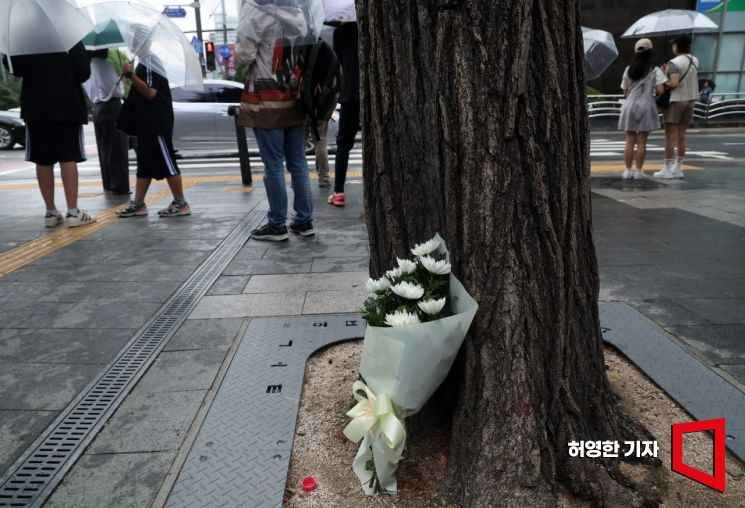 On the night of the 1st, near Seoul City Hall, a passenger car drove the wrong way at an intersection and struck pedestrians, resulting in 9 deaths. On the morning of the 2nd, someone placed chrysanthemums near the accident site. Photo by Heo Younghan younghan@
On December 4, the Supreme Court's Second Division (Presiding Justice Kwon Youngjun) upheld the lower court's ruling, sentencing Cha, a man in his 60s, to five years in prison for charges including violation of the Act on Special Cases Concerning the Settlement of Traffic Accidents (resulting in death). A prison sentence entails incarceration in a correctional facility, but unlike imprisonment with labor, forced labor is not imposed.
On July 1 of last year, Cha drove his vehicle in the wrong direction near City Hall Station in Jung-gu, Seoul, veered onto the sidewalk, and crashed into two vehicles and several pedestrians. The accident resulted in nine deaths and five injuries.
Cha claimed that sudden unintended acceleration had occurred, but the court of first instance found that "none of the characteristic signs of sudden unintended acceleration were detected." The court viewed each victim's accident as a separate crime and determined it constituted substantive concurrence, sentencing Cha to the statutory maximum of seven years and six months. Substantive concurrence refers to a situation where a person commits multiple violations of the law; in such cases, the sentence can be increased up to half of the most severe penalty applicable.
The appellate court also rejected the claim of sudden unintended acceleration but ruled that the deaths and injuries constituted ideal concurrence, reducing the sentence to five years in prison. Ideal concurrence refers to a situation in which a single act constitutes multiple offenses; in this case, sentencing is based on the penalty for the most serious offense.
Both Cha and the prosecution appealed, but the Supreme Court dismissed the appeals, finding no error in the lower court's judgment. The Supreme Court stated, "The lower court's determination that this accident constituted ideal concurrence arising from a single act of driving, in accordance with social norms, does not reflect any misunderstanding of the legal principles regarding concurrence of offenses."
© The Asia Business Daily(www.asiae.co.kr). All rights reserved.

















