Korean Diabetes Association Subdivides Severity into Four Grades and Stages
"Current System Makes It Difficult to Assess Disease Risk"
For the first time, criteria have been established to objectively assess the severity of diabetes. This is because the current classification system makes it difficult to determine the risk level of severe diabetes, highlighting the need to subdivide the criteria and strengthen management.
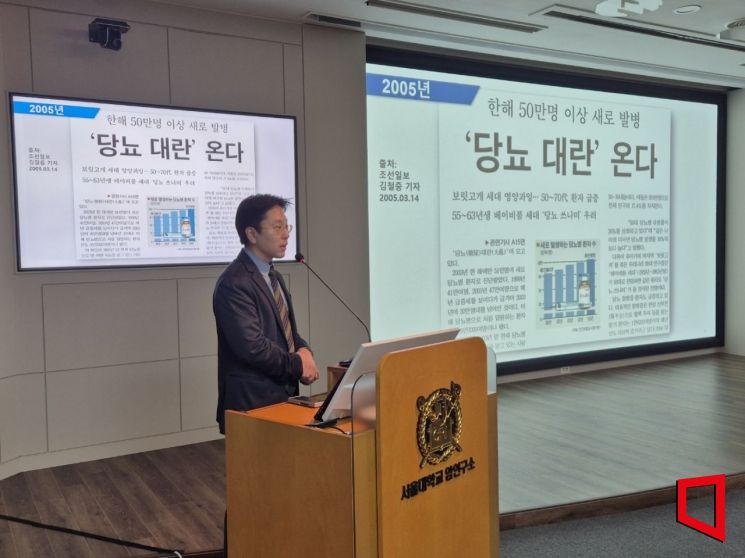 Lee Yongho, Executive Director of the Korean Diabetes Association and Professor of Endocrinology at Severance Hospital, is advocating for the need to improve the diabetes classification system at the symposium titled "Strengthening Severe Diabetes Management and Exploring Strategies for Classification System Improvement," held on the 3rd at the Seoul National University Cancer Research Institute in Jongno-gu, Seoul. Photo by Choi Taewon
The Korean Diabetes Association announced at a symposium titled "Strengthening Severe Diabetes Management and Exploring Strategies for Classification System Improvement," held on the 3rd at the Seoul National University Cancer Research Institute in Jongno-gu, Seoul, in collaboration with the Korea Medical Bio Journalists Association, that criteria should be established to objectively assess the severity of diabetes.
Diabetes is largely divided into type 1 and type 2 based on its cause. Under the current classification system, patients are generally classified as severe if they have complications, and mild if they do not. However, there are limitations because the degree of severity varies significantly between patients, making it difficult to accurately assess the risk of the disease. In response, the Association has developed criteria for a classification system that evaluates both the quantitative degree of metabolic abnormality ("grade") and the cumulative extent of organ damage caused by complications ("stage"). This new classification system was developed by the Association's Severe Diabetes Task Force Team and has been published in the international journal "Diabetes & Metabolism Journal."
The first assessment criterion of the "Diabetes Grade-Stage Classification (DGSC)" is the "metabolic grade." This quantifies the degree of insulin deficiency and resistance; insulin secretion is measured by C-peptide levels, and insulin resistance is assessed by daily insulin usage, dividing patients into four grades. Grade 1 is the initial stage, manageable with lifestyle modification or oral medication; Grade 2 is a moderate stage requiring multiple medications; Grade 3 is a severe stage requiring insulin injections; and Grade 4 is an ultra-severe stage where insulin secretion is nearly absent or extreme resistance is present.
The second criterion, "complication stage," complements the metabolic grade by assessing the extent of major organ damage-including the heart, kidneys, eyes, and nerves-caused by diabetes. The assessment includes cardiovascular disease, heart failure, chronic kidney disease, diabetic retinopathy, and neuropathy. Stage 1 is a state with no complications but with risk factors such as hypertension or obesity; Stage 2 is an early complication stage detected only through tests; Stage 3 is when clinical symptoms such as angina, impaired kidney function, or vision abnormalities are confirmed; and Stage 4 is a life-threatening advanced stage with conditions such as myocardial infarction, end-stage renal failure, or blindness.
The research team believes that, based on these criteria, cases with severely impaired insulin function or significant organ damage should be considered severe. Cho Youngmin, Director of Legislation for the Association and Professor of Endocrinology and Metabolism at Seoul National University Hospital, who led the research, stated, "Based on the metabolic grade and complication stage, the Association defines 'severe diabetes' as grade 3 or higher, or stage 3 or higher."
Cha Bongsoo, President of the Association and Professor of Endocrinology at Severance Hospital, explained, "Although various medical professionals treat diabetes, there have been no clear criteria for when to refer patients to diabetes specialists. Under the newly announced severe diabetes classification system, if a patient is classified as severe, referral to a diabetes specialist is recommended."
The Association plans to publish the "2025 Diabetes Clinical Guidelines" to provide standard treatment protocols, strengthen coverage by recognizing pancreatic dysfunction in type 1 diabetes, and establish institutional foundations such as evidence-based in-hospital blood glucose management centers.
Lee Yongho, Executive Director (Professor of Endocrinology at Severance Hospital), stated, "Through this symposium, we aim to establish the concept of severe diabetes and take the lead in building a system that enables personalized treatment and prevention for patients." He added, "The Association will spearhead evidence-based policy proposals and clinical improvements to raise the national standard of diabetes management."
© The Asia Business Daily(www.asiae.co.kr). All rights reserved.

















