Embrain Trend Monitor Survey: Office Workers' Lunch Perceptions
Honbap Rate: 57.2% in Their 20s vs. 42.4% in Their 50s
Entry-Level Employees 55.6% vs. Department Heads and Above 29.6%
"Lunch Alone Is Effective for Relieving Stress"
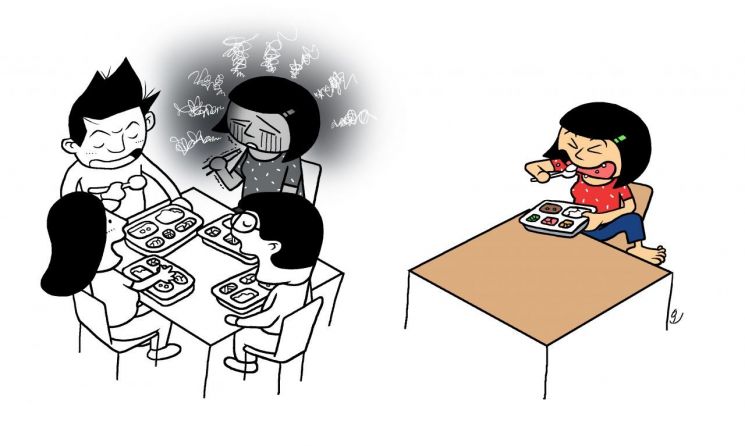
Eating alone, known as "Honbap," is a prevailing trend among younger people, but the proportion of those who eat alone decreases with age and higher job positions.
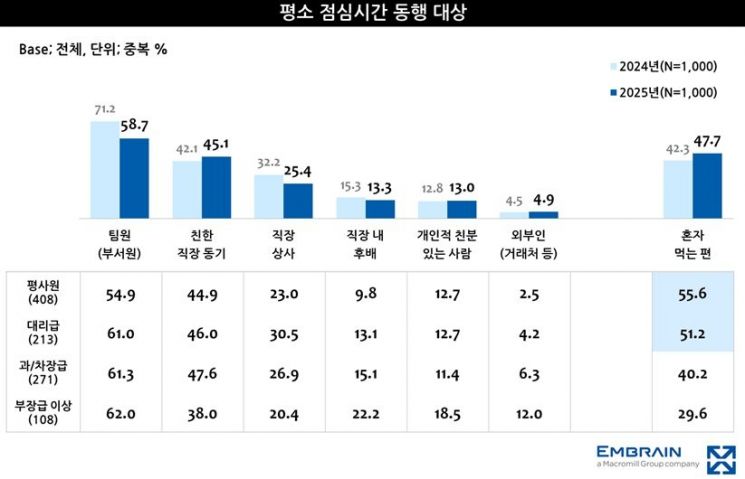
On December 2, market research firm Embrain Trend Monitor released the results of its "2025 Office Workers' Lunch Perception Survey," conducted among 1,000 office workers nationwide aged 19 to 59. According to the findings, most people usually spend their lunch breaks with team members (58.7%, multiple responses allowed), close colleagues (45.1%), or supervisors (25.4%). However, the rate of eating alone (Honbap) has increased slightly compared to previous surveys. This trend was particularly pronounced among younger workers and those in lower job positions. By age group, the rates were 57.2% for those in their 20s, 51.2% for those in their 30s, 40.0% for those in their 40s, and 42.4% for those in their 50s. By job position, 55.6% of entry-level employees, 51.2% of assistant managers, 40.2% of managers or deputy managers, and 29.6% of department heads or higher reported eating alone.
There was also a strong perception that eating lunch alone is effective for relieving work-related stress. By age group, 65.6% of those in their 20s, 65.2% of those in their 30s, 49.2% of those in their 40s, and 45.2% of those in their 50s agreed. By job position, 65.0% of entry-level employees, 62.9% of assistant managers, 47.2% of managers or deputy managers, and 33.3% of department heads or higher shared this view. This suggests a clear trend of using lunchtime as a period for personal recharging rather than for building relationships with colleagues.
When asked about lunch menus that have gained popularity, respondents mainly cited healthy or diet-friendly options (41.3%, multiple responses allowed) and dishes that are easy to eat alone (40.5%). More than half (50.1%, agreement rate) recognized the trend of having light meals such as salads or sandwiches. As the rate of eating alone rises, there is a growing tendency to have lunch in a way that suits individual preferences-conveniently and healthily.
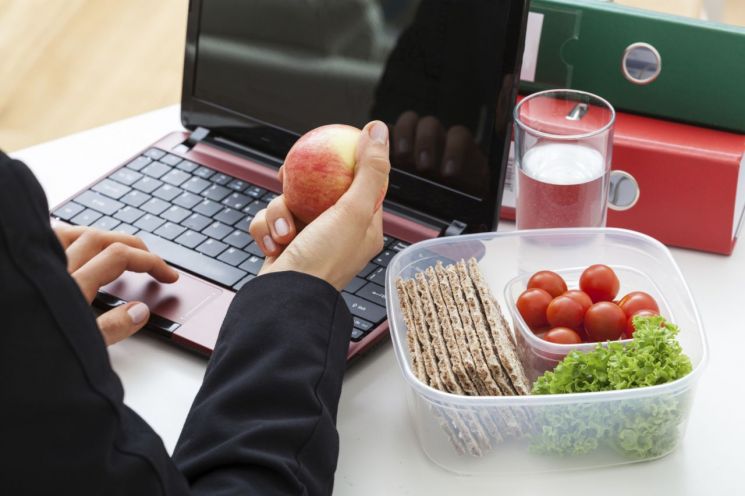 Lunch menu items that have gained increased interest among office workers include healthy foods such as salads and sandwiches. Getty Images
Overall, it was found that office workers are currently spending an average of 9,000 to 10,000 won per lunch. There was a slight increase in the perception that more people are having simple meals from convenience stores rather than dining at restaurants (47.0% in 2024 → 54.1% in 2025). Additionally, the belief that fewer people are having proper lunches due to rising prices also increased (45.8% in 2024 → 50.8% in 2025). The response rate indicating that more people around them feel burdened by meal costs also rose (65.8% in 2024 → 67.5% in 2025), suggesting that the burden of lunch expenses is increasing due to higher prices.
In particular, office workers in Seoul were more likely to use convenience stores or ready-to-eat meals (33.4% in Seoul, 27.2% in Incheon/Gyeonggi, 23.8% in other regions), or to bring their own lunch boxes and adjust their lunch patterns (30.4% in Seoul, 23.8% in Incheon/Gyeonggi, 23.0% in other regions). This indicates that office workers in the Seoul metropolitan area are feeling greater pressure from relatively high dining-out costs.
© The Asia Business Daily(www.asiae.co.kr). All rights reserved.
![Clutching a Stolen Dior Bag, Saying "I Hate Being Poor but Real"... The Grotesque Con of a "Human Knockoff" [Slate]](https://cwcontent.asiae.co.kr/asiaresize/183/2026021902243444107_1771435474.jpg)


















