Party-Government Consultation Held on Stablecoin Legislation
Consortium with 51% Bank Equity Set as Issuer
Ando Geol: "Issuer Structure Should Allow Multi-Sector Participation"
For the first time, the Democratic Party of Korea has voiced opposition to the government-party consultation that reached a consensus to designate a "consortium with 51% bank equity" as the issuer of stablecoins. The concern is that, due to the entrenched interests of traditional payment networks and an operational approach centered on regulation and risk management, stablecoins could be reduced to the level of existing digital deposits.
Ando Geol, a member of the National Assembly's Strategy and Finance Committee and Executive Vice Chairperson of the Democratic Party's Policy Committee, held a press conference at the National Assembly Communication Office that morning, stating, "In order to properly establish an innovative financial platform, above all, the issuer design must be prepared in an open and competitive structure."
Previously, the Democratic Party held a party-government consultation the previous day and coordinated positions among the Bank of Korea, the Financial Services Commission, and the banking sector regarding the stablecoin issuer issue, settling on a "consortium structure." They agreed that, in forming the consortium, banks would hold a 51% equity stake. This represents a compromise between the financial authorities' plan to restrict issuers to banks and various legislative proposals encouraging broader market participation. Other details will be discussed later if the government submits a bill by the 10th.
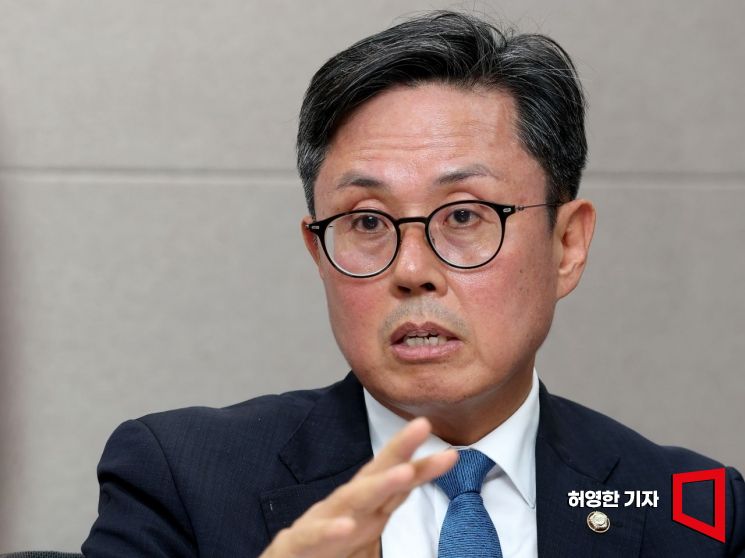 Ando Geol, a member of the Democratic Party of Korea, held a press conference at the National Assembly Communication Office on the 2nd and stated, "In order to properly establish an innovative financial platform, above all, the issuer design must be prepared in an open and competitive structure." He expressed opposition to the "consortium formation with 51% bank equity" tentatively agreed upon by the ruling party and the government. Photo by Heo Younghan
Assemblyman Ando stated, "Stablecoins are a national strategic institutional asset that creates new payment and exchange demand, drives the Web3 and fintech industries as high value-added growth sectors, and builds a digital financial infrastructure with global competitiveness. To permit only bank-centered consortia is, in effect, to abandon innovation."
He argued that, as a latecomer lagging behind major countries such as the United States, the European Union, and Japan, Korea must design the issuer structure in an open and competitive way that enables innovative services, global scalability, and user benefits in order to survive in the global market. Assemblyman Ando insisted that, to this end, the principle should be "multi-sector participation," allowing not only bank-centered consortia but also participation from non-bank financial institutions, fintech companies, blockchain technology firms, and digital distribution platforms.
Regarding the financial authorities’ concerns about potential stability issues arising from multi-sector participation, Assemblyman Ando emphasized, "Requirements for issuer eligibility, 100% reserve backing with safe assets and real-time verification, transparency in issuance and redemption procedures, and the establishment of foreign exchange and anti-money laundering (AML) control systems are all mechanisms that can be fully implemented within the current financial and foreign exchange supervisory framework."
© The Asia Business Daily(www.asiae.co.kr). All rights reserved.
![Clutching a Stolen Dior Bag, Saying "I Hate Being Poor but Real"... The Grotesque Con of a "Human Knockoff" [Slate]](https://cwcontent.asiae.co.kr/asiaresize/183/2026021902243444107_1771435474.jpg)
















