Visualizing Plastic Ingestion and Entanglement Among Large Marine Animals
Plastic cups and discarded fishing nets carelessly thrown into the sea have become the most lethal 'shadow killers' for marine life.
The Korea Institute of Ocean Science and Technology (KIOST, President Lee Heeseung) has published a visual booklet titled "Poison and Trap of the Sea: Plastic," which organizes scientific survey results into visual materials to help the public more easily understand the damage suffered by marine animals due to medium and large-sized plastics.
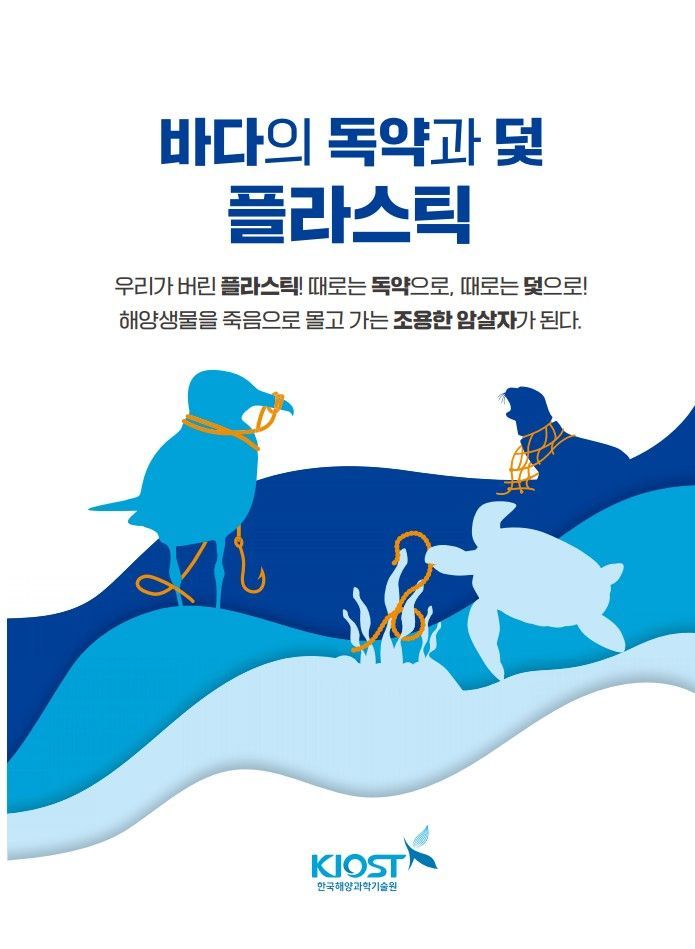
This booklet comprehensively covers cases of plastic ingestion by marine protected species such as sea turtles and seabirds, as well as the current status of entanglement damage among large marine animals.
In particular, the booklet analyzes detailed characteristics such as the shape, color, and material of plastics retrieved from the digestive tracts of marine animals, making it easy to identify the types of plastics ingested at a glance.
It also statistically summarizes the main causes of entanglement damage-such as discarded fishing gear, ropes, and fishing lines-and the occurrence patterns by biological group. Additionally, it compares survey results from domestic waters and major overseas regions, providing a multifaceted view of the level of pollution and ecological vulnerability of Korea's seas.
The research team led by Dr. Jang Mi and Dr. Noh Heejin at the Southern Sea Research Institute's Ecological Risk Research Division in KIOST has been conducting studies to scientifically determine the impact of marine plastic waste on ecosystems. In particular, they are leading research on the damage caused by medium and large-sized plastics, which have received relatively little attention so far. Medium and large-sized plastics not only break down into microplastics over time, causing secondary pollution, but also directly harm marine life through ingestion or entanglement.
The research team has established survey and evaluation methods to systematically assess the pollution characteristics of floating plastic waste and has quantified the pollution level and spatial distribution across all Korean waters, producing the nation's first floating plastic pollution map.
They also identified the ecological causes of plastic ingestion through behavioral experiments on sea turtles and developed techniques to analyze the structure and function of biological communities that use medium and large-sized plastics as new habitats. This has enabled them to assess the potential spread of invasive and harmful species and propose necessary management strategies.
Going forward, alongside microplastic research, the team plans to accumulate long-term data on various cases of ingestion and entanglement damage to marine life caused by medium and large-sized plastics, thereby expanding their research scope to ecosystem-level risk assessments of marine waste.
Dr. Noh Heejin, who published the visual booklet, stated, "I hope this booklet will serve as a key resource to inform the public about the importance of marine ecosystem conservation," and added, "We expect it will contribute to raising awareness and alertness among the public in the field of marine environmental education and outreach."
The booklet can be downloaded from the publications section of the KIOST website.
© The Asia Business Daily(www.asiae.co.kr). All rights reserved.

















