CCEJ Analyzes Six Years of State-Owned Asset Auctions
"9.077 Billion Won Appraised Value, Sold at a Discount of 1.768 Billion Won"
During the administration of President Yoon Suk-yeol, it has been revealed that a large volume of state-owned assets were sold off at significantly discounted prices. There have been several confirmed cases where prime real estate in the heart of Seoul’s Gangnam district was sold to private entities for tens of billions of won below market value. Critics point to the lack of transparency in the criteria and procedures for selling state-owned assets as the root cause. Last month, President Lee Jaemyung ordered a complete halt to the sale of state-owned assets.
According to an analysis of state-owned asset auction sales released by the Citizens’ Coalition for Economic Justice on December 2, there were 357 successful bids for such assets between 2020 and 2022, under the Moon Jae-in administration. The total appraised value of these assets was 58.1 billion won, while the winning bid amount reached 63.3 billion won, resulting in a bid-to-appraisal ratio of approximately 109%.
However, during the Yoon Suk-yeol administration from 2023 to 2025, the number of successful bids surged to 2,307, more than six times the previous three-year period. The total appraised value of these assets was 849.5 billion won, but the winning bid amount was only 667.5 billion won, with the bid-to-appraisal ratio dropping to 79%. In August 2022, shortly after President Yoon took office, the government announced a plan to “activate the sale and utilization of idle and underutilized state-owned assets.” After this, state assets were reportedly sold off indiscriminately at low prices.
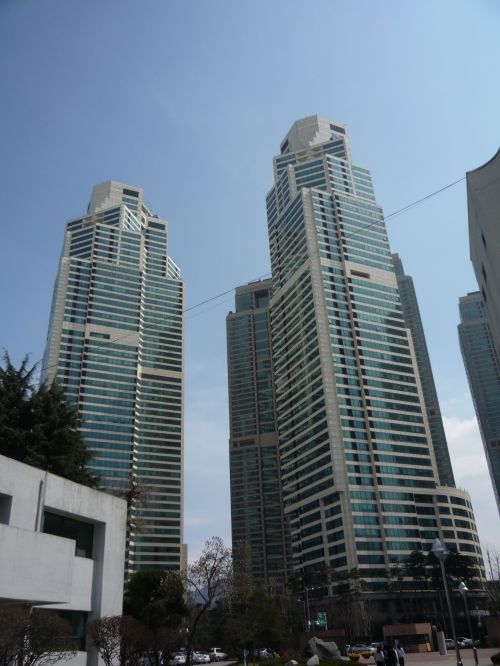
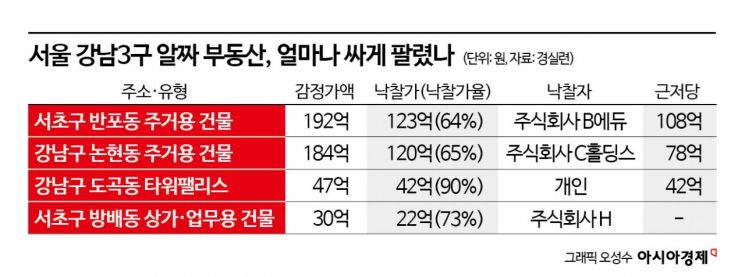
Prime real estate in the three Gangnam districts of Seoul was no exception. In Banpo-dong, Seocho-gu, a residential building appraised at 19.2 billion won was sold for 12.3 billion won to a company believed to be involved in private education. In Nonhyeon-dong, Gangnam-gu, a residential building valued at 18.4 billion won changed hands for 12 billion won.
The Tower Palace in Dogok-dong, appraised at 4.7 billion won, was sold for 4.2 billion won. It is believed that an individual financed the entire purchase with loans from IBK Industrial Bank of Korea and other lenders. In Bangbae-dong, a commercial and office building appraised at 3 billion won was sold for just 2.2 billion won to a private company.
The Citizens’ Coalition for Economic Justice argued, “These properties are located in areas where simply holding them increases their value, yet the government sold them off indiscriminately. Instead of reckless sales, public institutions could have used these assets for public-interest projects, or housing corporations could have developed public housing on the land.”
There are calls to strengthen the criteria for selling state-owned assets and to establish a robust management system. Within government ministries and agencies, there are ongoing discussions about revising the system so that the sale of state-owned assets is subject to review by the president or a separate consultative body, depending on certain criteria. The Citizens’ Coalition for Economic Justice warned that if the current proposal to require review only for properties valued at 10 billion won or more is adopted, it would be ineffective, as assets above this threshold accounted for just 0.3% of all sales over the past six years.
The coalition also pointed out that a lack of transparency in sales information has led to inconsistencies even among government departments and public institutions. For example, the Korea Asset Management Corporation (KAMCO) sold land cheaply to the private sector, only for Korea Land and Housing Corporation (LH) to later purchase housing built on that land at a high price through a lease-purchase arrangement. This practice of selling low and buying high has depleted state finances. Additionally, over 90% of transactions were conducted through private contracts, and agencies have been reluctant to provide information even when requested by the National Assembly and other bodies.
© The Asia Business Daily(www.asiae.co.kr). All rights reserved.



















