Lithuania vs. Belarus Border Dispute Intensifies
Eastern European Flights Paralyzed... "Russian Hybrid Strategy"
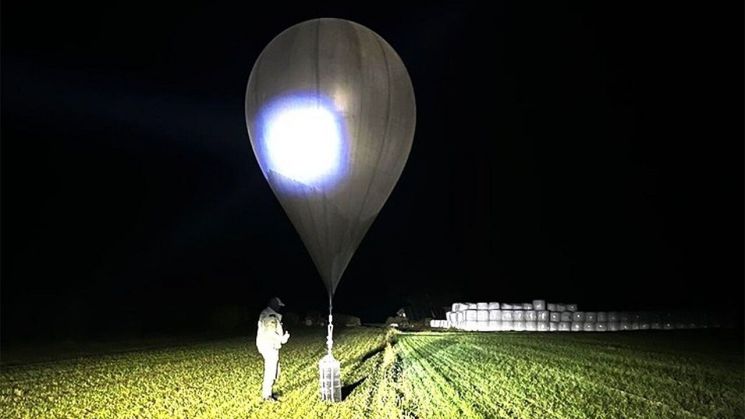 A Lithuanian soldier inspecting a balloon that crossed the border last October. Lithuanian Border Guard
Border disputes have erupted as balloons launched from Belarus have paralyzed the airspace over the Baltic Sea and other Eastern European countries. Member states of the European Union (EU) and the North Atlantic Treaty Organization (NATO) have protested, accusing Belarus of deliberate military provocation. Conversely, the Belarusian government has countered by claiming that drones from NATO member states have violated its own airspace.
Lithuania and Belarus in Border Dispute Over Balloons... Each Side Accuses the Other of Incursion

On December 1 (local time), Lithuanian media outlet Delfi reported that more than 60 Belarusian balloons gathered over Vilnius Airport, disrupting air traffic for over 11 hours. Thirty-one flights were canceled, nine were delayed, and ten were diverted to other airports. More than 7,400 passengers were stranded, causing significant confusion.
Since October, hundreds of balloons from Belarus have repeatedly paralyzed flights to and from Vilnius Airport, with over 110 flights canceled last month alone. The BBC reported that "balloons sent from Lithuania reach altitudes of 3,000 to 4,000 meters, posing a very high risk of collision with passenger planes," and that "with dozens of balloons appearing at once, it was nearly impossible for aircraft to operate."
Belarusian smuggling organizations have previously used balloons to smuggle cigarettes, as cigarette prices in Lithuania are about 4.5 times higher than in Belarus, leading to occasional interceptions of smuggling balloons. However, since October, Lithuanian border guards have captured hundreds of balloons, including some used for meteorological observation, leading the Lithuanian government to suspect that Belarus is deliberately sending balloons. In protest against Belarus, the Lithuanian government closed its border checkpoints entirely from October 30 to November 20 before reopening them.
The Belarusian government, on the other hand, has closed its own borders, claiming that Lithuanian drones have violated its airspace. The Belarusian Ministry of Foreign Affairs even summoned Erik Vilkanevicius, Lithuania's acting ambassador, to lodge a protest over the airspace violation. The Ministry stated, "A Western European reconnaissance drone flown from Lithuania entered Belarusian airspace and dropped extremist propaganda leaflets," adding, "We consider this a deliberate provocation against Belarus."
Is Russia Behind Belarus? ... "Tactical Nuclear Weapons Could Be Used in an Emergency"
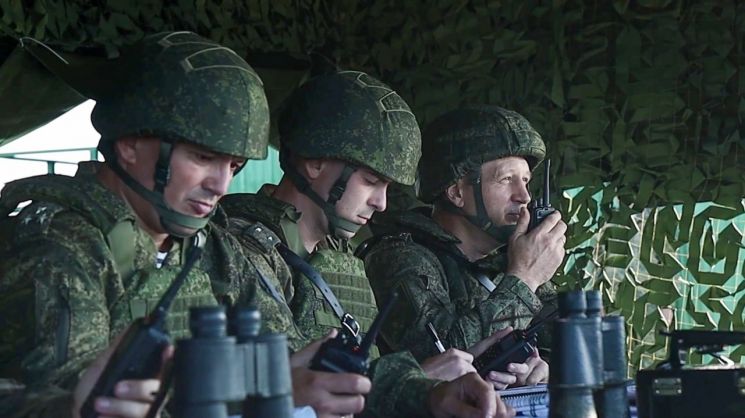 In September, Belarusian troops conducting joint exercises with Russian forces. Photo by TASS Yonhap News
Authorities in the EU and NATO suspect that Russia may be behind Belarus's balloon provocations and are concerned about possible Russian intervention in the future. Belarus is widely regarded as a de facto satellite state of Russia, and with the two countries having signed a mutual security treaty in March, Russia now has grounds for automatic involvement in any border dispute involving Belarus.
According to TASS, the Russia-Belarus mutual security treaty stipulates that both countries will take appropriate retaliatory measures if attacked by a third country, and it even includes provisions for the use of Russian tactical nuclear weapons in Belarus if deemed necessary for Belarusian security. It is believed that Russian tactical nuclear weapons are currently deployed in Belarus.
Belarusian President Alexander Lukashenko stated at a press conference early last month, "We exchanged nuclear weapons with Russia, sending our old weapons to Russia and bringing in the latest ones." Analysts believe that Belarus has swapped its old Soviet-era nuclear weapons for Russia's latest nuclear arsenal.
The EU, wary of Belarus's actions, has announced plans for additional sanctions. Ursula von der Leyen, President of the European Commission, said at a recent meeting addressing the situation at the Lithuanian border, "Incidents of Belarusian balloons entering Lithuanian airspace are increasing. We cannot tolerate Belarus's hybrid attacks, and we are preparing further measures against Belarus." Hybrid attacks refer to operations that paralyze an adversary's infrastructure and transportation networks through various forms of military provocation rather than conventional warfare.
© The Asia Business Daily(www.asiae.co.kr). All rights reserved.
![Clutching a Stolen Dior Bag, Saying "I Hate Being Poor but Real"... The Grotesque Con of a "Human Knockoff" [Slate]](https://cwcontent.asiae.co.kr/asiaresize/183/2026021902243444107_1771435474.jpg)


















