Mayor Lee's 2026 Policy Address
Restoring Daily Life for Residents Through Disaster Recovery
Driving Sancheong's Development with Seven Strategic Goals
"The year 2026 will be a crucial one for Sancheong to rise again and achieve a new leap forward. We will focus the full capacity of county administration on overcoming disasters and revitalizing the local economy, creating changes that residents can truly feel."
Lee Seunghwa, Mayor of Sancheong County, stated this during his administrative speech at the 310th Sancheong County Council 2nd Regular Meeting held on December 1, presenting the direction for next year's county administration.
First, Mayor Lee highlighted this year's major achievements, including securing 209.5 billion won in national and provincial funds for water and sewage projects, ranking 9th nationwide and 1st in the province in agricultural budget (173.1 billion won), securing an additional 19.3 billion won in special disaster recovery grants, implementing the province’s first full free rural bus service, operating a civil complaint response team, being selected as the only local government in the province for regional tourism growth, and Donguibogam Village being chosen for the 2025-2026 Korea Tourism Top 100.
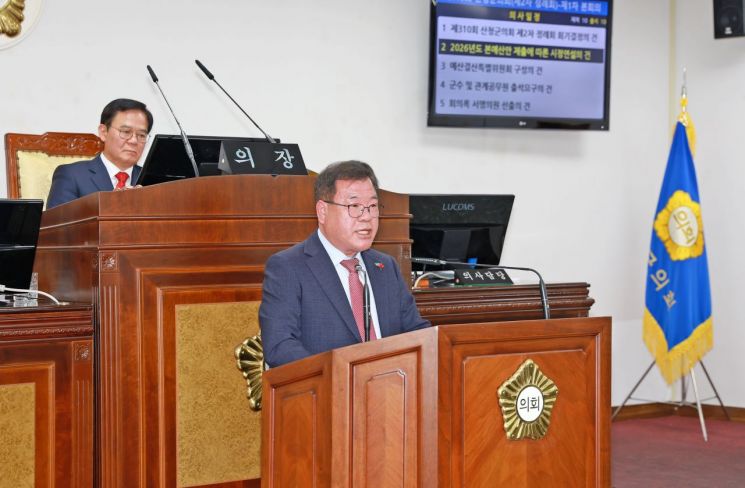 Lee Seunghwa, Sangcheong County Governor, is delivering the administrative speech at the 310th Sangcheong County Council 2nd regular session.
Despite difficult circumstances such as recovery from damages and worsening economic conditions, he announced seven strategic goals for 2026 to turn crisis into opportunity.
The seven strategic goals are: ▲ Completion of disaster recovery and strengthening disaster prevention infrastructure ▲ Revitalization of the local economy and fostering future growth industries ▲ Increasing farm household income and realizing sustainable future agriculture ▲ Advancing as a wellness tourism, culture, and sports city ▲ Implementing welfare policies that empower daily life ▲ Creating a safe and pleasant residential environment ▲ Promoting diverse population, youth, and return-to-farming/return-to-village policies.
In terms of key initiatives by sector, a disaster recovery budget of 291.6 billion won has been allocated to complete recovery and strengthen disaster prevention infrastructure.
The plan is to restore normalcy and reinforce safety foundations through reforestation and restoration in wildfire-affected areas, prevention and recovery of landslides, maintenance of sports and tourism facilities, and improvement projects in disaster-prone areas.
Efforts to revitalize the local economy and foster future growth industries will also accelerate. Support for small and medium-sized enterprises and small business owners, as well as business environment improvement projects, will be expanded. The modernization of traditional markets and the establishment of three youth malls at Sancheong Market will help invigorate local commerce.
The county will also lay the foundation for industrial growth and inject new momentum into the local economy by attracting more companies to the Oriental Medicine Anti-Aging Industrial Complex, completing and selling land in the Buri District, fostering Oriental medicine anti-aging bio companies, and promoting renewable energy convergence support projects.
Enhancing farm household income and building a sustainable future agriculture are also key goals. The county will conduct a full survey and release of small-scale agricultural promotion zones, expand support for farmers and fishermen, foster strategic and regionally specialized crops, and support the branding of high-quality fruit to enhance agricultural competitiveness.
To diversify sales channels and increase farm income, the county will operate a promotional sales center for Jirisan Sancheong dried persimmons, expand supply through the integrated food support center, and run pop-up stores for local agricultural specialties.
Based on Sancheong’s natural and healing resources, the county will pursue various projects to advance as a wellness tourism, culture, and sports city.
By operating wellness health tours and metropolitan city tours, completing infrastructure in Namsa Yedam Village, building park golf courses in Saengcho and Geumseo, constructing the Bandabi Sports Center and Obugamasil soccer field, and running a tourism goods shop, the county will expand tourism content and strengthen sports infrastructure to establish itself as a stay-type tourism city.
To ensure a happy life for all residents, welfare policies that support daily life will be strengthened. The county will promote integrated support for medical care, nursing, and caregiving for vulnerable groups, improve senior centers and provide food subsidies, implement pilot solar panel installation projects, and offer comprehensive fire and liability insurance to enhance the safety of the elderly.
Customized welfare services for each stage of life will be reinforced by operating public indoor playgrounds, disability centers, and sexual violence counseling centers, expanding youth activity programs, supporting nighttime taxi fares for high school students, and hiring substitute doctors.
In addition, the county will focus on creating a safe and pleasant residential environment that improves the quality of life for residents. The county will expand local water supply systems in Chahwang, Danseong, and Sicheon-myeon, improve public and rural village sewage systems, support management fees for apartment complexes, renovate vacant houses, refurbish the Sancheong Watershed Park, and expand LPG piping and small storage tank distribution to improve living conditions. The operation of lifelong learning centers and lifelong learning institutes will also enhance residents' access to education and improve quality of life.
To make Sancheong a desirable place to live and settle, the county will work to attract new residents and expand the foundation for local settlement.
The county will efficiently execute the local extinction response fund, strengthen support for new residents, company employees, and multi-child families, provide support for youth housing, interest payments, and certification acquisition, expand settlement support projects for return-to-farming and return-to-village residents, and offer farming settlement funds for young farmers, accelerating efforts to realize a "Sancheong where people want to live."
For the 2026 budget, Sancheong County has focused on wildfire and heavy rain recovery projects, setting the budget at 925.3 billion won, an increase of 275 billion won from this year. By major sector, 259.6 billion won has been allocated for disaster prevention and resident safety, 182.8 billion won for agriculture and forestry, and 149.4 billion won for social welfare, healthcare, and education, with a focus on areas directly related to residents' lives.
Mayor Lee emphasized, "We will steadfastly lead the county administration to ensure that 2026 is a year of visible and tangible change," and reiterated, "Through the resurgence of Sancheong in the Year of the Red Horse, Byeongo, we will achieve a leap forward and make Sancheong a place where everyone is truly happy."
© The Asia Business Daily(www.asiae.co.kr). All rights reserved.

















