Coupang Users on Edge Amid Surge in Phishing Attempts
Rapid Spread of Anxiety Triggers Phishing Alert
Do Not Click on Links from Unknown Sources
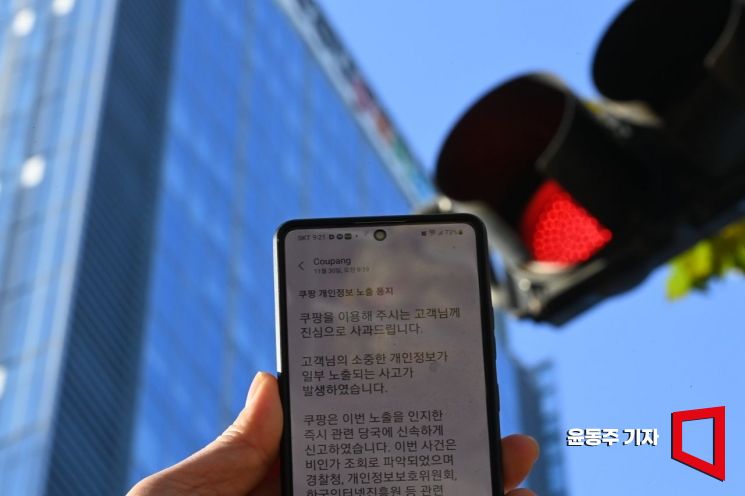 A massive personal information leak involving over 30 million cases has occurred at Coupang. This scale exceeds the economically active population of 29.69 million, making it the worst leak incident in history. On December 1, following an apology text message from Coupang regarding the personal information leak, a Coupang signboard installed at Coupang headquarters is visible. 2025.12.01 Photo by Yoon Dongju
"I never ordered anything, but suddenly last Friday I received an email from CJ Logistics saying a package had arrived. It seemed suspicious, so I looked at the message closely and realized there was no product information at all," the user said.
Recently, as the account information of 33.7 million members of Coupang, the leading e-commerce company in Korea, was leaked externally without authorization, there has been a surge in mysterious text messages and emails sent to Coupang users. Kim, an office worker living in Bundang-gu, Seongnam, Gyeonggi Province, said, "I received a delivery text message even though I hadn't ordered anything. When I compared it to previous delivery notifications I had received, I noticed that the sender information, business name, and product details, which are usually included, were missing." Kim added, "At first glance, it looked like a normal delivery notification, and there was even a delivery tracking link attached. I'm so relieved that I was suspicious." Kim immediately reported the message as phishing, deleted it, and blocked the sender.
In the above case, the user was able to prevent further damage because they had not actually ordered any products. However, experts warn that if someone who has placed an order receives a message cleverly combining their order and delivery information, they might click on the link without suspicion, so extra caution is needed.
Throughout the weekend, anxiety among Coupang users continued to spread. Many expressed shock and concern over the large-scale leak of sensitive personal information. Choi, a homemaker who had provided her apartment building's main entrance password for dawn deliveries, said, "Because I have children, I often use rocket delivery and dawn delivery for urgent school supplies and groceries. I had no choice but to enter the main entrance password for dawn delivery, but now I feel uneasy and want to change it completely while I have the chance."
Another Coupang user commented, "For months, I have been receiving messages pretending to be from credit card companies or delivery services. I can't help but think this is related to the Coupang hacking incident. Considering Korea's population is about 51 million, this means that the vast majority of citizens' high-value data has been exposed with no protection. The government must conduct a thorough investigation to prevent further confusion and ease public anxiety."
There is growing concern that the Coupang data leak could expose not only customer information such as names and addresses, but also consumption patterns and family information based on frequently purchased items. This information could be exploited for scams via text messages, voice phishing, smishing, and pharming, and personalized messages could make individuals more vulnerable to various crimes.
Professor Yeom Heungyeol of the Department of Information Security at Soonchunhyang University advised, "You should be especially cautious of messages or phone calls pretending to request compensation or verification of damage, or claiming delivery errors. If you use the same password for your home as your apartment entrance, you must change it immediately. Never click on links in messages from unclear senders, and always exercise extreme caution."
© The Asia Business Daily(www.asiae.co.kr). All rights reserved.
![Clutching a Stolen Dior Bag, Saying "I Hate Being Poor but Real"... The Grotesque Con of a "Human Knockoff" [Slate]](https://cwcontent.asiae.co.kr/asiaresize/183/2026021902243444107_1771435474.jpg)
















