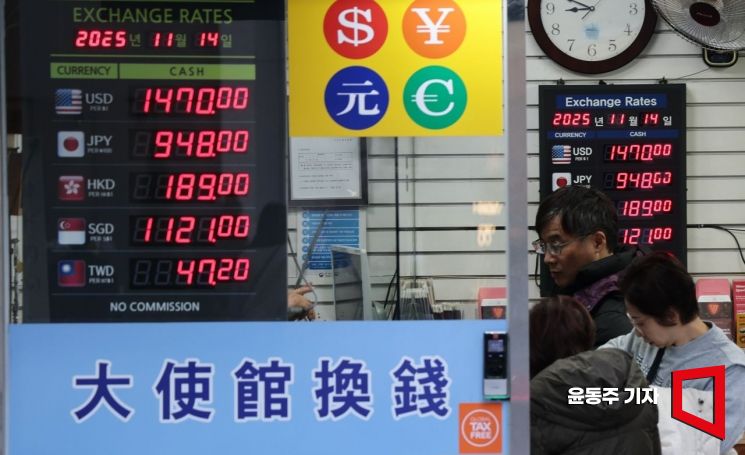
 On the 14th, the won-dollar exchange rate in the foreign exchange market fluctuated around the 1470 won level, and the exchange rate was displayed at a private currency exchange office in Jung-gu, Seoul. 2025.11.14 Photo by Yoon Dongju
The government has decided to regularly monitor export companies’ dollar exchanges and overseas investment activities in order to stabilize the foreign exchange market. It is also working to extend the foreign exchange swap agreement between the Bank of Korea and the National Pension Service, which is set to expire at the end of this year. Although the government has repeatedly expressed its commitment to stabilizing the exchange rate, there are concerns that it currently lacks effective short-term measures to defend the won, and that a deterioration in fundamentals and rising external uncertainties have pushed the appropriate exchange rate level higher, making stabilization difficult.
On the 1st, the Ministry of Economy and Finance announced that, after reviewing the structural conditions of the foreign exchange market the previous day, it had decided to swiftly implement policy measures to stabilize foreign exchange supply and demand. The meeting was chaired by Deputy Prime Minister and Minister of Economy and Finance Koo Yooncheol, and was attended by the Ministry of Health and Welfare, which oversees the National Pension Service, as well as the Ministry of Trade, Industry and Energy, the Financial Services Commission, the Bank of Korea, and the Financial Supervisory Service.
As a first step, the government will conduct regular inspections of export companies’ dollar exchange practices and overseas investment status. This means it will periodically review when and how much of the dollars earned abroad by export companies are converted into won, as well as the proportion of overseas investments in stocks, bonds, and other assets. An official from the Ministry of Economy and Finance explained, "We intend to monitor foreign currency flows in connection with corporate support measures such as policy funds."
This move is based on the perception that excessive demand for dollar exchanges and hoarding by export companies have contributed to instability in the foreign exchange market. Amid a continued dollar shortage, and with capital outflows and increased demand expected during the process of investing 350 billion dollars in the United States, companies are reportedly holding onto the dollars they earn overseas rather than bringing them into the domestic market.
The government has also begun detailed discussions to extend the foreign exchange swap agreement between the foreign exchange authorities and the National Pension Service, which is set to expire at the end of this year. Under this agreement, the Bank of Korea lends dollars from its foreign reserves to the National Pension Service, with the contract renewed annually. This is intended to prevent a sudden surge in dollar demand in the foreign exchange market that could occur if the National Pension Service were to procure dollars directly from the market for overseas investments. The swap agreement between the Bank of Korea and the National Pension Service has played a key role in reducing exchange rate volatility.
The Financial Supervisory Service will conduct a two-month inspection, from this month through January next year, of securities companies and other financial institutions regarding the adequacy of investor information and protection related to overseas investments. The Financial Supervisory Service recently held a working-level meeting with foreign exchange managers at securities companies to review their currency exchange practices and made this decision. During the meeting, concerns were raised that processing a large number of currency exchange orders for overseas stock trades immediately after the market opens at 9 a.m. could increase exchange rate volatility in the early session, and companies were asked to spread out settlement demand.
Previously, the government established an emergency cooperation system for foreign exchange market stabilization by forming a four-party consultative body with the National Pension Service and other relevant organizations. Taking into account ongoing institutional changes such as the National Pension Service’s parametric reforms, the government plans to develop a new management system that can achieve both profitability for the pension fund and stability in the foreign exchange market. A government official stated, "We are currently holding discussions aimed at balancing foreign exchange market stability with securing profitability for the National Pension Service." As of the end of August, the National Pension Service has become a major player in the foreign exchange market, with 771.31 trillion won invested in overseas assets such as stocks and bonds. This exceeds South Korea’s foreign exchange reserves of 428.82 billion dollars (about 632 trillion won as of the end of September). Overseas investments now account for 58.34% of the National Pension Service’s total financial assets, and this proportion is increasing every year.
Although the authorities have repeatedly expressed their commitment to stabilizing the exchange rate, they currently lack effective short-term measures to defend the won. There are also concerns that, due to the weakening fundamentals of the Korean economy and increased external uncertainty, the appropriate exchange rate level has risen significantly, making it difficult for market intervention alone to lower the rate. Jang Boseong, Director of the Macroeconomic Finance Division at the Korea Capital Market Institute, pointed out, "The structural increase in dollar demand, driven by individuals’ overseas stock investments and companies’ overseas investments, is a key factor behind the weak won," adding, "The foreign exchange market has grown so large that it will be difficult for authorities’ interventions to have sufficient effect."
© The Asia Business Daily(www.asiae.co.kr). All rights reserved.
![Clutching a Stolen Dior Bag, Saying "I Hate Being Poor but Real"... The Grotesque Con of a "Human Knockoff" [Slate]](https://cwcontent.asiae.co.kr/asiaresize/183/2026021902243444107_1771435474.jpg)
















