If you feel cold, raise the heating temperature gradually
Last winter, average monthly heating costs per household exceeded 100,000 won
Lowering by 1°C saves 5,000 won per month; layering clothes saves 10,000 won
Smart ways to save money on
As daily minimum temperatures begin to drop below freezing, interest in saving on heating costs is increasing. Every winter, online communities are flooded with posts asking how to use gas boilers more efficiently to save even a little on heating bills. Typical questions include what the optimal indoor temperature should be, whether to keep the boiler running continuously or turn it on and off, and whether to use the 'away mode' when leaving the house.
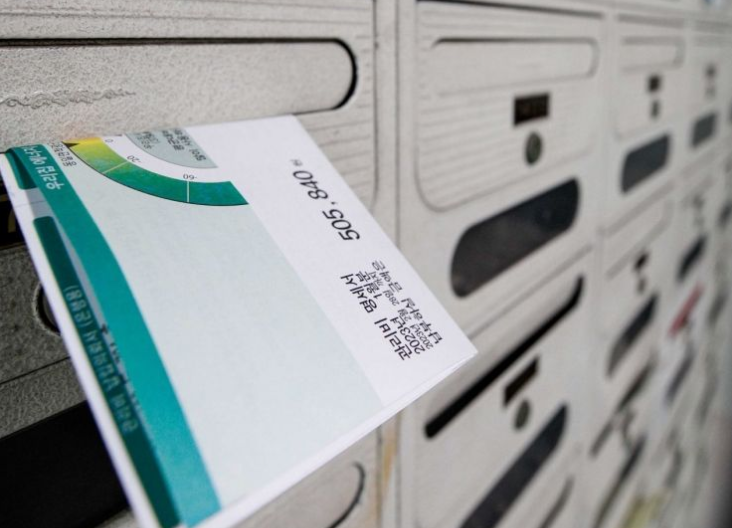 In January 2023, during the winter season when energy demand increased, a maintenance fee bill was delivered to the mailbox of an apartment in Seoul that had been experiencing a series of maintenance fee shocks. Photo by Kang Jinhyung aymsdream@
On December 1, Yonhap News introduced efficient heating methods for winter boiler use, as well as safety management tips. According to Korea Gas Corporation, last winter, the average monthly heating cost per household was about 100,000 won (98,000 won in December last year and 126,000 won in January this year). This is an average figure, so households with more members or larger homes may face even higher actual costs.
The most basic way to reduce heating costs is to lower the heating temperature. The government recommends an optimal indoor temperature of 20°C during winter. Although this may seem low, experts say that this temperature is actually better for your health. The National Health Insurance Service suggested an indoor temperature of 18-20°C for winter in its January 2021 'Healthin' webzine, noting that a large difference between indoor and outdoor temperatures makes it easier to catch a cold.
According to the Korea Energy Agency, lowering the heating temperature by 1°C can reduce energy consumption by 7%. In monetary terms, based on the average unit price of Seoul city gas, this equates to a monthly saving of 5,150 won. In addition, wearing thermal underwear, cardigans, lap blankets, or socks can save an extra 10,300 won per month. Even if the indoor temperature is 20°C, wearing thermal or indoor clothing can help maintain a perceived temperature of 23-24°C. Using air caps, commonly known as 'ppokppoki', draft stoppers, curtains, and rugs to reduce heat loss through gaps is also effective. This can raise indoor temperatures by 2 to 3 degrees Celsius. Reducing shower time by five minutes can cut monthly usage by 7.2% and save 6,830 won on heating bills.
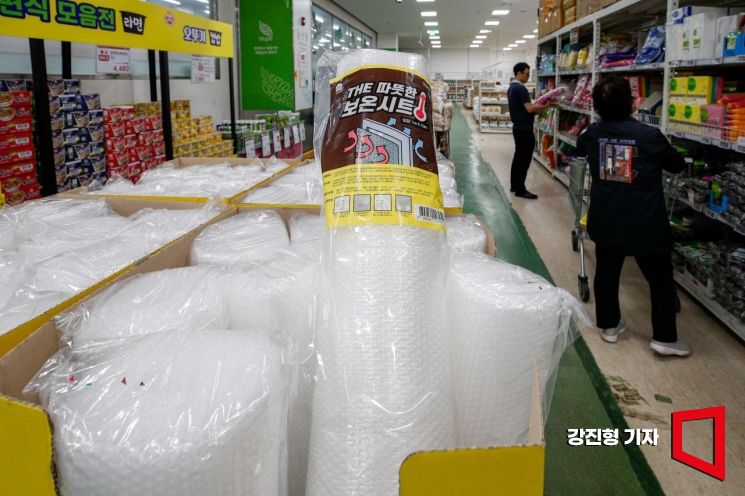 Using air caps commonly known as 'ppokppoki', draft stoppers, curtains, and rugs to reduce heat loss through gaps is also effective. This can raise indoor temperatures by 2 to 3 degrees Celsius. Photo by Kang Jin-hyung
Efficient use of home boilers is another way to save. As of 2023, 81.8% of Korean households use individual heating (where each household has its own boiler), 15.2% use district heating (where hot water produced at a combined heat and power plant is supplied to apartment building machine rooms), and 3% use central heating (where a central boiler room within a residential complex provides heat). The Korea Energy Agency advises that regardless of the heating method, for small spaces around 33 square meters, it is most efficient to initially set the boiler temperature high until the room is warm, then gradually lower the temperature.
For district heating, if you feel cold even after setting the indoor temperature, you should increase the heating temperature gradually by 0.5-1°C increments. Raising the temperature all at once can cause excessive heating costs. For unused rooms, set the mode to 'away' and close the door to prevent heat loss, while manually adjusting the heating water distribution valve so that only the required amount is supplied to each room. The distribution valve is usually located under the kitchen sink. When closing the valve for unused rooms, make sure to also adjust the main shut-off valve to control the indoor water flow appropriately.
Use 'Away Mode' Rather Than Turning Off the Boiler When Leaving Home
How to manage heating when leaving home is another common concern. Experts recommend that, whether you use individual or district heating, it is better to set the boiler to 'away mode' or a lower temperature rather than turning it off completely. This is because the highest energy consumption occurs when the boiler is restarted, which can result in a 'bill shock.'
 At the launch ceremony of the summer energy-saving campaign held on the 10th in Myeongdong, Seoul, a sticker showing participation in the campaign is attached to the door of a cafe. Photo by Jo Yongjun jun21@
So, which is better: using 'away mode' or simply lowering the temperature? For individual heating systems, it is better to lower the set temperature by 1-2°C for short absences. If the indoor temperature drops too low, it takes longer to reheat the house, and more energy may be used in the process. If you are away for more than a week, it is better to use 'away mode' to minimize unnecessary heating while also preventing freezing and pipe bursts.
For district heating, you should not turn off the power even if you are away for an extended period. The District Heating Corporation has advised through its official social media channels that "for absences of three days or more, it is best to set the system to 'away mode,'" and warned that "if the power is cut off, the valve may open automatically to prevent freezing, which can actually increase usage and result in excessive heating costs." Additionally, during winter, you should always keep the indoor temperature controllers in each room turned on, even when away. The District Heating Corporation explains that maintaining a constant temperature 24 hours a day through a continuous heating system is the most effective way to use district heating.
Safety Is as Important as Efficient Boiler Use
Safety is just as important as efficient boiler use. According to the Korea Gas Safety Corporation, from 2017 to 2021, there were 21 accidents involving carbon monoxide poisoning and other incidents caused by faulty installation, aging, or defects in gas boilers, resulting in 46 casualties. The most common cause was disconnection of the exhaust pipe connection (9 cases), followed by failure to meet installation standards for exhaust and intake pipes (8 cases). The Korea Energy Agency emphasizes that you should check at least once a year to ensure there is no deformation or disconnection in the exhaust pipe connection.
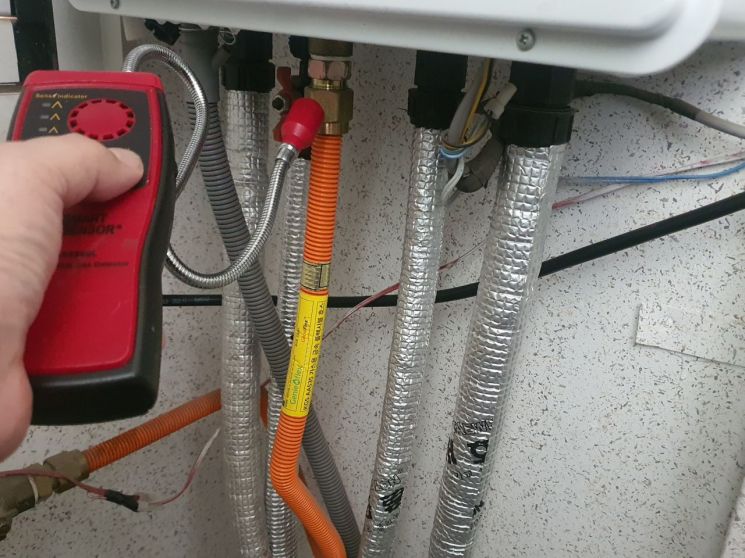 Since boilers are mostly installed in places vulnerable to cold, caution is required to prevent freezing damage. If the water inside the boiler pipes or equipment freezes, the equipment or pipes can easily be damaged. Generally, the anti-freezing function built into boilers operates electrically, so it is necessary to ensure that the electricity is always connected. Photo by The Asia Business Daily Database
It is also necessary to install a carbon monoxide alarm in the boiler room and frequently check for leaks by opening the boiler pipe cover. If you smell something like rotten onions, it may indicate a gas leak; in this case, stop the boiler, close the intermediate gas valve, open all windows for ventilation, and request an inspection. If you feel dizzy or nauseous, you should also suspect a gas leak. Do not store flammable items such as oil, gasoline, thinner, paper, or plastic in the boiler room.
Since boilers are usually installed in places vulnerable to cold, you should also be careful to prevent freezing. If water inside the boiler pipes or equipment freezes, the equipment or pipes can easily be damaged. Generally, the anti-freezing function built into boilers operates electrically, so you must ensure that the power is always connected. When leaving home during winter, do not close the distribution valve or the intermediate gas or oil valves. If the fuel valve is closed, the anti-freezing function will not work. Wrapping boiler pipes with insulation or thermal tape, as you would with water pipes, is also a good idea. You can also use old clothes, towels, or cloth for this purpose.
© The Asia Business Daily(www.asiae.co.kr). All rights reserved.



















