Financial Supervisory Service Notifies Banks of 2 Trillion Won Fine for Incomplete Sales of Hong Kong ELS
Large-Scale Fines Inevitably Weaken Financial Soundness
Concerns Over Disruption to Government Financial Policies, Including Productive and
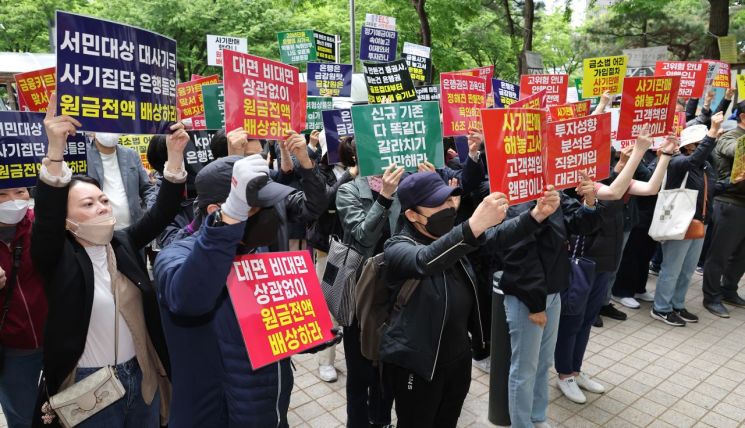 In April 2024, victims of the Hong Kong ELS incident held a rally in front of the Financial Supervisory Service in Yeouido, Seoul, demanding compensation for damages. Photo by Yonhap News Agency
Concerns are mounting over the deterioration of financial soundness in the banking sector after the Financial Supervisory Service notified banks of fines amounting to trillions of won in connection with the Hong Kong H Index (Hang Seng China Enterprises Index, HSCEI) equity-linked securities (ELS) incident. The burden is expected to increase further as the Fair Trade Commission is also set to impose fines related to collusion over the loan-to-value (LTV) ratio for home mortgages.
As financial soundness weakens, there are growing concerns that key government financial policies-such as productive finance, inclusive finance, and enhanced shareholder returns-could face setbacks. It is understood that financial authorities are considering measures such as reducing fines and easing capital regulations in response to market concerns.
Financial Supervisory Service Notifies Banks of 2 Trillion Won Fine for Mis-selling Hong Kong ELS
According to the financial sector on December 1, the Financial Supervisory Service issued a preliminary notice on November 28 to KB Kookmin Bank, Shinhan Bank, Hana Bank, NH Nonghyup Bank, and Standard Chartered Bank Korea, stating that they would be fined and penalized a total of about 2 trillion won for mis-selling Hong Kong ELS. This is the largest fine ever imposed since the enactment of the Financial Consumer Protection Act in 2021.
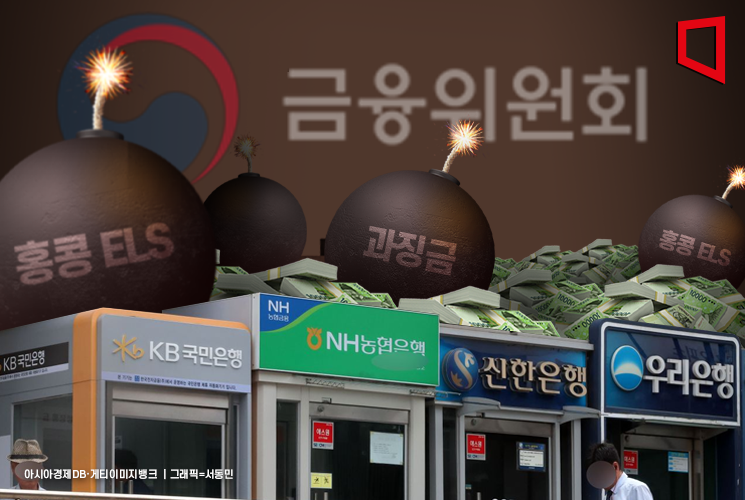
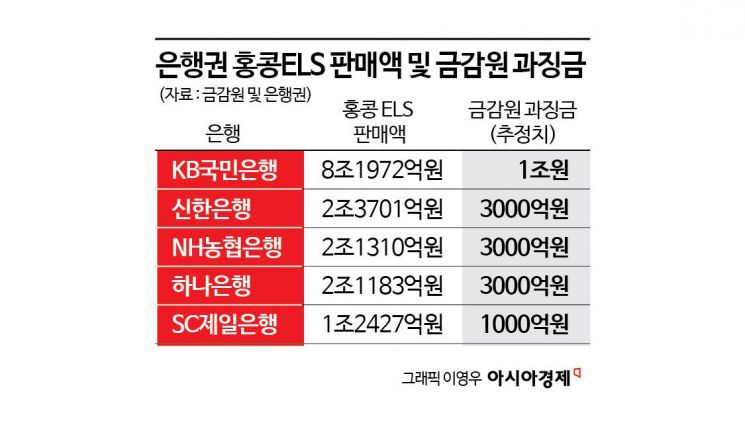
The amount of Hong Kong ELS sold was 8.1972 trillion won at KB Kookmin Bank, 2.3701 trillion won at Shinhan Bank, 2.1310 trillion won at NH Nonghyup Bank, 2.1183 trillion won at Hana Bank, 1.2427 trillion won at Standard Chartered Bank Korea, and 41.3 billion won at Woori Bank. Although Woori Bank was also a seller, it was excluded from the preliminary notification due to the small sales volume.
The Financial Consumer Protection Act stipulates that fines may be imposed up to 50% of the revenue obtained through illegal acts or an equivalent amount. The Financial Supervisory Service is said to have calculated the fines based on the sales amount. The market estimates that KB Kookmin Bank will face the largest fine, around 1 trillion won, while Shinhan, Hana, and Nonghyup will each face fines of approximately 300 billion won.
The banking sector has been shocked by the higher-than-expected fines. A representative from one of the major commercial banks said, "We are deliberating on countermeasures as the fines are significantly higher than previously expected." Banks are also concerned about the possibility that the Fair Trade Commission may soon impose fines related to LTV collusion. The Fair Trade Commission believes that the four major banks colluded by sharing LTV information. The banking sector anticipates that the Fair Trade Commission's fines could amount to at least several hundred billion won.
The imposition of large-scale fines negatively affects banks' capital soundness. Currently, when a financial institution is fined, it is typically required to recognize an additional 600% of the fine amount as operational risk, which increases the risk-weighted assets (RWA) burden for up to ten years. If the fine is finalized at 2 trillion won as preliminarily notified by the Financial Supervisory Service, this would result in an increase of approximately 12 trillion won in RWA. According to securities analysts, this could lower the common equity tier 1 (CET1) ratio of financial holding companies by about 100 basis points (bp, where 1 bp = 0.01 percentage point). A decline in CET1 reduces banks' capacity to lend, which could hinder the Lee Jaemyung administration's financial policies such as corporate lending, productive finance, and shareholder returns. The five major financial holding companies have pledged to invest a total of 508 trillion won in productive and inclusive finance over the next five years, but they may immediately face difficulties in raising investment funds.
A senior official in the banking sector stated, "If RWA increases, banks' lending capacity will decrease accordingly," adding, "Large-scale fines could cause difficulties as we seek to expand productive and inclusive finance."
Financial Authorities Consider Easing Banks' Capital Ratio Burden
With concerns that government financial policies could be affected, financial authorities are considering measures to ease the capital ratio burden for banks. The banking sector has argued that it is unreasonable to immediately reflect the fines in RWA before the fines are finalized. Accordingly, the Financial Services Commission is reportedly discussing a plan to defer the reflection of these fines in RWA until they are finalized.
The banking sector also plans to make every effort to seek reductions in the fines. Starting on the 18th, banks will present their opinions, explanations regarding mis-selling, and details of their active compensation efforts at several upcoming disciplinary review committee meetings at the Financial Supervisory Service.
The fines notified by the Financial Supervisory Service could be significantly reduced through the disciplinary review committee and regular meetings of the Financial Services Commission. Under the revised Financial Consumer Protection Act, fines for minor violations can be adjusted by up to 50%, and depending on efforts for internal control and prevention of recurrence, they can be further reduced by up to 75%.
Choi Jungwook, a researcher at Hana Securities, said, "The amount in the preliminary notice from the Financial Supervisory Service is before any reduction criteria are applied," adding, "Once reasons for reduction are considered in the upcoming disciplinary review committee, the actual fines are likely to be significantly lower." The final fines are expected to be determined in the first half of next year after review by the disciplinary committee and regular meetings of the Financial Services Commission.
© The Asia Business Daily(www.asiae.co.kr). All rights reserved.
!["The Woman Who Threw Herself into the Water Clutching a Stolen Dior Bag"...A Grotesque Success Story That Shakes the Korean Psyche [Slate]](https://cwcontent.asiae.co.kr/asiaresize/183/2026021902243444107_1771435474.jpg)


















