Various Steps Taken to Remove Contaminants
Sold for 500 to 750 Won
The dish known as "pagpag," which refers to food made by reprocessing discarded food waste and sold in the slums of the Philippines, is currently a hot topic on social networking services (SNS). Travel influencers are fueling controversy by sharing videos of themselves trying this shocking food firsthand. According to the South China Morning Post (SCMP) on November 30, videos of Chinese influencers eating the so-called "pagpag" in the slums of the Philippines are going viral on SNS.
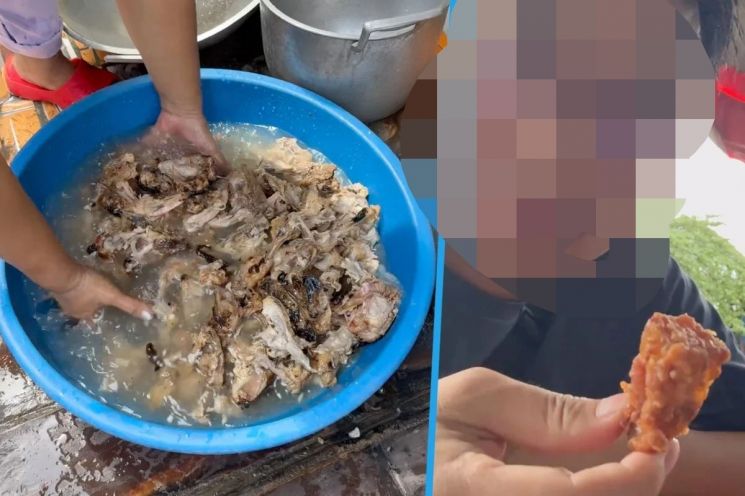 The food called Pakpak eaten by the residents of Tondo indirectly reveals their difficult situation. Pakpak, derived from Tagalog, means "to dust off." SCMP
Tondo, a representative slum located northwest of Manila, is covered in garbage. While there are no tall buildings, the population density is four times higher than that of Seoul. This area is home to people who make their living by sorting and collecting waste. In particular, a major fire broke out here in November of last year, destroying over 1,000 homes. The houses, tightly packed and made of light wood, remain highly vulnerable to fires.
The food called pagpag, eaten by Tondo residents, indirectly reveals the difficulties they face. The word pagpag, derived from Tagalog, means "to dust off." The process of making pagpag involves first searching through food waste to pick out edible portions such as rice and chicken, which are then washed. To remove contaminants, the ingredients are boiled in hot water, and vinegar and calamansi are added to eliminate odors. Finally, the food is seasoned with spices and fried to complete the dish. The selling price is around 20 to 30 pesos (approximately 500 to 750 won).
Pagpag: A Dish That Emerged Amid Extreme Poverty in the 1960s
For families living in extreme poverty in the Philippines, pagpag is often the only source of protein they can access. This food first appeared in the 1960s, when the Philippines was experiencing a severe debt crisis and widespread unemployment. At that time, many people flocked to the cities in search of work, and in the midst of extreme poverty, people began gathering and eating discarded food scraps, giving rise to pagpag.
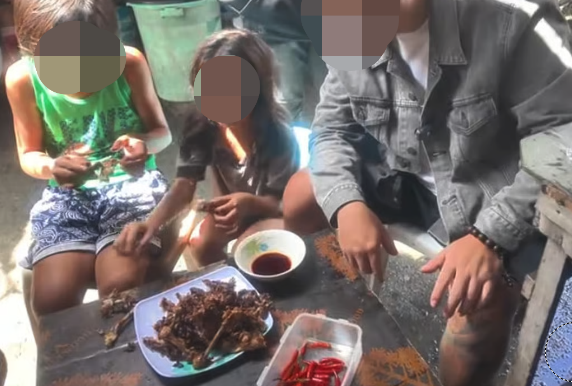 Pakpak is the only source of protein that families in extreme poverty in the Philippines can taste. This food first appeared in the 1960s when the Philippines was experiencing a severe debt crisis and unemployment. SCMP
The controversy surrounding pagpag began recently when a Chinese travel influencer known as "Baozhou Brother," who has 6.5 million followers, uploaded a video introducing the dish. In the video, he remarked, "The taste itself is not bad, but it is psychologically difficult to accept." Another Chinese influencer with 200,000 followers, "Twenty Years Old and Still Never Been to Starbucks," also posted a video of himself trying pagpag on the 28th of last month. He commented, "Locals really do eat this. Look at this piece of meat-only half is left. I will imagine having gone ten days and nights without food in the desert." After sharing pagpag with local children, he added, "This is the inequality of the world. What the rich throw away as garbage becomes a treasure here." The video sparked heated debate on Chinese SNS. One user commented, "Just pretend to eat it. Don't actually eat it."
Another user wrote, "Stop eating it. I can't even bear to watch." Yet another commented, "Even this is not the worst. There are families here who cannot afford even a box of secondhand chicken. Some people only buy a box for their child's birthday, and even then, they collect the leftover bones to sell to those who are even poorer."
© The Asia Business Daily(www.asiae.co.kr). All rights reserved.
![Clutching a Stolen Dior Bag, Saying "I Hate Being Poor but Real"... The Grotesque Con of a "Human Knockoff" [Slate]](https://cwcontent.asiae.co.kr/asiaresize/183/2026021902243444107_1771435474.jpg)












