Hanwha Covers All Costs for Seoul Fireworks Festival as a Social Contribution
Busan Fireworks Festival Operates with 2.3 Billion Won in City Budget as Service Fees
Controversy over fairness has arisen after it was revealed that the cost structures of the fireworks festivals held in Seoul and Busan are significantly different. For the Seoul International Fireworks Festival, Hanwha Group covers all expenses, whereas for the Busan Fireworks Festival, the city of Busan actually pays Hanwha a service fee.
On November 29, Assemblywoman Kim Hyojeong of the Busan Metropolitan Council (People Power Party, Buk-gu 2nd District) stated, "Hanwha Group has operated the Seoul Fireworks Festival as a social contribution project for more than 20 years, investing over 10 billion won each year." Hanwha also spent an additional 3 billion won this year, beyond its existing budget, citing "citizen safety and improvements to the viewing environment."
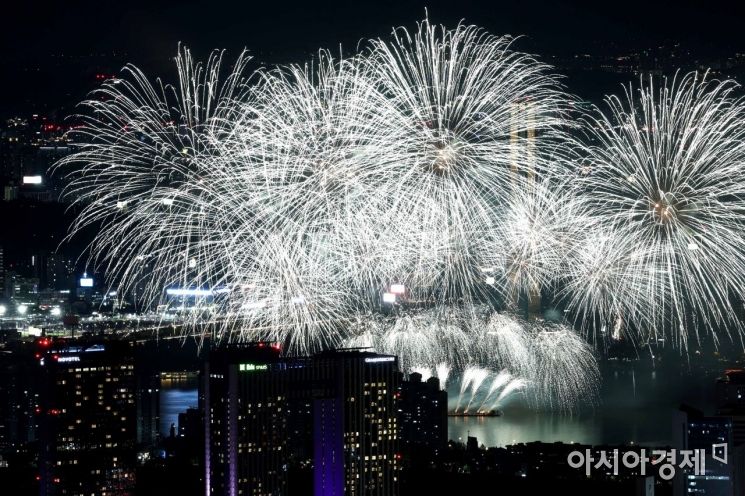 The spectacular fireworks of the Seoul International Fireworks Festival are decorating the night sky.
In contrast, the total cost of this year's 20th Busan Fireworks Festival was 3.9 billion won. Of this amount, the city of Busan allocated a budget of 2.3 billion won, while the remaining 1.6 billion won was covered by sponsorships and paid ticket sales. The entire 2.3 billion won budget was paid to Hanwha Group as a "fireworks production service fee."
Assemblywoman Kim pointed out that, ultimately, Hanwha bears hundreds of billions of won in costs for the Seoul event under the banner of social contribution, while for the Busan event, it receives a budget to carry out the project-thus solidifying this structural difference.
Hanwha has reportedly stated, "The Seoul festival has always been our group's social contribution project, whereas the Busan festival is a separate event conducted on a contractual basis," emphasizing that the nature of the two projects is different.
However, Assemblywoman Kim argued that this leads to outcomes that do not align with public sentiment. She said, "Many people find it hard to accept that the same company produces both fireworks festivals, yet in Seoul, the company pays the costs, while in Busan, the event is funded by citizens' taxes. This perception of unfairness is likely to grow."
She went on to emphasize, "The city of Busan should engage in more proactive discussions with Hanwha to establish a structure in which the region and the company can share benefits. The festival model should be redesigned so that Busan, Hanwha, and citizens all create value together."
© The Asia Business Daily(www.asiae.co.kr). All rights reserved.

















