Hong Kong Authorities: "Death Toll from Apartment Fire Rises to 128"
The number of fatalities from the massive fire that broke out in a high-rise apartment complex in Hong Kong continues to rise, fueling widespread public criticism over inadequate safety management.
On the 27th (local time), major foreign media outlets such as The Guardian and The New York Times focused on the fire, reporting on the wave of public anger spreading throughout Hong Kong society. The Guardian stated, "Anger is growing among Hong Kong residents over the cause of the fire," and highlighted that "the reality of being forced to live in disaster-prone, high-density high-rise apartments due to soaring housing prices has emerged as a major issue."
The New York Times also pointed out, "Public dissatisfaction is mounting in Hong Kong, one of the fastest-aging regions in the world, over whether building safety systems are adequately addressing these vulnerabilities." The report added, "Some are questioning whether this tragedy is the result of corruption and a lack of accountability."
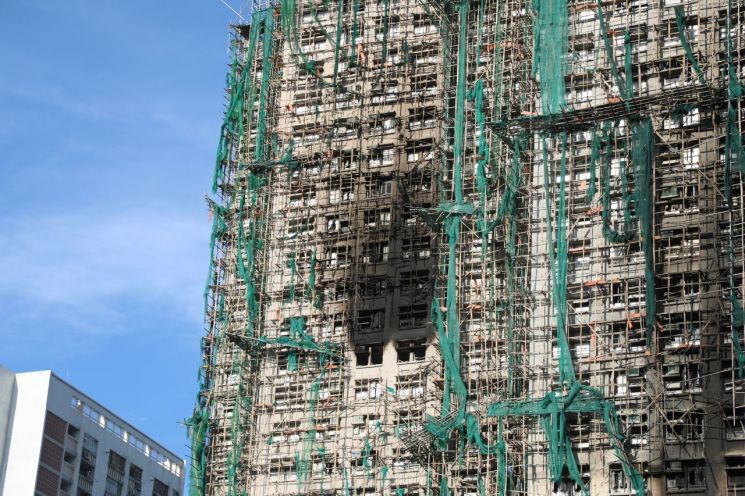 On the 28th (local time), part of the exterior wall of the high-rise apartment complex Wong Fuk Court in Tai Po, northern Hong Kong, where a large fire broke out, turned black. Photo by Yonhap News
Since sovereignty was returned to China in 1997, Hong Kong has been granted a high degree of autonomy as a Special Administrative Region (SAR) under the 'one country, two systems' principle. However, this autonomy has been weakened due to increased control by the Chinese central government. Especially after the large-scale anti-government protests in 2019 and the implementation of the Hong Kong National Security Law, concerns have been raised that the accelerated 'Sinicization' of Hong Kong is infringing upon fundamental rights such as freedom of expression and assembly.
Economic discontent has also been building. As a large influx of labor and capital from mainland China has intensified job competition and sent housing prices soaring, Hong Kong citizens have increasingly criticized the worsening cost of living. In this context, the occurrence of a major fire disaster that claimed more than 100 lives has further fueled criticism that, while China has tightened political control over Hong Kong, it has failed to adequately ensure public safety and livelihoods.
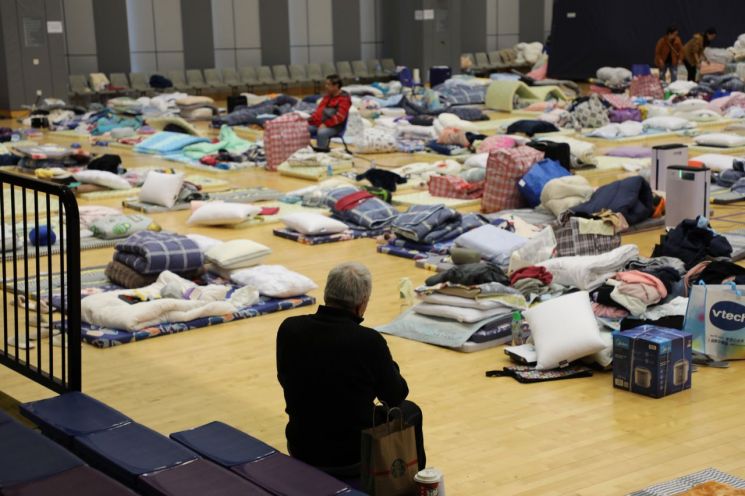 On the 28th (local time), fire victims rest while sitting in the auditorium of the Tung Chung Street Civic Center in northern Hong Kong, where a temporary shelter was set up. Photo by Yonhap News Agency
In response, Chinese state media have emphasized that both the central government and the Hong Kong government are responding swiftly to manage the aftermath of the disaster. On the 27th, the state-run Xinhua News Agency reported that President Xi had "expressed condolences for the victims and the firefighters who lost their lives, instructed that comfort be provided to the bereaved families and affected residents, and ordered support for Hong Kong authorities to do their utmost in extinguishing the fire, searching for missing persons, treating the injured, and handling post-disaster recovery."
The fire broke out at around 2:52 p.m. on the 26th in Wong Fuk Court, a 32-story (lobby plus 31 floors) residential high-rise apartment complex located in the Tai Po district of northern Hong Kong. The fire affected seven out of the eight apartment buildings in the complex, which houses around 2,000 households. Local fire authorities struggled with the intense flames and completed firefighting operations after about 43 hours, at 10:18 a.m. on the 28th.
Chris Tang, Secretary for Security of the Hong Kong Special Administrative Region, stated at a briefing on the afternoon of the 28th that 128 people have died as a result of the fire so far, and more bodies may still be found. The number of injured stands at 79.
© The Asia Business Daily(www.asiae.co.kr). All rights reserved.
![Clutching a Stolen Dior Bag, Saying "I Hate Being Poor but Real"... The Grotesque Con of a "Human Knockoff" [Slate]](https://cwcontent.asiae.co.kr/asiaresize/183/2026021902243444107_1771435474.jpg)

















