KCCI Cultural Tourism Committee Makes Proposal to Second Vice Minister of Culture
Chinese Tourists to Korea Spend More Than Visitors from Other Countries
The domestic tourism industry has requested the government to extend the visa-free entry program for Chinese group tourists. The industry cited the significant increase in Chinese tourist visits and sales since the program's implementation as evidence of its tangible benefits.
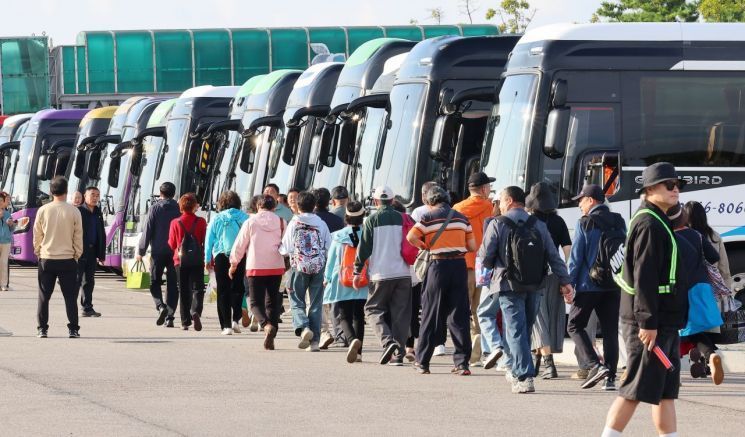 On the morning of September 29, the first day of visa-free entry for Chinese group tourists, Chinese group cruise tourists arriving at Incheon Port International Cruise Terminal in Yeonsu-gu, Incheon, are heading to buses. Photo by Yonhap News Agency
The Korea Chamber of Commerce and Industry announced on the 28th that it held the 26th Cultural Tourism Industry Committee meeting at Lotte Hotel in Jung-gu, Seoul. The meeting was attended by more than 20 representatives from companies and organizations in the aviation, hotel, tourism, content, and K-food sectors, including Kim Dae-hyun, the Second Vice Minister of the Ministry of Culture, Sports and Tourism, to discuss current issues.
The tourism industry proposed extending the visa-free entry program for Chinese group tourists, which is temporarily in effect from September 29 of this year to June 30 of next year, citing its substantial impact on attracting tourists and its economic ripple effects. For example, Shilla Duty Free's Myeongdong branch reported that, in the month following the program's launch, the number of Chinese visitors increased by 90% compared to the previous year, and sales rose by 40%.
The spending power of Chinese tourists was also presented as supporting evidence. According to the '2024 Foreign Tourist Survey Report' published by the Ministry of Culture, Sports and Tourism, the average expenditure per Chinese tourist visiting Korea is 2.24 million won, which is significantly higher than that of tourists from neighboring countries such as Japan (1.11 million won), the Philippines (1.52 million won), and Thailand (1.56 million won).
Given that China has announced it will extend its visa-free entry policy for Korean nationals by one year until the end of next year, instead of ending it this year, there were additional calls for a reciprocal extension of Korea's policy on diplomatic grounds.
There was also a proposal to introduce an 'airport fast track' service as a way to enhance tourism competitiveness. Fast track is a service that provides expedited processing for a fee, and among the world's top 30 airports by passenger volume, Incheon Airport is the only one that does not offer this service. The industry pointed out that delays in immigration procedures create a negative first impression for tourists visiting Korea, and that Korea is losing appeal, especially among high-spending tourists.
The meeting also included discussions on the need to create synergy by linking the cultural content industry with the tourism industry. As K-content not only increases the sales scale of related industries such as tourism and distribution, but also serves as a national brand with far-reaching ripple effects, there was consensus on the need to develop cultural content as a tourism resource.
Committee Chairman Woo Ki-hong emphasized, "With the K-culture boom, the number of inbound tourists to Korea is expected to surpass 20 million for the first time this year," adding, "In order to foster the cultural and tourism industries as new growth engines for the national economy, the industry and government must continue close cooperation and communication."
© The Asia Business Daily(www.asiae.co.kr). All rights reserved.
![Clutching a Stolen Dior Bag, Saying "I Hate Being Poor but Real"... The Grotesque Con of a "Human Knockoff" [Slate]](https://cwcontent.asiae.co.kr/asiaresize/183/2026021902243444107_1771435474.jpg)
















