Bluepoint Partners Discusses Strategies for Nuclear Fusion Industrialization
"Success of Nuri Rocket Launch Offers Valuable Lessons"
"Long Road to Commercialization... Investor Patience Is Crucial"
As artificial intelligence (AI) continues to spread and electricity demand surges, research institutes, startups, and investors gathered to seek solutions for the industrialization of nuclear fusion. Participants unanimously agreed that public-private cooperation is essential for Korea to keep pace amid the rapid growth of global nuclear fusion companies.
On the 28th, Bluepoint Partners held a forum titled "Fusion: The Gamechanger of Next-Generation Energy Industry" at the Textile Center in Gangnam-gu, Seoul, where strategies for the industrialization of nuclear fusion were discussed from the perspectives of technology, policy, and investment. Industry, academia, research organizations, and investors-including the Ministry of Science and ICT, the Korea Institute for Advancement of Technology Commercialization, and Seoul National University-joined forces to explore ways to translate research and development (R&D) achievements into real business ventures.
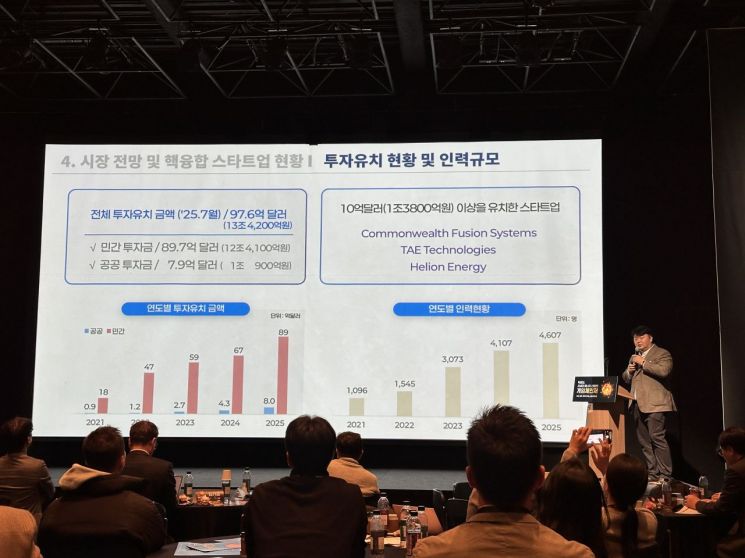 On the 28th, at the Textile Center in Gangnam-gu, Seoul, Eunyoung Jung, team leader at Samsung C&T Corporation, is presenting on "Fusion Technology and the Current Status of Startups" at the forum titled "Fusion, the Gamechanger of the Next-Generation Energy Industry." Photo by Seongmin Lee
Nuclear fusion is a technology that produces energy by mimicking the process that powers the sun, generating energy through the fusion reaction of deuterium and tritium. It is referred to as the "dream energy" because it does not emit carbon, does not generate high-level radioactive waste, and carries no risk of explosion, making it extremely safe.
Hwang Yongseok, a professor at Seoul National University, noted that the rise of AI is transforming the status of nuclear fusion. Professor Hwang stated, "Until now, nuclear fusion has been regarded merely as an alternative for the carbon-neutral era, but with AI, global electricity demand is skyrocketing. We are facing a situation where we need to build twice the current global power infrastructure. We must consider how the nuclear fusion technology we have accumulated so far can contribute to society."
There were also calls to establish a structure that encourages active private sector participation in the industrialization of nuclear fusion. Eunyoung Jung, team leader at Samsung C&T Corporation, emphasized, "The recent success of the fourth Nuri rocket launch was the result of transferring Korea Aerospace Research Institute technology to Hanwha and initiating full-scale private sector collaboration. If public and private sectors do not cooperate in nuclear fusion as well, Korea will continue to fall behind."
She cited differences in R&D and investment culture as reasons for the rapid growth of American nuclear fusion startups. Jung explained, "Domestic R&D rarely acknowledges the possibility of failure at higher management levels, whereas in the United States, byproducts from the research process are seen as new business opportunities. As talented individuals flock to the U.S., the nuclear fusion startup ecosystem is expanding like a domino effect."
There are also concerns that the domestic ecosystem may fall further behind, as more than half of nuclear fusion startups are currently concentrated in the United States. Given the technological characteristics that require a long time to reach commercialization, the patience of investment capital is also considered crucial.
Lee Yonggwan, CEO of Bluepoint Partners, stated, "Nuclear fusion startups will likely reach the break-even point later than any other business," and added, "While technology is important, capital is decisive in this field. Setting clear milestones and persuading investors based on those milestones will likely take at least 10 to 20 years."
© The Asia Business Daily(www.asiae.co.kr). All rights reserved.

















