Pressure Mounts Across the National Manufacturing System
Room for Tariff Negotiations Remains Limited
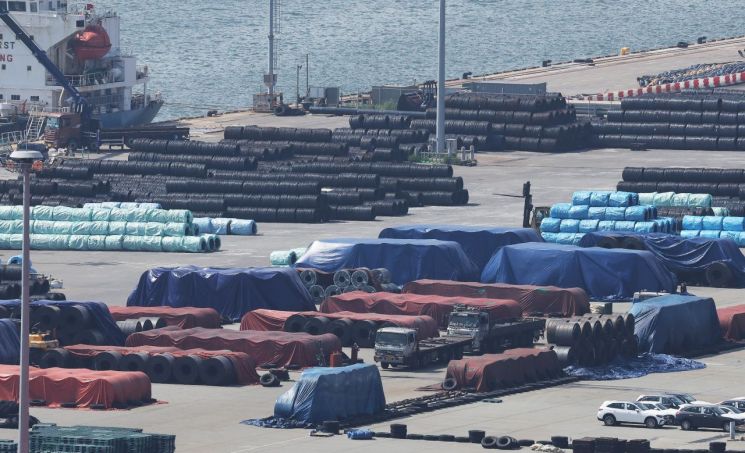
The United States has imposed a steep 50% tariff on Korean steel, sending shockwaves throughout the entire Korean manufacturing ecosystem. While the immediate impact is a decline in steel exports and profitability for the steel industry, analysts point out that the real pressure is being felt across the entire national manufacturing system, including the cost structure and competitiveness of the shipbuilding industry, the stability of the energy supply chain centered on LNG (liquefied natural gas) carriers, and demand for industrial electricity. Although Minister of Trade, Industry and Energy Kim Jeonggwan recently stated that "there is room for negotiation on steel tariffs," raising hopes for a possible reduction, many argue that considering the current U.S. policy environment and industrial strategy, it will be difficult to achieve results through negotiations in the short term.
According to the Korea International Trade Association (KITA) on November 28, Korea's steel exports to the United States from January to September this year amounted to $2.78958 billion, down 16% from the previous year. This is due to a sharp decline in price competitiveness in the U.S. market. Data submitted to the National Assembly shows that POSCO and Hyundai Steel are expected to pay about 400 billion won in tariffs to the United States this year alone. According to materials submitted by the two companies to Assemblyman Park Sooyoung of the People Power Party, the tariffs to be paid from March to December total $281 million (about 400 billion won), which is nearly equivalent to their combined operating profit for the second quarter. Foreign media have also pointed out that "Korean steelmakers' exports to the U.S. have become virtually unprofitable," and that "a shift toward specialty products is inevitable."
The problem is that this shock does not end with deteriorating profits for the steel industry. Korean shipbuilding has led the global market with orders for high-value-added vessels such as LNG carriers and ultra-large container ships, with high-strength steel plates produced in Korea serving as a key competitive advantage. However, if a sharp decline in U.S. exports and prolonged high tariffs lead steelmakers to adjust production, the price of steel plates may become unstable (with a possible increase), and procurement risks will inevitably rise. A shipbuilding industry insider commented, "Steel plates account for half of shipbuilding competitiveness. If the steel production structure is shaken, the cost shock will be much greater for high-priced vessels like LNG carriers." In fact, concerns are spreading within the industry that "the shock to steel will spill over into shipbuilding."
This shock could further extend from shipbuilding to the energy supply chain. Large LNG carriers built by Korean shipbuilders serve as key transportation infrastructure for overseas gas field development projects, and rising shipbuilding costs directly impact the feasibility of these projects. An industry source said, "A rise in LNG carrier prices could disrupt the investment structure for overseas gas fields. Ultimately, steel tariffs are a factor that threatens the stability of Korea's energy supply chain."
Changes are also expected in terms of electricity supply and demand. The domestic steel industry relies heavily on electric arc furnace (EAF) methods, making it a key driver of industrial electricity demand. A reduction in steel production could lead to a decrease in industrial electricity demand, instability in regional power grid operations, and added pressure to adjust Korea Electric Power Corporation's rate structure. This is why there are concerns about a chain reaction from steel tariffs affecting the power and industrial systems.
Against this backdrop, Minister of Trade, Industry and Energy Kim Jeonggwan recently appeared on a broadcast and mentioned that "there is room for negotiation on steel tariffs." Minister Kim explained, "If cooperation in shipbuilding and the use of Korean steel increase, leading to higher ship prices, there will be grounds to persuade the United States. We can keep the door open for discussions on tariff adjustments through a package of cooperation in shipbuilding, energy, and investment." In fact, it is reported that the government is considering utilizing shipbuilding, steel, and investment cooperation as a single package to create 'strategic leverage.'
However, caution prevails regarding the possibility of a tariff reduction. First, the United States uses steel tariffs as a core tool for industrial protection, regardless of whether a country is an ally or not, so making an exception only for Korea would inevitably raise fairness issues. Minister Kim also stated, "The United States has made it clear that it is difficult to make an exception for Korea alone."
The fact that steel protection is a central pillar of a potential second Trump administration's industrial strategy also reinforces the cautious outlook. The policy aims to revive manufacturing, with steel and aluminum tariffs at its core. S&P Global also assessed, "Although Korean steelmakers are taking a major hit, there is little chance of a short-term change in the U.S. high-tariff policy."
Industry insiders and observers are increasingly emphasizing the need to stabilize the steel plate supply chain, pursue joint strategies between shipbuilding and steel, and manage cost and supply chain risks across the industry, regardless of tariff negotiations. One industry insider stated, "Tariffs have become an issue that shakes the entire Korean manufacturing system, beyond a simple trade issue. What is needed now is not immediate expectations for negotiations, but fundamental improvements to the industry's structure and a strategic response."
© The Asia Business Daily(www.asiae.co.kr). All rights reserved.

















