Daishin Securities predicted that the Bank of Korea, which has kept its base rate unchanged for four consecutive times, is likely to cut rates once in the first half of next year. Accordingly, the base rate is expected to stand at 2.25% by the end of the first half of next year.
Gong Dongrak, a researcher at Daishin Securities, evaluated and forecasted the final Monetary Policy Committee meeting of the year and the future monetary policy path in a report released on the 28th, titled "The Possibility of a Rate Cut Remains, But as if the Cuts Are Over."
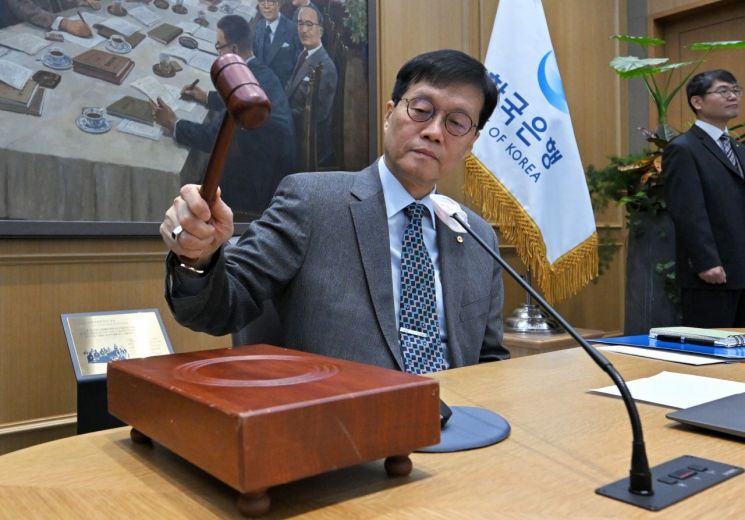 Lee Chang-yong, Governor of the Bank of Korea, is striking the gavel at the Monetary Policy Committee plenary meeting held at the Bank of Korea headquarters in Jung-gu, Seoul on the 27th. Photo by Yonhap News
The previous day, the Monetary Policy Committee of the Bank of Korea kept the base rate unchanged at 2.5%. This decision was attributed to the worsening real estate issues in the Seoul metropolitan area and increased instability in the foreign exchange market. Even before the committee meeting, the market had widely anticipated a freeze in the base rate. As a result, market attention during this meeting was focused on Governor Lee Chang-yong's remarks.
Gong noted, "Governor Lee seemed conscious of the market's expectations during the press conference, avoiding particularly hawkish statements or assessments, and at times made several comments aimed at stabilizing the market." However, despite these efforts to calm the market, he pointed out that the weakness in the bond market intensified further.
He summarized the reasons for this into two main points. First, he highlighted that "the language regarding the future direction of monetary policy changed from a 'stance' of additional rate cuts to a 'possibility,' and the 'timing' of further cuts was replaced with 'whether' they would happen." He explained that, although Governor Lee directly addressed the controversial "policy shift" remarks made in a foreign media interview prior to the meeting, which had shocked the market, the market essentially interpreted the change in wording as equivalent to those previous comments.
The second reason was the lack of concrete stabilization measures. Gong stated, "While the possibility of stabilization measures in response to the sharp rise in interest rates was hinted at, Governor Lee diagnosed the recent rate increases as a situation that could occur amid changing expectations for monetary policy, and avoided giving a direct answer regarding specific responses." He added, "From the perspective of market participants, there was little to reassure sentiment."
Accordingly, he predicted, "Given that the market had expected the November committee meeting to stabilize investor sentiment and reverse the mood, the opposite effect may occur, and heightened volatility in market interest rates is likely to persist for some time."
He also assessed that the possibility of further base rate cuts remains open. Gong said, "Aside from analyzing the committee meeting as a monetary policy event and the resulting market response, we still see room for additional rate cuts in our outlook for the Bank of Korea's base rate." He added, "We expect the specific timing of a cut to be in the first half of 2026, with the number of cuts likely to be just one."
As the basis for this, he cited Governor Lee's remarks about a negative output gap in gross domestic product (GDP). Gong explained, "In the previous committee meeting, Governor Lee stated that the GDP gap would turn negative in the first half of 2026. However, in this meeting, which included a revised economic outlook, the projected duration of the negative GDP gap was extended to the end of 2026." He pointed out, "This suggests that the estimate of potential growth rate may have been lowered compared to before."
This implies the possibility of a downward revision to the neutral interest rate level. Gong added, "If financial stability imbalances are resolved, and only macroeconomic conditions are considered, the neutral rate could be lowered further," and clarified, "There is still room for additional rate cuts in this rate cut cycle."
© The Asia Business Daily(www.asiae.co.kr). All rights reserved.
![Clutching a Stolen Dior Bag, Saying "I Hate Being Poor but Real"... The Grotesque Con of a "Human Knockoff" [Slate]](https://cwcontent.asiae.co.kr/asiaresize/183/2026021902243444107_1771435474.jpg)











