Strengthened Export Market Diversification After First U.S.-China Trade Dispute
Driven by Tariff Response, Oversupply Resolution, and Expansion of Influence in Emerging Markets
Potential for Greater Influence if Combined with AI Technology Competitiveness
Concerns Over Increasing Challenges for Manufacturing-Centric Countries Such as South Korea
This year, despite the implementation of U.S. tariff policies, the impact on China was less severe than expected. This is attributed to China’s rapid diversification of export destinations, which became prominent after the first round of U.S.-China trade tensions. Analysts note that this diversification was driven not only as a response to U.S. tariff shocks, but also to address domestic oversupply and to expand influence in emerging markets. Moving forward, if China combines its existing strengths in manufacturing competitiveness with advanced technologies such as artificial intelligence (AI) and expands the influence of 'Made in China' products in countries other than the United States, there are concerns that manufacturing-centric countries-including South Korea, Germany, and Japan-may face increasing challenges.
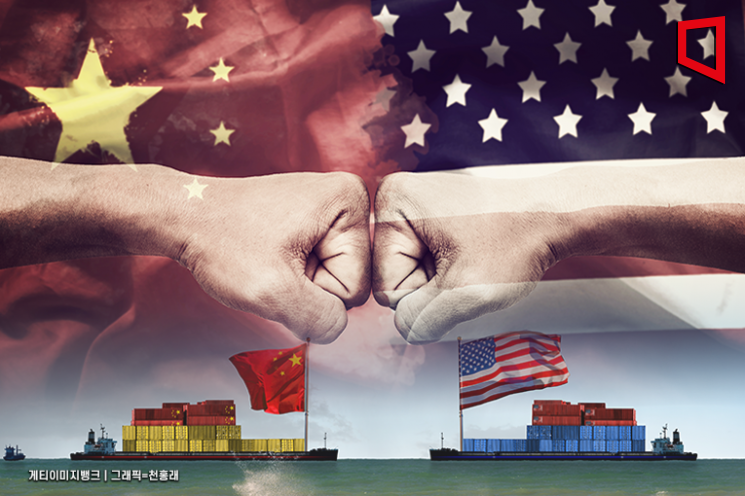
On November 28, the Bank of Korea made this assessment in its November economic outlook, specifically in the report titled 'Assessment of the Recent Acceleration in China’s Export Market Diversification' (authored by Lee Junho, Jung Heewan, Lee Sangheon, Yoo Geonhu, and Lee Seungmin).
Initially, the Chinese economy was expected to suffer significant damage due to U.S. tariff policies. However, China has managed to maintain strong export growth by offsetting the sharp decline in exports to the U.S. with increased exports to other markets, resulting in better-than-expected growth. Since the implementation of U.S. tariff measures in April (the second and third quarters of this year), China’s exports to the U.S. dropped by 26% year-on-year, while exports to other regions such as the European Union (EU), ASEAN, and Africa increased by 12%. China’s Herfindahl-Hirschman Index (HHI), which measures export concentration, fell sharply this year. This diversification of China’s export destinations began to stand out after the first round of U.S.-China trade tensions in 2018 and has accelerated further this year due to the implementation of U.S. tariff policies. The share of Chinese exports going to the U.S. has continued to decline since the first round of trade tensions (from 19.3% in 2018 to 14.7% in 2024), dropping further to 11.4% in the first to third quarters of this year.
Lee Junho, head of the China Economic Team in the Bank of Korea’s Economic Research Bureau, assessed that China’s recent export market diversification has proceeded rapidly in response to U.S. tariff shocks, to resolve domestic oversupply, and to expand influence in emerging markets.
Lee explained, "After the imposition of U.S. tariffs, China’s exports to ASEAN surged. This is believed to be due to China leveraging its strong supply chain connections with ASEAN to reroute exports to the U.S. via the 'China→ASEAN→U.S.' pathway." He added, "Since the mid-2010s, not only global multinational companies but also Chinese firms have significantly increased investments in ASEAN, resulting in trade between China and ASEAN expanding from an annual average of 309.8 billion dollars in 2010-2014 to 743.5 billion dollars in 2020-2024." Using the ADB-MRIO (Asian Development Bank Multiregional Input-Output) tables to estimate China’s exports to the U.S. via ASEAN, there was a sharp increase immediately following the first round of U.S.-China trade tensions in 2019. Lee stated, "When examining changes in trade flows through global trade networks following this year’s U.S. tariff policies, it is highly likely that China’s exports to the U.S. via ASEAN have also increased this year." Major items with significant changes in the U.S. import share from China and ASEAN included toys, vacuum cleaners, televisions, and other electrical and electronic equipment.
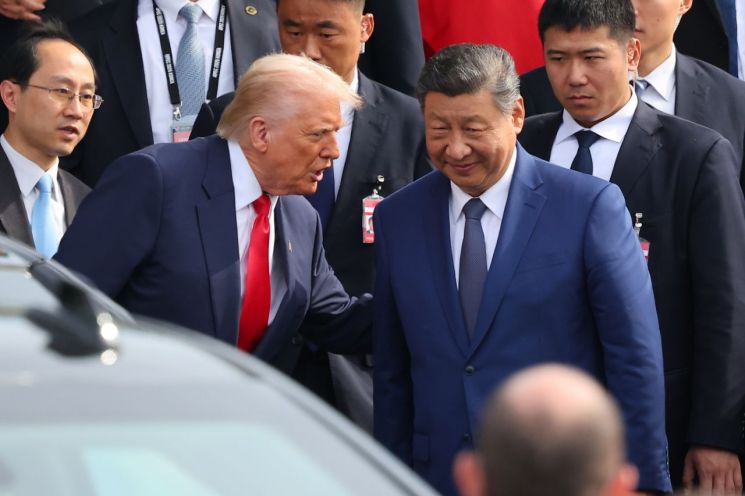 Donald Trump, President of the United States, and Xi Jinping, President of China, are seen leaving the meeting venue while conversing after concluding the US-China summit on October 30 at Naraemaru within the 5th Air Mobility Wing of Busan Air Force Base. Photo by Yonhap News
China’s export market diversification has also accelerated as a means to resolve domestic oversupply. Oversupply persists not only in traditional manufacturing sectors such as steel, but also in new industries like electric vehicles, batteries, and solar power. Due to sluggish domestic demand and stronger regulations within China, low-priced exports of oversupplied goods are expanding beyond the U.S. to the rest of the world. Lee noted, "In particular, the production scale of Chinese electric vehicles, solar panels, and batteries far exceeds both domestic and global demand, resulting in a significant increase in exports of these items to the EU and continued declines in export prices."
Recently, the Chinese government has been pursuing supply-side reforms to mitigate overproduction through restructuring of key industries such as steel, petrochemicals, electric vehicles, solar power, and batteries. Private companies are also implementing self-help measures to curb overproduction. Lee predicted, "However, meaningful production cuts and restructuring will take time, so the pressure for China to export oversupplied goods to countries other than the U.S. is expected to persist."
As the U.S. continues to prioritize domestic interests, China is expanding exports to regions such as Africa and Latin America to increase its influence and secure markets. In the first to third quarters of this year, China’s exports to Africa and Latin America (excluding Mexico) increased by 27.9% and 11.5%, respectively, far outpacing the overall export growth rate of 6.1%. Lee analyzed, "The sharp increase in China’s exports to Africa is due to a surge in ship deliveries to Liberia and a significant rise in passenger car exports to North Africa, as well as increased strategic utilization of Africa through the Belt and Road Initiative." Since 2013, China has greatly increased its investments in Africa through the Belt and Road Initiative, strengthening not only diplomatic ties but also economic exchanges with the continent.
In Latin America, exports to countries other than Mexico and Brazil (such as Argentina, Chile, and Colombia) have risen sharply. Lee explained, "This is also aimed at securing an early foothold in Latin American markets," adding, "China has steadily expanded its influence in Latin America through loan extensions, port acquisitions, and 5G network purchases." While China’s market share in imported durable goods such as passenger cars, home appliances, and mobile phones has steadily increased, this year, the contribution of exports to Argentina, Chile, and Colombia-especially in passenger cars-has become particularly notable.
Even if U.S. tariff policies are relaxed, the U.S.-China rivalry is likely to persist, and China is expected to continue its efforts to diversify export destinations. In the short term, this will help buffer the decline in exports to the U.S., while in the medium to long term, China is expected to further expand the influence of 'Made in China' products in emerging markets and other countries outside the U.S. Lee emphasized, "If China’s manufacturing competitiveness-which enables export market diversification-is combined with advanced technology competitiveness such as AI, China’s role as the world’s factory will be further strengthened, potentially expanding the global dominance of Chinese manufacturing. In this process, manufacturing-centric countries such as South Korea, Germany, and Japan may face increasing difficulties, so careful attention is needed."
© The Asia Business Daily(www.asiae.co.kr). All rights reserved.
![Clutching a Stolen Dior Bag, Saying "I Hate Being Poor but Real"... The Grotesque Con of a "Human Knockoff" [Slate]](https://cwcontent.asiae.co.kr/asiaresize/183/2026021902243444107_1771435474.jpg)

















