Statement on Monetary Policy: From Rate Cut Stance to Possibility
Timing and Pace of Further Cuts Becomes Possibility and Timing of Additional Cuts
Monetary Policy Board Split Evenly on Next Three Months: Freeze vs. Cut
"No Possibility of R
"Both further cuts and a rate freeze remain on the table."
Lee Chang-yong, Governor of the Bank of Korea, made this statement during a press conference held on November 27, following the Monetary Policy Board’s meeting to decide the direction of monetary policy. He was addressing the situation where the six board members (excluding the governor) were evenly split, three to three, on the outlook for interest rates over the next three months. While market participants remain divided on the timing of the next rate cut, there is increasing emphasis on a more hawkish stance, with forecasts shifting toward a delayed rate cut next year or even a rate freeze for 2026.
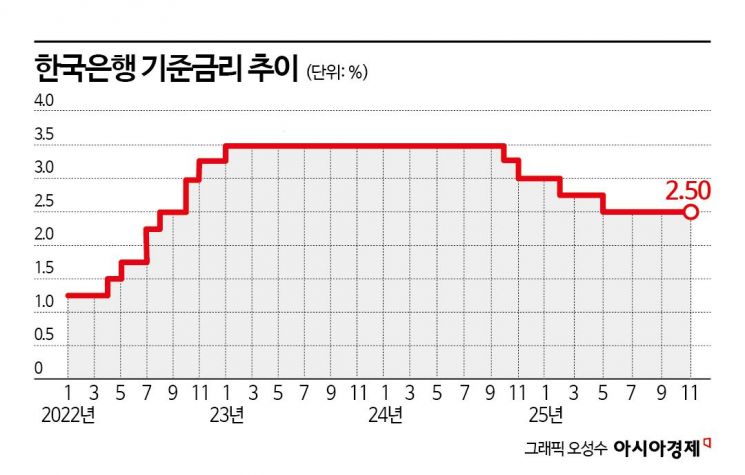
The Monetary Policy Board of the Bank of Korea decided to keep the base interest rate unchanged at 2.50% per annum on this day. Governor Lee explained, "Although the growth outlook has been revised upward, both upside and downside risks remain for the future path," adding, "Financial stability risks persist, such as heightened expectations for rising real estate prices and increased exchange rate volatility, and inflation has also risen somewhat." The economic growth rate for this year was projected at 1.0%, up 0.1 percentage points from the August forecast (0.9%), and next year's growth rate was expected to be 1.8%, up 0.2 percentage points from the previous forecast.
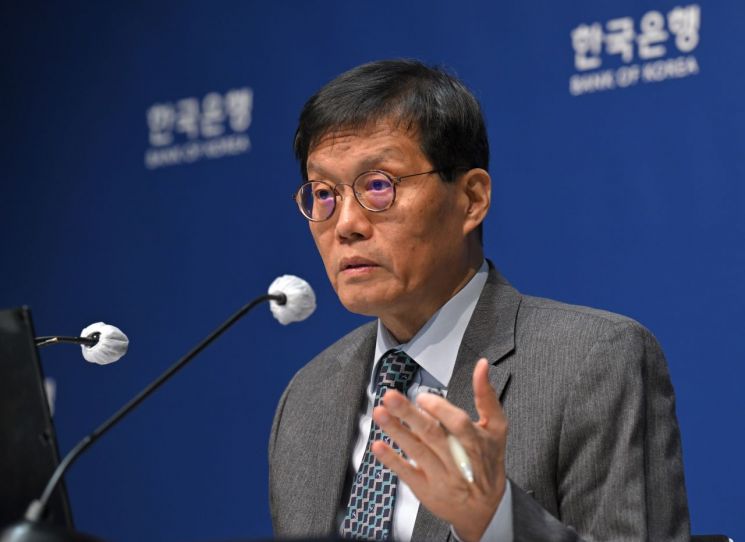 Lee Chang-yong, Governor of the Bank of Korea, is speaking at a press conference held at the Bank of Korea in Jung-gu, Seoul on the 27th. Photo by Yonhap News
Monetary Policy Statement: From Rate Cut Stance to Possibility... Drawing a Clear Line Against Hikes
Since October last year, the Monetary Policy Board had stated in its monetary policy direction statement that it would "maintain a rate cut stance while monitoring changes in domestic and external policy conditions, inflation trends, and financial stability, and decide on the timing and pace of additional cuts accordingly." However, this month, the wording was revised to: "Keep the possibility of a rate cut open, but closely monitor changes in domestic and external policy conditions, as well as growth and inflation trends and financial stability, and decide on the possibility and timing of additional rate cuts for the base rate."
Regarding the split in board members’ opinions on future rates, Governor Lee explained, "The three members who suggested a freeze believed that, given the significant increase in exchange rate volatility and heightened inflation concerns, it is necessary to keep rates unchanged for now and monitor developments." He continued, "The three members who saw the possibility of a cut pointed to both upside and downside risks for growth and the uncertainty surrounding the future monetary policy of the Federal Reserve, suggesting that the possibility of a rate cut should remain open for the time being."
Governor Lee noted that interpreting this situation as the "end of the rate cut cycle" is a matter of individual judgment, but he clearly ruled out the possibility of a hike. He stated, "None of the board members proposed discussing a rate hike this time. At this point, it is not the stage to consider raising rates." He added, "It typically takes at least eight months, on average twelve months, for the direction to shift from rate cuts to hikes, so it is rare to see a sudden reversal. Do not interpret a policy shift as a move toward a rate hike."
Market Split: "Rate Cut Delayed" vs. "Rate Cuts Are Over"
The market is also divided over the possibility of further rate cuts. However, following the latest policy meeting, more analysts are shifting their forecasts to a delayed rate cut or even a rate freeze for next year. Kim Jina, a researcher at Eugene Investment & Securities, said, "For a rate cut to become feasible, many conditions must be met, including stabilization of the exchange rate and real estate market, and a significant economic slowdown. The 'possibility of a cut' is just that-a possibility. If the Bank of Korea is now monitoring not only exchange rate movements but also the resulting inflationary pressures, the likelihood of a cut has diminished even further. I am revising my forecast from 'if a cut does not happen in the first quarter, rates will be frozen for the year' to simply 'rates will be frozen for the year.'"
Park Junwoo, a researcher at Hana Securities, commented, "The Bank of Korea's recent rate decisions have been heavily influenced by growth, real estate, and exchange rates. Given the recovery in growth, rising real estate prices, and surging exchange rates, the current freeze is natural, and the possibility of a prolonged freeze remains." He added, "Even if potential growth rates are achieved in 2026 and 2027, the GDP gap is still expected to remain in the -1% range. I am maintaining my forecast for a base rate cut, but revising the timing from February and August next year to May and November."
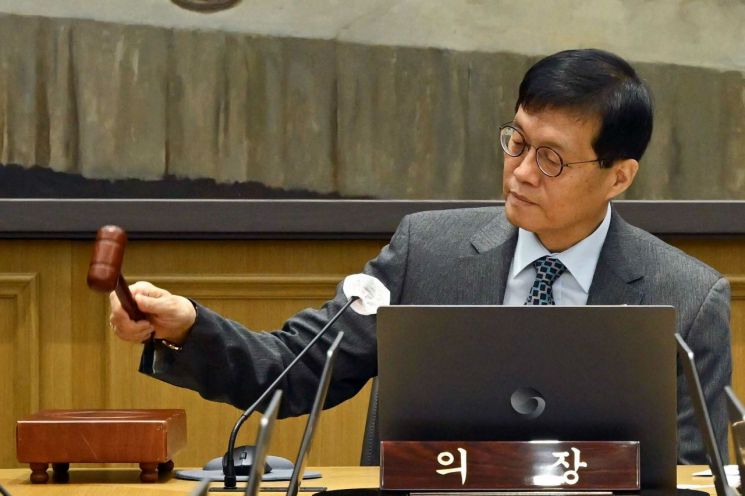 Lee Chang-yong, Governor of the Bank of Korea, is striking the gavel at the Monetary Policy Committee plenary meeting held at the Bank of Korea headquarters in Jung-gu, Seoul on the 27th. Photo by Yonhap News
High Exchange Rate: Concern Over "Overconcentration in Overseas Stock Investment" Rather Than Level
During the press conference, Governor Lee commented on the recent high exchange rate, saying he is not concerned about the level itself, but emphasized several times, "There is too much concentration in one direction (of demand). The recent rise in the exchange rate is being driven by domestic investors’ overseas stock investments, which is concerning." He noted that in the past, the Korean won moved in line with other currencies during periods of a strong US dollar, but in recent weeks, the depreciation of the won has become more pronounced.
He continued, "There is a lot of talk about an artificial intelligence (AI) bubble in overseas stocks, and so much money has flowed out that I am concerned about whether risk management is being conducted properly, and how exchange rate risk is being managed. Exporters benefit from a high exchange rate, but domestic-oriented companies suffer losses, which also affects the domestic economy." He added, "The current situation is different from the past when there was a high level of external debt in national debt, and it is also different from when the US rapidly raised rates, strengthening the dollar and global exchange rates. While these movements do not threaten financial stability, I am concerned about the inflationary threat posed by the high exchange rate." Governor Lee also remarked, "If this overconcentration subsides, I believe individual investors will return, as they will need to manage risks."
Regarding the view that the recent rapid increase in real estate asset prices is due to abundant liquidity, he said, "It is true that liquidity has increased significantly, but I do not believe that new liquidity has been injected in large amounts." He explained that liquidity that had been circulating elsewhere is now moving into the broad money supply (M2) as it is being used to buy homes or invest in stocks, resulting in a change in its composition.
© The Asia Business Daily(www.asiae.co.kr). All rights reserved.
![Clutching a Stolen Dior Bag, Saying "I Hate Being Poor but Real"... The Grotesque Con of a "Human Knockoff" [Slate]](https://cwcontent.asiae.co.kr/asiaresize/183/2026021902243444107_1771435474.jpg)













