Government Unveils 'AI Regulatory Rationalization Roadmap'
High-Value Public Data to Be Selected and Released Starting This Month
Guidelines to Clarify Immunity Regulations for Responsible Officials
Reviewing Various AI-Related Copyrights to Eliminate Uncertainty
Significantly Expanding Pilot Zones for AI Autonomous Driving
National Tax Service to Develop Generative AI-Based Tax System
The government has decided to focus on opening up public data related to artificial intelligence (AI), which had previously seen a utilization rate of only about 2% due to regulatory barriers. A task force (TF) comprising relevant ministries will be formed to amend problematic legal provisions and provide incentives to public officials who actively promote data openness. By rationalizing copyright regulations related to AI, the government also aims to advance AI services, such as expanding the scope of autonomous driving pilot projects to the city level.
On November 27, the Office for Government Policy Coordination announced the "AI Regulatory Rationalization Roadmap" in collaboration with other ministries. This roadmap is part of a broader initiative to proactively identify and address regulatory issues for emerging industries and technologies, based on predictions about future developments. The government has selected the AI sector as the first area for regulatory rationalization under the new administration, aiming to strengthen the foundation for industrial competitiveness.
The AI Regulatory Rationalization Roadmap addresses four areas based on the industry value chain: ▲ technology development ▲ service utilization ▲ infrastructure ▲ trust and safety norms. The approach departs from traditional legal revisions, instead focusing on identifying regulatory issues closely tied to the realities of the industry to resolve on-site challenges. Associations, companies, research institutes, experts, and 25 ministries collaborated to develop a total of 67 detailed tasks.
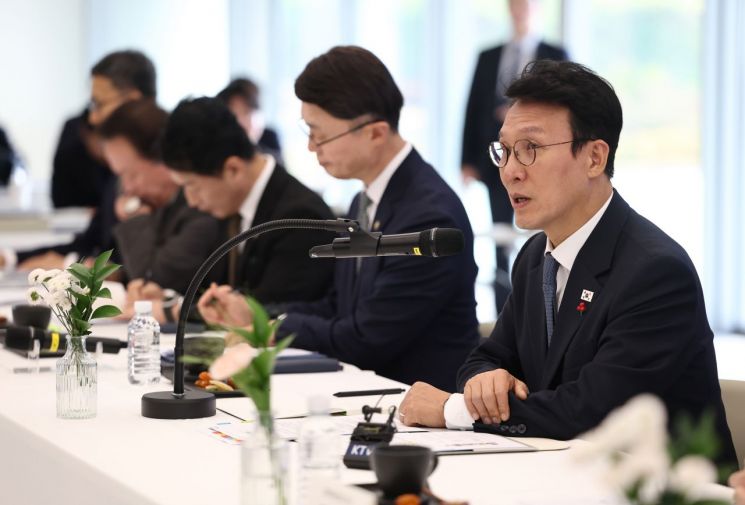 Prime Minister Kim Minseok is delivering opening remarks at an on-site meeting held on the 27th at Naver Data Center 'Gak Sejong' in Sejong City. Photo by Yonhap News
Strengthening Public Data Openness... Addressing On-Site Challenges Related to AI Copyright
First, in the area of technology development, efforts will be made to expand the use of public data. This is to address the issue that only a small proportion of open public data is high-value data needed for AI training, and even then, additional refinement and processing are often required for use. Accordingly, the government will reflect corporate demand and select the "AI·High-Value Public Data Top 100" starting this month for release. Detailed standards and management systems for public data will also be established to facilitate AI training and analysis.
Dongkyun Son, Director of the Regulatory Coordination Office at the Office for Government Policy Coordination, stated, "Last year, only 2.3% of public institutions reported that they had opened public data. The opening rate is low, and statistics show that the process of opening data often takes more than a year." (Related article: [Reporter’s Notebook] Ensuring the 'AI Powerhouse' Slogan Is Not in Vain) He added, "Going forward, we will enable the private sector to make greater use of public data."
Individual laws will also be revised to expand public data openness. To this end, the government will form a TF led by the Ministry of the Interior and Safety within this year, bringing together relevant ministries. Starting next year, this TF will review provisions in individual laws, such as the Framework Act on National Taxes and the Statistics Act, that hinder data openness and provision, and will pursue amendments as necessary.
Immunity for those responsible during the process of opening public data will be clarified. To address the tendency of officials to be reluctant to open data due to legal and administrative burdens, the government will specify the current immunity regulations and introduce case-based immunity guidelines that can be applied in practice. The government will also consider providing incentives to public officials who actively promote data openness.
Rationalizing regulations on AI and intellectual property rights is another key task. To reduce legal uncertainty regarding the use of copyrighted data for AI training, the government will issue guidelines this month that specify the criteria and cases for fair use. A new category of public works that can be used for AI training will be established this month to clarify whether AI companies can use such works, and next year, the government will introduce a mandatory system for attaching the Public Nuri license to public works.
In addition, examination standards will be established for recognizing industrial property rights (patents and design rights) for AI-generated works. For patents, criteria for determining AI contributions and draft standards for legal status review will be prepared in the first half of next year. For design rights, draft criteria for eligibility based on creative contribution will also be introduced in the same period. The procedures for pseudonymization and data combination will be streamlined to increase data usability.
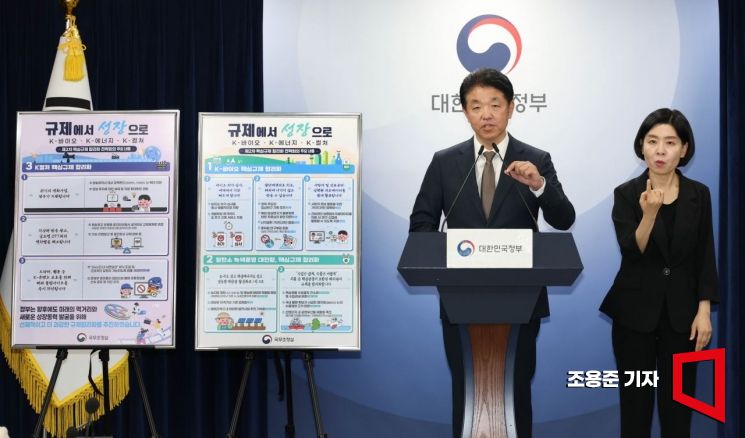 Dongkyun Son, Director of the Regulatory Coordination Office at the Office for Government Policy Coordination.
Expanding Autonomous Driving to City Level... Increasing AI Utilization in Public Administration
In the area of service utilization, the government will rationalize regulations for mobility and intelligent robots. The designation of autonomous driving pilot zones will be expanded to the city level, and by the first quarter of next year, the Autonomous Vehicle Act will be amended to grant designation authority to local governments. Regulations that hinder the activation of parking robots and outdoor delivery robots will be revised, and safety standards will be updated. The relevant roadmap will be established by the first half of 2027.
Director Son explained, "The United States operates 2,000 autonomous vehicles, and China operates 3,000, while we have only 132. In China, pilot operations cover areas as large as 3,000 square meters, but in Korea, operations are limited to 47 small, region-specific zones, making it difficult to expand technology and business." He continued, "We aim not only to expand autonomous vehicle pilots but also to establish a foundation for active use of AI in autonomous vehicles."
In public administration, AI will be used to improve efficiency in public services. The National Tax Service will develop an AI-based tax consultant using generative AI starting next year. The Ministry of SMEs and Startups will establish an AI assistant for small business consultations and policy recommendations from next year. The Public Procurement Service will introduce a new AI technology category in the evaluation of excellent procurement products, increasing the relevant score and significantly expanding the maximum bonus points for technology quality.
In the area of infrastructure, the government will ease the burden of facility operation by revising requirements for installing artworks and elevators in data centers. By the first half of next year, the location and amount (calculation rate) for artwork installation will be adjusted, and a revision will be introduced to exclude the area of computer rooms (server rooms) from the calculation of required floor area for elevator installation.
In the area of trust and safety norms, the government will define the concept of high-impact AI to rationalize the burden of responsibility for operators. High-impact AI refers to AI systems that can have a significant impact on life, physical safety, or fundamental rights, or that may pose risks. In January next year, the government will specify criteria for determining high-impact AI by area and detail concrete measures for ensuring reliability in subordinate legislation.
Meanwhile, Prime Minister Kim Minseok visited the Naver Data Center 'Gak Sejong' in Sejong City on this day to hold a meeting with AI-related companies. The event was attended by Choi Sooyoun, CEO of Naver, and Kim Yoowon, CEO of Naver Cloud, among others. Prime Minister Kim stated, "I hope this will be an opportunity to discuss what is needed to advance work in the fields of AI and data, and which areas should be prioritized in the process of deregulation."
© The Asia Business Daily(www.asiae.co.kr). All rights reserved.


















