KDCA Now Manages a Total of 1,389 Rare Diseases
Special Calculation System to Be Applied
On November 27, the Korea Disease Control and Prevention Agency announced that it has newly designated 75 rare diseases, including "congenital functional short bowel syndrome," as nationally managed rare diseases in order to systematically manage rare diseases and strengthen support for diagnosis and treatment for rare disease patients.
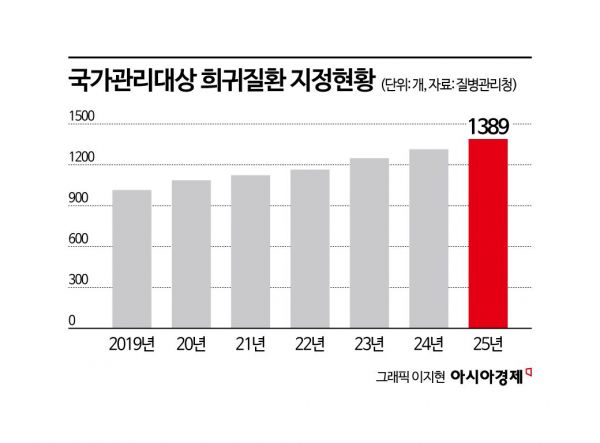
As a result, the number of nationally managed rare diseases has increased from 1,314 last year to 1,389 this year.
A rare disease is defined as a disease with fewer than 20,000 patients in Korea or a disease for which the number of patients is unknown due to diagnostic difficulties. In accordance with the Rare Disease Management Act, the government designates and announces nationally managed rare diseases every year after reviewing new applications and conducting deliberations.
Once designated as a nationally managed rare disease, patients become eligible for the National Health Insurance Service’s special calculation system, which reduces out-of-pocket expenses to about 10% of the total medical costs. Those whose income is below 140% of the median income can also receive assistance through the KDCA’s medical expense support program for rare disease patients, further alleviating their financial burden.
In addition, for genetic diseases, patients who have difficulty obtaining a diagnosis will be included in the "Rare Disease Diagnostic Support Program," which supports diagnostic testing (whole genome sequencing analysis) to enable early and timely treatment.
Im Seungkwan, Commissioner of the Korea Disease Control and Prevention Agency, stated, "We will continue to identify and designate nationally managed rare diseases, link them with support programs, and strengthen the national management system for rare diseases so as to bring meaningful changes to the lives of patients and their families."
© The Asia Business Daily(www.asiae.co.kr). All rights reserved.

















